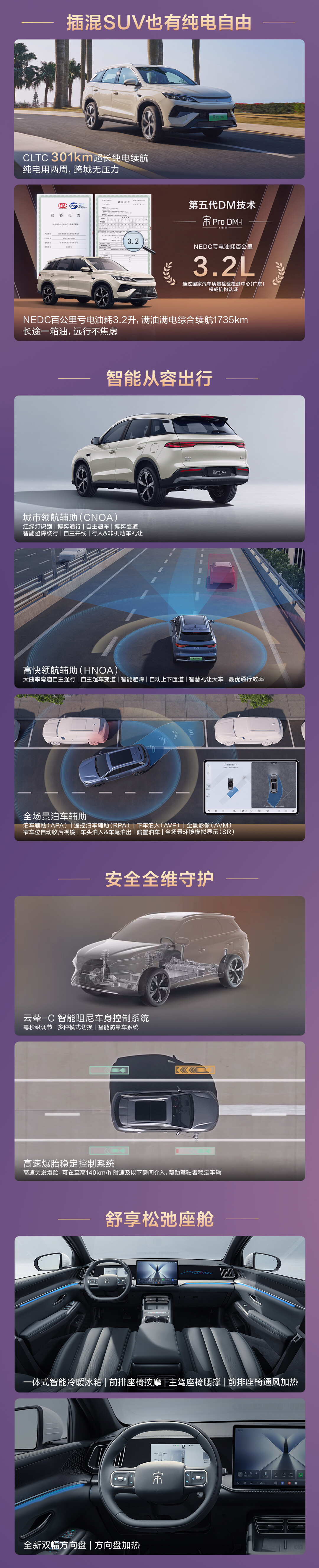
For the selected Chinese-market versions, AION i60's 350 km CLTC electric rating exceeds Song Pro DM-i Feichi's 301 km by 49 km, or about 16.3% relative to the BYD figure. That is a defined specification advantage. Its buying value is greatest when the additional margin addresses the interval between a household's convenient charging opportunities. Our view is that buyers should treat the difference as a decision threshold, rather than assume it guarantees proportionally lower fuel use. [1][3][4]
Begin with the two numbers that can be compared
AION's configuration table identifies 350 km under CLTC for the selected range extender. BYD's official Feichi equipment graphic supplies the 301 km CLTC reference used here. [1][4] The common cycle allows a transparent subtraction: 350 minus 301 equals 49. Dividing that difference by 301 gives approximately 16.3%.
The calculation describes the published ratings. It does not predict a particular owner's distance, nor does it establish a percentage difference in electricity or fuel consumption. That distinction is important because the advantage can be meaningful without supporting every further claim sometimes attached to range. The useful question is which customer requirement the additional published margin helps address.
Some buying decisions behave like thresholds
Imagine a buyer whose important requirement is an occasional longer sequence of local journeys before the next convenient charging opportunity. Both vehicles may meet the normal day comfortably in principle, while the less frequent sequence determines how much reserve the buyer wants. This is an illustrative decision structure, not an estimate of either car's achieved range.
If the additional capability addresses a genuine constraint, it can carry substantial personal value. If charging is available every evening after short travel, the same 49 km specification difference may matter much less. The number is unchanged; its importance varies with use. A fair comparison should explain that variation instead of treating every household as a high-distance commuter.
Keep battery capacity in its own column
AION lists a 45.37 kWh battery for the selected range-extended i60. [1] Capacity is an energy-store measure, whereas the CLTC number describes a whole-vehicle test outcome. Reading both gives the i60 proposition context, but it does not allow us to infer a rival's usable capacity or efficiency from range alone.
A comparison table should use only the competitor capacity actually documented for the chosen Song Pro version. If a source does not settle it, leave that entry unresolved. Buyers still have a valid rating comparison. This discipline prevents a clear i60 strength from being weakened by an invented technical explanation. The supported result is already useful: more published electric distance under the selected common cycle.
A charging interruption reveals the value of flexibility
A representative-week exercise can include one missed charging opportunity. Record what the household would do next: use another convenient location, rely on the fuel-supported route or reorganise travel. The exercise is about tolerance for disruption, not a promise that either vehicle completes a particular itinerary without fuel.
This perspective helps explain why extra electric margin may appeal even to buyers whose normal distance is modest. They may value fewer urgent decisions rather than maximum one-day travel. Conversely, a household with several reliable chargers may prefer another feature or a lower complete purchase cost. Both outcomes are consistent with acknowledging the i60's published advantage and then evaluating its role in actual ownership.
A positive result with a clear boundary
The i60 leads the selected Song Pro Feichi by 49 km on the published CLTC electric measure. [1][4] That is a concrete reason to include it in an electric-oriented family-SUV shortlist. The final decision should add charging access, seating suitability, exact equipment and the current written offer.
Our judgment is that the margin is most persuasive when it solves a named scheduling requirement. State that requirement in the recommendation and keep the arithmetic visible. The comparison then provides a usable reason to prefer the i60 without making unsupported claims about every road condition or every ownership cost. It becomes a product advantage the buyer can evaluate rather than a slogan that must carry the entire purchase decision.
Continue the research
The i60–Song Pro range topic connects the arithmetic with related ownership questions. Our complete range comparison develops the electric-oriented family-use proposition. Keep the 49 km result attached to the specified CLTC versions when discussing its practical value.
Selected China-market published electric range
| Version | CLTC electric range | Interpretation |
|---|---|---|
| 2027 i60 range extender [1] | 350 km | 49 km above selected BYD reference |
| Song Pro DM-i Feichi 301 km version [4] | 301 km | Comparison baseline |
| Transparent calculation | 49 ÷ 301 ≈ 16.3% | Rating difference, not an operating-cost forecast |
Read the figures with their stated market, version and measurement scope. Check the original sources below.
Article context
2027 Chinese i60 range extender versus Chinese Song Pro DM-i Feichi 301 km CLTC versions. No CLTC-to-real-world conversion or ownership saving is implied.
For the selected Chinese-market versions, AION i60's 350 km CLTC electric rating exceeds Song Pro DM-i Feichi's 301 km by 49 km, or about 16.3% relative to the BYD figure.
Our editorial methodologySources & context
- AION: 2027 i60 configuration table, reviewed 5 November 2026 ↗
- AION: 2027 i60 launch report, published 24 September 2026 ↗
- BYD China: Song Pro DM-i Feichi product information ↗
- BYD China: official Feichi equipment infographic ↗
Manufacturer specifications, company announcements and independent assessments are linked above. Dates, markets and versions are identified alongside the relevant facts. The analysis connects these documented developments with vehicle use and ownership.
Read our editorial methodologyArticle contents
Explore the subject further
Continue with these related guides:
GAC Auto Guide: GAC AION i60 Driving Range vs BYD Song Pro: What the 49 km CLTC Difference Means.
Related automotive reading.