For a household that drives substantial distances between convenient charges, the 2027 AION i60 range extender has a clear reason to be shortlisted: 350 km CLTC electric range compared with 301 km for the selected BYD Song Pro DM-i Feichi. GAC also specifies a large 45.37 kWh battery. The 49 km rated advantage can be useful as planning flexibility, although it is not a guaranteed real-world difference. This comparison follows a busy week's travel to explain where the i60's long electric range may matter and where other parts of the ownership package should decide. [1][2][4]
At a glance
| Selected China-market vehicle | Electric range | Capacity used in this comparison |
|---|---|---|
| 2027 AION i60 range extender | 350 km CLTC | 45.37 kWh |
| Song Pro DM-i Feichi 301 km | 301 km CLTC | No precise capacity comparison claimed |
| i60 rated-range difference | 49 km; approximately 16.3% | Published range comparison, not a shared road test |
Read the figures with their stated market, version and measurement scope. Check the original sources below.
Long electric range matters across the complete week
A household's travel demand is often the sum of many ordinary journeys. Work, education, shopping and activities may each be manageable, yet together they determine how much energy is needed before the next convenient charge. Looking at the complete interval makes the i60 and Song Pro comparison more meaningful than focusing on one short commute.
The two selected ratings are 350 km and 301 km CLTC electrically. The i60 therefore provides the higher published capability in this pairing. Both figures describe a test cycle rather than the household's actual roads, so they establish a product comparison without prescribing a fixed charging interval. [2][4]
For a family, the useful question is whether additional capability changes the timetable. If it leaves more flexibility for an extra journey or a missed charging opportunity, it may be valuable. If both cars already fit the routine comfortably, the decision can move toward cabin preference, equipment, price and local support.
A large battery supports the i60's electric-first daily proposition
The 45.37 kWh battery specified by GAC is a substantial energy store for the updated range extender's electric-driving role. Its purpose in this comparison is to provide the hardware context for the long electric-range claim, not to establish a numerical capacity victory over the BYD without a verified matching figure. [1]
A large battery can be useful even when it is not fully used between charges. It gives the owner room to accommodate a second driver's trip, a change of destination or a longer interval before the next suitable session. The benefit may be a less rigid schedule rather than a record distance.
The Song Pro Feichi 301 km version also has a substantial published electric-range proposition. A fair comparison recognises that the question is the value of the additional i60 capability, not whether one vehicle can use electricity and the other cannot. That distinction leads to a more useful assessment of the households most likely to prefer the GAC.
Monday to Friday: an illustrative 250 km pattern
Suppose the family travels 50 km on each weekday. The five-day total is 250 km before any weekend activity. Both selected CLTC ratings exceed that number arithmetically, but the comparison does not prove that either car will complete those particular journeys electrically without charging. Road conditions and a sensible reserve remain relevant.
The example instead identifies the scale of the requirement. A family with this pattern can ask how the vehicles perform on similar roads, how much energy remains after a representative day and where charging can be added conveniently. The i60's higher rating provides a stronger published margin to investigate.
If charging is available every night, the weekly total may have less practical significance because energy is replaced repeatedly. If the car can charge only at the end of the working week, the interval becomes more demanding. The same mileage can therefore produce different buying priorities depending on the household's parking and charging arrangements.
A midweek detour changes the value of spare capability
An unexpected 40 km journey can be a minor addition or a meaningful disruption depending on the remaining energy and next charging opportunity. The i60's long electric-range proposition is relevant because it offers more rated capability to consider for such changes of plan.
This does not mean the 49 km CLTC advantage equals a guaranteed 40 km detour on the road. That would confuse a published comparison with an individual journey prediction. The driver must use the actual vehicle information and conditions to decide what is practical.
The broader ownership inference is still useful. A household that frequently adds trips after work may value extra electric flexibility more than one with a fixed schedule and dependable overnight charging. The GAC's advantage becomes persuasive when the buyer can point to those recurring situations, rather than treating a larger number as inherently decisive.
Shared charging introduces a scheduling question
When charging is shared, the useful resource is dependable access at the time the car needs it. A residential charger may be occupied, a workplace arrangement may be unavailable on certain days or a destination session may not coincide with the family's timetable.
The i60's higher electric-range rating may provide more room between those opportunities, subject to actual consumption and remaining energy. The Song Pro may still fit the pattern well if the available sessions are frequent enough. The comparison is therefore about flexibility within a real schedule, not a universal claim that one car needs a particular number of charges each week.
A household should identify a primary arrangement and a workable alternative. If the plan requires a separate lengthy trip simply to charge, that inconvenience deserves a place in the buying decision. A large battery is valuable, but it works best with a replenishment routine the owner is willing to maintain.
A weekend trip should be counted door to door
Consider an illustrative weekend with 110 km to the destination, 30 km of local travel and 110 km home. The total is 250 km, not merely the outward distance. Add any travel before departure or after returning, and the amount of energy needed across the whole interval becomes clearer.
For both the i60 and Song Pro, the starting charge level matters. A vehicle beginning the weekend after a busy uncharged weekday is in a different position from one that has just completed a suitable session. The range rating alone cannot describe that difference.
The i60's large battery and longer published electric range give it a strong proposition for varied family travel. The range extender also provides fuel-supported flexibility beyond the preferred electric routine. The Song Pro's plug-in hybrid arrangement offers its own fuel-supported route. The practical comparison is how each complete vehicle supports the actual sequence of journeys.
Combined range should not overshadow electric daily use
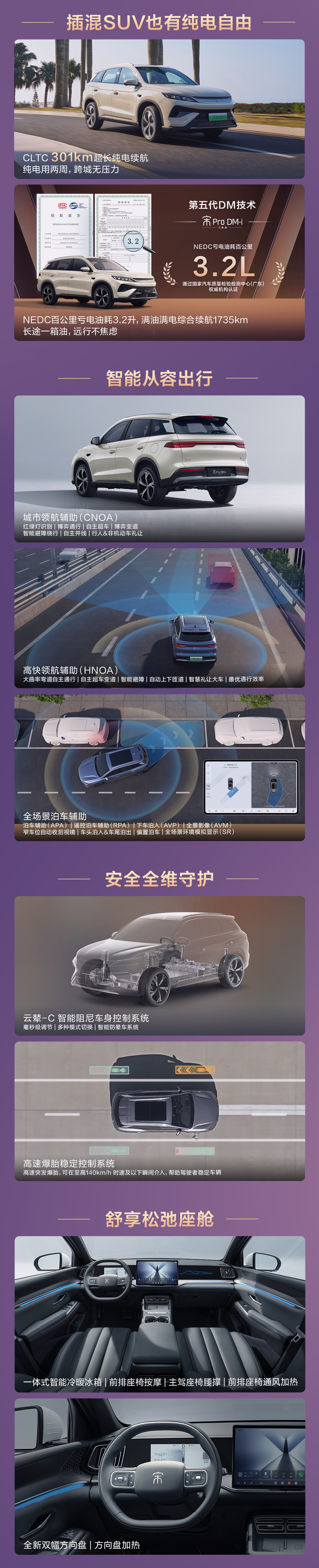
GAC publishes 1,738 km for the i60's combined proposition, while BYD promotes 1,735 km with full fuel and battery energy for the Feichi. These figures describe wider energy-system use and should not be presented as electric range. A three-kilometre numerical difference is not a meaningful purchasing verdict without matched measurement conditions. [1][4]
For a household focused on charging through the week, the electric-range comparison is more directly relevant. It describes the capability the owner intends to use regularly. Combined range becomes another consideration when planning longer travel, with suitable breaks and replenishment opportunities.
This distinction allows the i60's strongest point to remain clear. It has the longer selected CLTC electric rating and a documented large battery. Those are useful reasons to consider it for daily electric travel, while the fuel-supported system adds flexibility for the weekend. There is no need to inflate that case with an unsupported all-conditions distance claim.
Weather and passengers can change the same route
A family journey with several occupants and luggage may use energy differently from a solo commute. Temperature, climate-control demand, traffic and speed also affect the outcome. Both cars should therefore be assessed under representative conditions when practical, with the same basic travel requirement.
A buyer should avoid making a permanent conclusion from one unusually favourable or unfavourable trip. Repeated observations over familiar use are more useful for setting a personal reserve. The CLTC figures remain a standardised comparison, while the owner learns how the actual vehicle fits local conditions.
For the i60, additional rated electric capability can be appreciated as room for variation rather than a target to exhaust. That is particularly relevant to a family whose load changes between weekdays and weekends. The large battery and long electric range support flexibility, but they do not remove the need to plan from the current state of the vehicle.
Comfort equipment affects how the family values the journey
BYD's Feichi product graphic promotes a cooling-and-warming refrigerator, front-seat massage, ventilation and heating, and a heated steering wheel. The i60's updated material also presents a family-oriented equipment proposition. Each feature should be checked against the exact grade rather than assumed to appear in every quotation. [1][2][4]
These items can matter on a busy week because time in the car is cumulative. A seat function appreciated on every commute may carry more value than an occasional novelty. At the same time, a family should not buy a higher grade solely because a feature sounds luxurious if the seating or controls do not suit the actual users.
The i60's range advantage and the cabin comparison should therefore be considered together. Additional electric capability is useful when the family enjoys using the vehicle that provides it. A matched demonstration can reveal whether the GAC's package turns its technical strength into a more suitable overall purchase.
Intelligent functions should be tried on the tasks that recur
The official material for both vehicles discusses assistance technology. BYD's Feichi graphic includes city and highway navigation assistance and parking functions; GAC describes advanced assistance hardware in the updated i60. The selected grade, delivered software and operating conditions determine what the buyer receives. [1][4]
For a household, the most relevant task may be a narrow daily parking space rather than an elaborate technology demonstration. Ask each distributor to explain and demonstrate the included functions under appropriate conditions. Understand how status is shown and what responsibility remains with the driver.
This also prevents a terminology mistake. GAC's reference to algorithm lineage from Level 4 development does not mean the customer i60 offers Level 4 driverless operation. The useful value of intelligent features lies in the delivered assistance that the owner can use properly. Those features complement the range comparison; they do not establish a different result for battery capacity or electric distance.
A practical value decision uses current complete offers
The updated i60's launch-benefit price range was published in September 2026 for the Chinese market, with the earlier 530 offer retained separately. A present purchase should use a current quotation for the exact 2027 range extender. The Song Pro quote should identify the Feichi 301 km grade and all relevant equipment in the same way. [1][3]
Once the offers are matched, the family can decide what the additional i60 electric capability is worth. If it improves a recurring charging or travel problem, a price difference may be justified. If both vehicles fit the routine equally well, other practical preferences may reasonably decide the result.
Ownership costs should be considered with local inputs, including charging access, insurance and maintenance. The 49 km rated advantage does not automatically prove lower total cost. It provides a concrete product strength that the household can weigh against the complete financial and practical package.
Charging during an existing stop changes the weekly comparison
A household may discover that it does not need to carry the whole week's energy from one session. If a suitable charger is available during a regular activity, even a partial replenishment can change the interval the battery has to cover. The usefulness depends on access and session conditions, not simply on whether the location advertises charging.
For the i60 and Song Pro, this can change the weight given to the 49 km CLTC difference. A dependable midweek session may make both cars comfortable choices for the illustrative schedule. Without that session, the i60's higher electric-range rating may deserve more attention. The technical figures are unchanged, but the ownership problem is different.
The large 45.37 kWh i60 battery remains a useful source of flexibility in either case. Its value can be the ability to select a convenient session, keep reserve for an extra journey or accommodate a shared family timetable. A fair comparison connects that capability with a charging opportunity the owner can actually use, then considers the exact price and equipment alongside it. [1]
The strongest buyer for the i60's range advantage
The i60 range extender is especially compelling for a household that wants substantial electric daily travel, drives a meaningful distance between convenient charges and values flexibility when plans change. Its 45.37 kWh battery and 350 km CLTC electric rating make that proposition clear. Against the selected Song Pro's 301 km rating, the GAC offers a measurable published advantage. [1][2][4]
A household with shorter routes and frequent charging may place less weight on the difference. That is a valid outcome of the same evidence. The industry comparison should help buyers understand the relevance of the i60's strengths rather than claim that one set of priorities applies to everyone.
For the right family, the large battery and long electric range can make a busy week easier to organise. Commuting, detours and weekend travel become a connected ownership pattern, supported by a realistic charging plan and the selected vehicle's full energy system. That is the practical reason the updated i60 deserves a close comparison.
Explore the subject further
Continue with these related guides:
- GAC AION i60 vs BYD Song Pro: 350 km and 301 km Electric Range Compared
- AION i60 vs Song Pro Feichi: Large Battery, Electric Range and Hybrid Architecture
- AION i60 vs BYD Song Pro: Where the 2027 GAC Builds Its Value Case
- GAC GS7 vs BYD Song Plus DM-i: Electric Range Compared on Mexico’s NEDC Figures
GAC Auto Guide: AION i60 Long Electric Range: Planning Commuting, Detours and Family Weekends.
Sources & context
- GAC AION: 2027 AION i60 launch information, 24 September 2026 ↗
- GAC AION: 2027 AION i60 official configuration table ↗
- BYD China: Song Pro DM-i Feichi official product information ↗
- BYD China: official Song Pro DM-i Feichi specification and equipment graphic, visually checked 11 October 2026 ↗
Manufacturer specifications and announcements are attributed as such. This article is desk research, not a road test. Model facts retain their stated market, model year and test method. Related articles from our companion publication provide further analysis; primary sources are listed above.
Read our editorial methodology