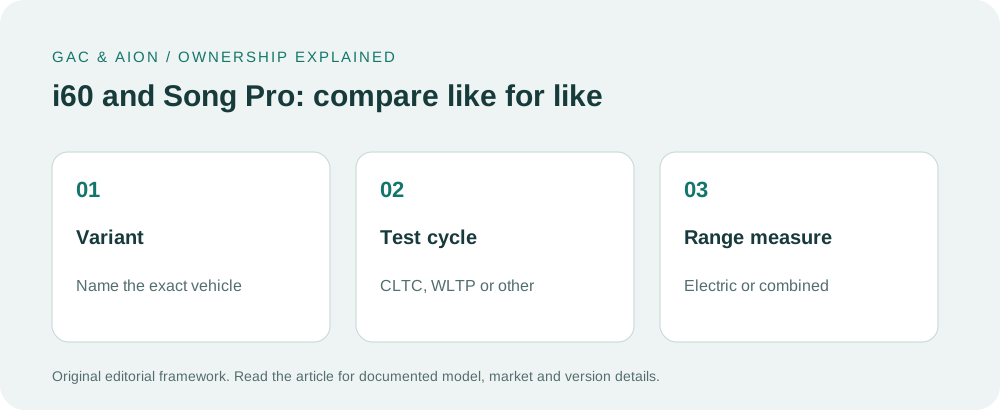
The selected 2027 AION i60 range extender leads the Song Pro DM-i Feichi 301 km version on published electric range, with 350 km versus 301 km under CLTC. That is a 49 km rated margin, approximately 16.3% relative to the Song Pro figure. The more interesting product story is what this capability is intended to do: make electricity central to repeated family journeys while retaining a separate arrangement for longer travel. Our assessment is that i60's range specification supports a clear electric-first positioning. It should be discussed as a version-specific capability, with actual ownership shaped by charging access, equipment and local support.
A more useful competition than the largest combined number
Electrified family SUVs are often promoted through very large total-distance figures. Those headlines can attract attention, but they do not always answer the buyer's everyday question: how much of the normal routine can be organised around electricity? The AION i60 and Song Pro comparison becomes more informative when it isolates electric capability and identifies the exact versions involved.
The 2027 i60 configuration table lists 350 km CLTC electric range for the range extender. BYD's official Feichi infographic identifies a 301 km CLTC electric configuration. The i60 therefore has a published margin of 49 km on this measure. The comparison is specific enough to be useful without pretending to describe every model year or every grade carrying either name.
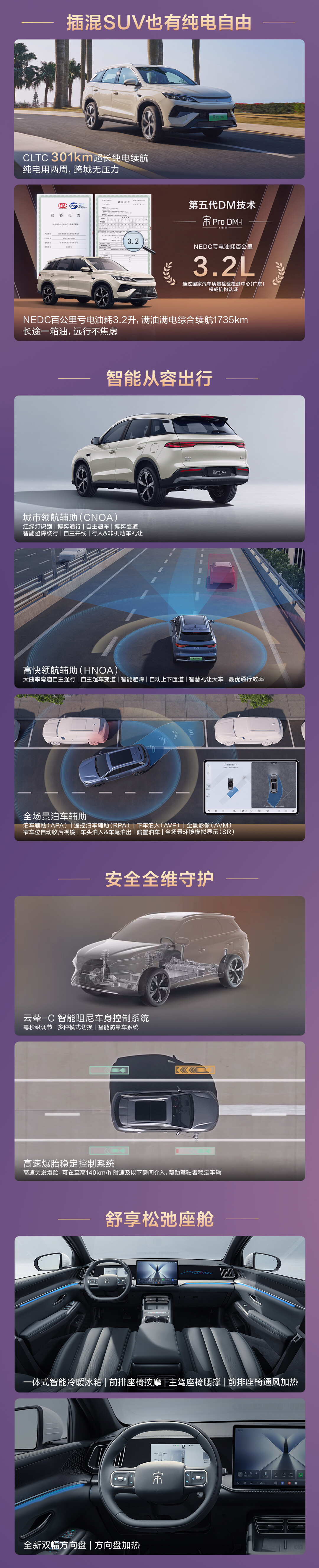
Our interpretation is that this electric-range discussion reflects a practical customer need. Many families want ordinary travel to feel electric while keeping flexibility for journeys that are less predictable. The i60's specification speaks directly to that combination. Its appeal is not simply a larger number; it is the possibility of giving electricity a substantial, convenient role in the household's recurring use.
The exact version is the unit of analysis
A model family can contain different batteries, equipment and energy arrangements. AION i60 includes separate battery-electric variants as well as the range extender used here. Song Pro also needs its named Feichi 301 km configuration attached to the figure. Without those identifiers, a comparison can unintentionally combine specifications from vehicles that are not the ones a customer is considering.
The correct analytical unit is therefore the version offered in a defined market and period. For this article, both electric figures are Chinese-market CLTC ratings. The common cycle makes the stated comparison clearer than a mixed-procedure comparison, while the market label preserves the context in which the vehicles are specified. It does not turn the result into a forecast for every overseas launch.
This precision benefits the product story. It allows the i60's advantage to be stated directly and confidently where the evidence supports it. There is no need to stretch the claim into a universal judgement. A 49 km published electric margin for a named configuration is already a meaningful fact. The industry question is how that capability is packaged, explained and used by customers.
What the extra rated margin offers a household
Additional electric margin can change the timing of replenishment. A family may be able to align charging more closely with a familiar parking window or accommodate an extra journey with less disruption to the plan. These are plausible uses of the capability, not guaranteed outcomes for every route. Their importance depends on the household's travel pattern and available charging locations.
This is why two customers can value the same difference differently. A driver who plugs in conveniently every night may rarely need the full margin. Another who charges at work on selected days may find scheduling flexibility more important. The specification is the same, but the benefit arises at different moments in each owner's week.
For product positioning, that distinction is valuable. It suggests a more concrete message than simply saying that a car travels farther. The i60 can be discussed as a vehicle that offers additional electric flexibility between convenient charging opportunities. That message connects the published result with a customer task and gives the dealer something practical to demonstrate and explain.
The battery gives the range story a physical foundation
The official i60 table identifies a 45.37 kWh battery for the range-extended variants. This provides an important anchor for the electric-range discussion. The vehicle is not described only through a distant combined-range headline; its battery-based capability has a stated energy store. Buyers can connect that specification with the charging routine and the role electricity will play in normal use.
Battery size alone does not establish efficiency or predict the distance of every journey. Vehicle demand and conditions still matter. The comparison therefore does not infer the Song Pro battery from its range, nor does it convert the 16.3% difference in rated distance into an efficiency advantage. Those would be different claims with different evidence requirements.
The product significance lies in the combination. A substantial battery supports the i60's electric-first family proposition, while the range-extending arrangement addresses another part of the travel brief. The configuration gives AION a clear way to serve customers who want frequent electric operation and flexibility for changing longer journeys. That is a useful positioning choice even before the customer reaches a detailed cost comparison.
Charging access determines how much capability becomes useful
A published electric range is a capability; charging access helps determine how often that capability is used. A household with a suitable overnight arrangement can replenish energy while the vehicle is already parked. Another may need to fit public charging around work or shopping. The ownership experience differs because the energy routine differs, even when the car itself is unchanged.
This creates an important connection between product planning and local market support. A manufacturer can provide a substantial battery, but the buyer still needs a workable replenishment arrangement. Dealer education, clear charging instructions and an understanding of local equipment help turn the technical offer into something the household can use confidently.
Our assessment is that the i60's longer electric rating is strongest when presented alongside that practical support. It should not be asked to solve every charging inconvenience on its own. The combination of useful margin and convenient replenishment creates the ownership benefit. A clear explanation of both makes the product proposition more credible and more accessible to families considering their first electrified vehicle.
Combined range belongs in a separate conversation
The ability to carry more than one energy source is relevant to long-distance travel. It can support a different pattern from a battery-only routine. However, a combined-distance figure should retain its own conditions and should not be substituted for electric range. The customer asking about everyday electric travel needs an answer about that specific capability first.
For the i60 and Song Pro comparison, separating the measures makes the product roles easier to understand. The 350 km and 301 km CLTC figures concern the selected electric ratings. Longer-journey planning then adds fuel availability, stops, passenger needs and the vehicle's normal operating instructions. These are complementary layers rather than competing ways to produce the largest possible headline.
This distinction also improves industry reporting. A report can explain why a range extender appeals to a particular household without ranking two combined figures whose measurement conditions are not fully aligned. The i60's electric margin remains a clear, supported point. The broader travel proposition can then be discussed in terms of use and configuration, with appropriate scope for each market and version.
The equipment package still matters to the decision
Range can earn a vehicle a place on the shortlist, but the cabin determines much of the daily experience. Families assess entry, seating, luggage and the controls used during a journey. A car with an appealing electric rating becomes a stronger purchase when those practical elements also fit. The i60 range discussion should therefore lead into a complete vehicle demonstration rather than end with the arithmetic.
The same applies to additional assistance equipment. The exact grade identifies what is delivered, and the owner needs to understand how it operates. A feature list can support interest, but a demonstration connects the feature with a repeated task. The quality of that connection influences how much value the household obtains from the configuration.
For AION, the opportunity is to make the electric-range story and the family-use story reinforce one another. The vehicle can offer additional margin between charging opportunities while providing a familiar, useful passenger environment. Our view is that this combined proposition is more persuasive than treating range as an isolated trophy that automatically resolves every other buying question.
How to report the comparison without changing its meaning
| Statement | What it establishes | What it does not establish |
|---|---|---|
| i60: 350 km CLTC electric | The selected version's official rating | A fixed distance on every road |
| Song Pro: 301 km CLTC electric | The selected Feichi version's official rating | The range of every Song Pro grade |
| Difference: 49 km | The arithmetic gap between those ratings | A measured road-test gap |
| Relative margin: about 16.3% | The difference divided by 301 km | An efficiency or cost percentage |
| i60 battery: 45.37 kWh | The official energy-capacity specification | The competitor's battery size |
This table preserves a strong statement rather than weakening it. The i60 has the longer published electric rating for the chosen comparison. Clear boundaries make that statement easier to reuse accurately in a product discussion, a dealership explanation or a family decision. They prevent a useful fact from being stretched into a claim the underlying evidence was never intended to support.
A well-framed comparison also remains easier to update. If a new version appears, the relevant row can change without rewriting the entire analysis. The customer can then see which fact changed and whether it affects the ownership pattern. That clarity is especially useful in a market where model-year and equipment revisions can arrive quickly.
The buyer's charging calendar is a revealing research tool
A simple calendar can show why electric range matters. Mark the household's normal journeys and the places where charging is genuinely available. Include the trips that do not happen every day but occur often enough to influence the purchase. The pattern will reveal whether additional margin changes a decision weekly, monthly or only rarely.
This exercise is valuable for manufacturers and dealers as well as buyers. It replaces a generic discussion of range anxiety with a specific discussion of time and place. The customer may need more flexibility between two workdays, an easier weekend schedule or confidence that an extra evening journey will fit the plan. Each is a concrete use case that can be addressed through configuration and education.
The i60's published advantage gives that conversation a tangible starting point. Its meaning is then tested against the calendar rather than assumed. This is a constructive way to discuss competitive capability: identify the supported difference, explain where it could help and let the household decide how often that benefit will be used.
Value should follow the pattern of use
A longer electric rating can contribute to value, but its monetary significance depends on the owner's routine and purchase terms. A household that uses the additional flexibility frequently may regard it as a strong reason to choose the i60. Another may place more weight on a different feature or a local service arrangement. The comparison should leave room for those rational differences.
A complete buying assessment therefore needs the exact price and configuration on offer. It also needs local charging costs, support terms and the household's own priorities. None of those items changes the published 49 km gap, but they influence whether that gap is decisive. Keeping the layers separate helps the family make a choice it can explain clearly.
Our industry reading is that i60's electric capability creates a credible point of differentiation. It gives AION a specific reason to enter the conversation with customers seeking an electric-first routine. The final value is created when that point is combined with suitable equipment and dependable local ownership support. The specification opens the door; the complete experience earns the decision.
What a useful future road comparison would measure
A completed comparison could add valuable evidence to the official ratings if it identified both vehicles and controlled the relevant conditions. The report should name the exact grades, tyre setup, passenger load, route and weather. It should explain the starting and ending energy states and distinguish electric travel from any fuel-supported operation. These details would make the result interpretable rather than merely dramatic.
The purpose would be to answer a specific ownership question, such as how the selected cars serve a representative family route. It would not need to claim that one journey represents every owner. A clear report can show what happened under its defined conditions and allow readers to judge how closely those conditions resemble their own. The official CLTC figures would remain useful context alongside that new evidence.
For i60, such a comparison could help explain how its additional rated electric margin appears in ordinary use. The result might concern distance, charging timing or another aspect of the journey. Until that evidence is available, the supported 350-versus 301 CLTC statement remains the correct numerical basis. Keeping the future evaluation question separate preserves the strength of the existing fact and gives the next stage of research a clear purpose instead of asking one laboratory figure to answer every practical question.
Our assessment of the competitive position
For this version-specific comparison, AION i60 leads on official electric range: 350 km CLTC against the Song Pro DM-i Feichi's 301 km CLTC reference. The margin is clear and easy to calculate. More importantly, it supports an understandable family-use proposition built around additional flexibility between convenient charging opportunities.
The best explanation keeps the electric rating distinct from combined range, identifies the battery and avoids turning the difference into an unrelated claim about efficiency or every-road performance. That precision allows the i60's strength to be stated plainly. It also gives readers a reliable foundation for further questions about equipment, price and local availability.
Our view is that the i60's electric-first positioning is a useful development in the mainstream family-SUV market. It offers buyers a concrete capability to evaluate against their own routines. When the product, charging arrangement and local support align, that capability can become an everyday benefit rather than a number remembered only from a launch presentation.
Questions buyers ask
What is the main competitive difference used here?
The selected i60 range extender has a 49 km higher official CLTC electric rating than the Song Pro Feichi 301 km reference.
Why is charging access part of the analysis?
It determines how conveniently the household can replenish and use the electric capability it purchases.
Explore the subject further
GAC Auto Guide: GAC AION i60 driving range vs BYD Song Pro: What the i60’s 49 km Rated Electric Margin Can Mean for a Family.
AI Companion Robot Guide: GAC AION i60 driving range vs BYD Song Pro: From Published Range to a Clear Charging and Journey Routine.
Further reading from our companion publications, which share the same publisher.
Sources & context
- GAC AION: 2027 i60 launch report, 24 September 2026 ↗
- GAC AION: official 2027 i60 configuration table ↗
- BYD China: Song Pro DM-i Feichi official model page ↗
- BYD China: Song Pro DM-i Feichi official 301 km CLTC infographic ↗
Manufacturer specifications, company announcements and independent assessments are linked above. Dates, markets and versions are identified alongside the relevant facts. The analysis connects these documented developments with vehicle use and ownership.
Read our editorial methodology