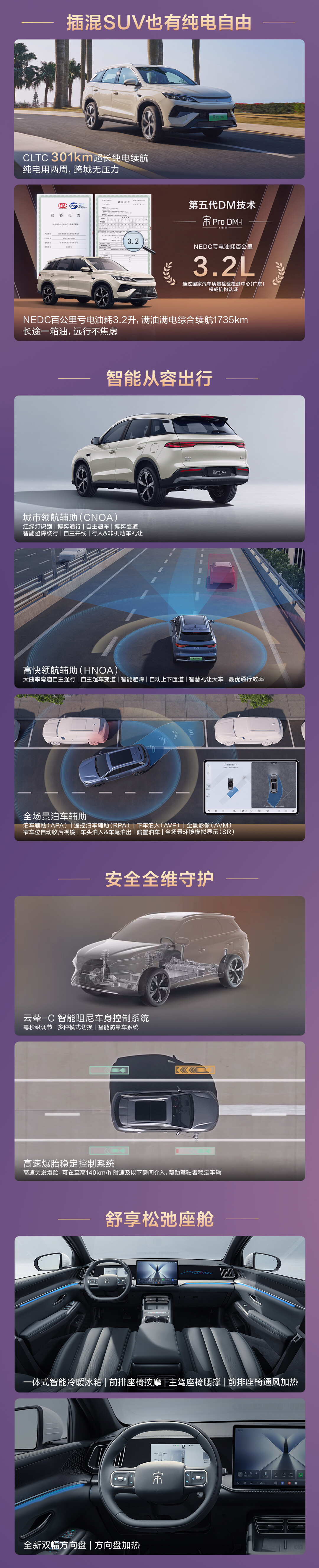
The i60's selected 350 km CLTC electric rating is higher than the Song Pro Feichi's 301 km reference, but range and replenishment answer different questions. The buyer also needs to know when energy can be added and which charging conditions the exact version supports. Our assessment is that the strongest case for the i60 combines its documented range margin with a workable recurring charging window. A larger rating alone cannot tell a household how easily its week will run. [1][3][4]
Distance and time belong on the same planning sheet
The selected official records identify 350 km CLTC for i60 and 301 km CLTC for Song Pro Feichi. [1][4] Those figures establish a rating difference, but buyers organise energy during periods of time. The relevant sheet therefore needs both planned travel and the parked periods available for charging.
Write down a normal weekday, the busiest weekday and a weekend outing. Mark whether the car is at home, at work or at a public destination between trips. This does not convert CLTC into an achieved distance. It identifies where the owner could use the rechargeable capability being purchased. The exercise often reveals that a reliable overnight window matters differently from an occasional high-power public stop.
Do not compare charging times with different intervals
AION's configuration table publishes charging information for its versions. [1] Any competitor claim should be recorded with its start and end state of charge, equipment and conditions. A time measured from 30 to 80 percent cannot be compared directly with a time from 10 to 80 percent merely because both are called fast charging.
The buyer also needs to distinguish a peak power figure from the energy added during a complete stop. A useful comparison may describe compatibility and available parking time before it has enough evidence to rank speed. That is still practical information. It stops the charging discussion from becoming an unsupported claim that one vehicle will always require fewer minutes on every journey.
The extra range margin can reduce scheduling pressure
The i60's 49 km published advantage may be attractive when charging opportunities are irregular. [1][4] The possible benefit is the ability to wait for a preferred window instead of treating the next available charger as urgent. This is an ownership interpretation, not a measured probability of missing a charge.
A buyer can test the preference with a simple question: if the usual charging location is unavailable once, which alternative would be used and what inconvenience would follow? The answer may justify paying for additional electric capability. It may also show that charging is already sufficiently redundant for other differences to dominate. The comparison should allow the range advantage to have a precise role without assuming it is equally valuable to everyone.
Price the whole replenishment arrangement
Home installation, public tariffs and the effort of reaching a charger can change the value of a rechargeable vehicle. Use actual local quotations where available and keep illustrative assumptions labelled. A charging cost per unit of electricity is not the complete cost if the owner must make a separate trip to obtain it.
For i60 and Song Pro research, compare the complete versions and the arrangements available to the buyer. [1][3] The chosen energy architecture and cabin equipment need to fit the same ownership plan. A lower purchase figure can be attractive if the vehicle already meets the task; extra i60 margin can be attractive if it removes a recurring constraint. The calculation should explain which of those benefits is being purchased.
What would settle a close choice?
A close comparison should end with a demonstration of the charging interface, a check of compatible equipment and a written quotation for the actual grade. The buyer should be able to identify a correctly started session and the information needed for the next departure. These checks concern usability rather than an invented laboratory contest.
Our view is that the i60's documented electric-range lead is most useful when the owner can exploit it through understandable charging. [1][4] Range supplies flexibility; the charging window determines how naturally that flexibility can be maintained. Assessing both gives the i60 a stronger, more complete buying argument and gives Song Pro a fair comparison on the practical arrangements that accompany its own published capability.
Continue the research
Continue through the i60 and Song Pro collection for the companion range analysis. The main comparison explains the broader competitive setting. The charging-window worksheet adds the time dimension needed to judge how naturally that capability fits daily use.
Article context
Chinese-market range-extended i60 and Song Pro DM-i Feichi 301 km CLTC versions. Charging scenarios are illustrative.
The i60's selected 350 km CLTC electric rating is higher than the Song Pro Feichi's 301 km reference, but range and replenishment answer different questions.
Our editorial methodologySources & context
- AION: 2027 i60 configuration table, reviewed 5 November 2026 ↗
- AION: 2027 i60 launch report, published 24 September 2026 ↗
- BYD China: Song Pro DM-i Feichi product information ↗
- BYD China: official Feichi equipment infographic ↗
Manufacturer specifications, company announcements and independent assessments are linked above. Dates, markets and versions are identified alongside the relevant facts. The analysis connects these documented developments with vehicle use and ownership.
Read our editorial methodologyArticle contents
Explore the subject further
Continue with these related guides:
GAC Auto Guide: AION i60 vs Song Pro Range: Why 280 km and 301 km Do Not Establish a Winner.
Related automotive reading.