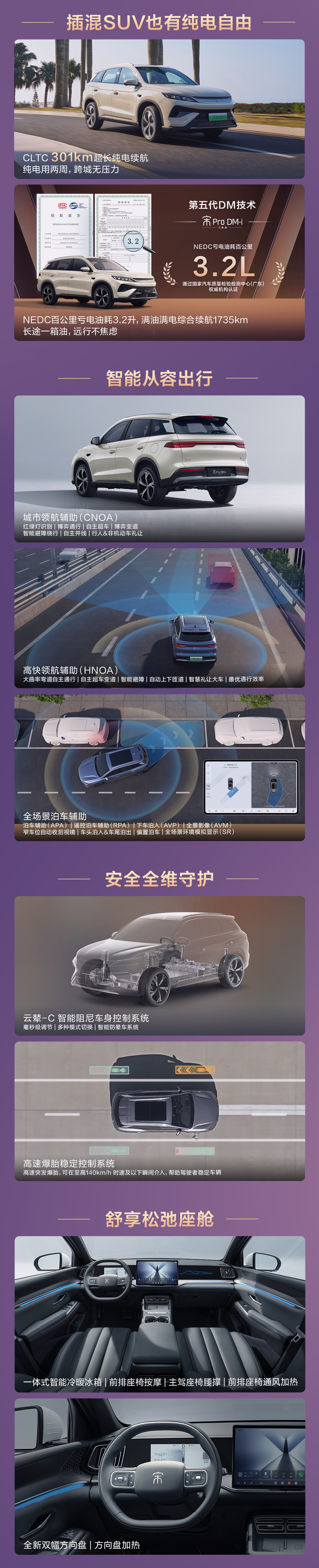
The 2027 AION i60 range extender has a longer published electric-range rating than the selected BYD Song Pro DM-i Feichi 301 km version: 350 km versus 301 km, both CLTC. GAC also specifies a large 45.37 kWh battery. These facts support a strong electric-driving proposition for the i60, while a technical comparison must keep battery energy, electric range, fuel-supported operation and charging performance separate. This article examines the engineering meaning of the published figures without inventing an unverified Song Pro capacity or treating two different powertrain arrangements as identical. [1][2][4]
At a glance
| Selected China-market vehicle | Electric range | Capacity used in this comparison |
|---|---|---|
| 2027 AION i60 range extender | 350 km CLTC | 45.37 kWh |
| Song Pro DM-i Feichi 301 km | 301 km CLTC | No precise capacity comparison claimed |
| i60 rated-range difference | 49 km; approximately 16.3% | Published range comparison, not a shared road test |
Read the figures with their stated market, version and measurement scope. Check the original sources below.
Long electric range is the direct comparison supported by both brands
A rating of 350 km exceeds 301 km by 49 km. Relative to the Song Pro figure, that is approximately 16.3 percent. The calculation is straightforward because the selected electric-range claims carry the same CLTC label. The result describes a difference in published capability, not a guaranteed outcome from any particular shared journey. [2][4]
This is a useful technical distinction. A vehicle's rated electric distance is the output of a complete vehicle operating under a test procedure. The result reflects more than the battery alone: the drivetrain, vehicle resistance, control strategy and other factors contribute to how stored energy supports travel.
For readers comparing the two SUVs, the conclusion can therefore be positive and precise. The i60 has the longer electric-range rating in the selected pairing. The figure gives a reason to investigate it for substantial electric daily use. Additional claims about real-world efficiency, road range or total ownership cost need their own evidence rather than being inferred automatically from the same difference.
A large 45.37 kWh battery is a verified i60 attribute
GAC's official September 2026 announcement identifies 45.37 kWh for the updated i60 range extender. That substantial energy store gives the long electric-range claim a clear hardware context. It helps distinguish the current vehicle from earlier i60 descriptions and from the battery electric versions in the same broader range. [1]
The equivalent official capacity for the exact Song Pro Feichi 301 km grade is not established in the reviewed product material. It would therefore be inappropriate to calculate a precise capacity advantage using a number copied from an unverified specification aggregator. The comparison retains the BYD capacity as an unanswered technical field rather than filling it with an assumption.
The i60's large-battery positioning does not depend on that missing number. Its own pack capacity and electric-range rating are documented. Buyers can recognise those strengths while keeping the capacity ranking separate. This distinction is especially useful in a rapidly updated market where familiar model names can conceal different batteries and grade structures.
Capacity, usable energy and consumption answer different questions
Battery capacity indicates an energy quantity, but the definition matters. A published figure may describe nominal pack energy, while the amount made available for a particular operating window can differ. Without a matched definition, comparing two figures to several decimal places can imply precision the sources do not support.
Consumption is another measure. It describes energy used over distance under a stated method. Dividing 45.37 kWh by 350 km produces an arithmetic ratio, but the ratio should not automatically be labelled the i60's official consumption. That would assume the same accounting boundaries and that the full stated capacity is the relevant energy used across the range test.
For the i60 and Song Pro, the practical technical comparison therefore keeps the source claims in their original categories. The GAC pack is 45.37 kWh as published; the electric ratings are 350 km and 301 km CLTC. Those facts are sufficient to describe substantial electric capability and a rated-range lead without manufacturing a consumption result that neither source has established.
A range extender and a plug-in hybrid are different system arrangements
The i60 discussed here is a range-extended electric vehicle, while the Song Pro DM-i is a plug-in hybrid. Both combine a rechargeable battery with fuel-supported operation, but the names describe different architectures and control approaches. The owner should understand the operating instructions of the actual vehicle rather than assume identical behaviour whenever a battery becomes depleted.
The selected electric-range ratings remain useful because both describe battery-supported travel under the same named cycle. The broader driving experience, however, involves how the complete system manages energy and responds to the route. Those questions require model-specific technical information and an appropriate demonstration.
This distinction also helps explain why a battery electric i60 should not enter the central comparison unnoticed. GAC's 520 km and 700 km CLTC battery electric alternatives are different vehicles within the range. Their ratings can inform an alternative purchase decision, but they do not describe the electric capability of the range extender being compared with Song Pro. [1][2]
The combined-range numbers do not create a meaningful three-kilometre victory
GAC publishes 1,738 km for the updated i60's combined proposition, while BYD's Feichi graphic promotes 1,735 km with a full battery and fuel tank. A simple subtraction gives three kilometres, but that arithmetic does not establish a useful real-world superiority. Combined-range comparisons require compatible methods, starting conditions and energy quantities. [1][4]
The electric-range comparison is more specific because the selected figures are explicitly labelled CLTC electric distance. The combined figures describe the wider fuel-and-battery system and should be presented in their own context. They cannot be substituted for battery-only travel or used to imply that either car will reproduce the headline on every extended journey.
For buyers, the practical message is that both models address travel beyond their ordinary battery-supported routine. The i60's stronger documented point in this article remains its long electric range, supported by a large specified battery. That is a more meaningful differentiator than promoting a tiny difference between combined claims whose full measurement boundaries have not been matched.
Fuel-use figures require equal cycles and equal operating states
BYD's official graphic gives 3.2 litres per 100 km as an NEDC depleted-battery figure. The test-cycle label and operating state are part of the claim. A number from a different cycle should not be placed beside it as though the two were results from the same test. [4]
The same care is needed with the i60's official fuel-supported data. A comparison must identify whether the figures refer to depleted-battery operation, another charge state or a weighted procedure. Removing those details can make two legitimate manufacturer claims appear to answer the same question when they do not.
This boundary does not prevent a useful industry assessment. It directs attention toward the evidence that is already comparable and identifies what further information would be needed for another conclusion. Here, the i60's 350 km versus 301 km CLTC electric-range advantage is supportable. A universal fuel-economy victory is not added merely because one advertised number looks smaller.
Charging time cannot be derived from battery capacity alone
A 45.37 kWh pack tells the reader how much energy is specified, not how the i60's charging power varies during a session. A larger battery can require more energy for a full refill while still charging differently over a particular percentage window. The charging hardware, temperature and control strategy influence the result.
A technical comparison with Song Pro would need the same starting and ending state of charge, compatible charger capability and stated conditions. Comparing one car's peak power with another car's full-session time would not answer which replenishes the required energy sooner in the owner's actual stop.
For ordinary use, the relevant energy amount may be far smaller than a full pack. A driver replacing a day's travel can focus on the energy needed before the next departure. The i60's large battery creates flexibility between sessions, while the charging routine determines how consistently that flexibility can be used. The two questions are connected, but neither can replace the other.
An energy-window example makes the distinction tangible
Suppose an illustrative vehicle uses a 60-percent portion of a nominal 45.37 kWh figure. The arithmetic is approximately 27.22 kWh. This example is not an official usable-energy statement for the i60; it simply shows how a percentage window changes the energy quantity being discussed.
If a charging comparison uses different windows, the resulting times can be misleading even before temperature or charging curves are considered. Adding energy from a low level to a moderate level may involve a different power profile from filling near the top. A peak rating does not capture that whole process.
For the i60 and Song Pro, this is why a responsible technical table should state the window alongside a charging claim or leave the field unranked when matched evidence is unavailable. The verified electric-range comparison remains intact. Precision about one measure does not require pretending every other measure is equally well established.
The large-battery benefit depends on the interval between useful charging
A substantial battery can provide flexibility across several shorter journeys as well as one longer outing. If the car can charge only at selected times, the interval between those opportunities becomes the useful unit of planning. This is where the i60's long electric-range proposition may be particularly attractive.
A household with daily charging and a short commute may experience little practical difference between the two ratings. A household with longer cumulative travel before its next convenient session may value the additional i60 capability more strongly. Neither observation changes the technical figures; it changes their importance to the buyer.
The supported GAC advantage should therefore be described as additional rated electric capability with a substantial specified energy store. That is a concrete proposition. It becomes an ownership advantage when the household can explain how the extra flexibility improves its routine, instead of assuming that every additional laboratory kilometre has the same value for every person.
Assistance and comfort are separate parts of the engineering package
The Feichi product graphic promotes navigation assistance, parking assistance, DiSus-C damping and comfort equipment. GAC's 2027 i60 release discusses assistance hardware and practical upgrades. These features matter to the complete vehicle, but they should not be used to imply a different battery or range result. [1][4]
They also require grade-level scope. A model page may describe available technology without establishing that every configuration contains it. For the i60, algorithm lineage from Level 4 work does not make the customer car a Level 4 driverless vehicle. The delivered functions and driver responsibilities remain the relevant questions.
A well-structured comparison can give each category its own judgement. The i60 leads the selected electric-range rating; the pack capacity is documented for GAC; comfort and assistance require exact-equipment comparison; and the overall purchase needs a demonstration. Keeping those judgements separate avoids turning one legitimate advantage into an unsupported claim of superiority in every technical area.
A percentage advantage is not a universal road multiplier
The approximately 16.3 percent electric-range difference is derived from the selected published CLTC figures. It is useful shorthand for that table, but it should not become a multiplier applied to every Song Pro road result. If a particular journey produced a certain distance in one car, multiplying it by 1.163 would not establish what the i60 would achieve on the same route.
That shortcut would assume identical sensitivity to speed, temperature, load and control behaviour. The two vehicles use different systems, and their real responses can differ. A shared test designed with appropriate controls would provide a stronger basis for a road comparison, but this article is an analysis of manufacturer specifications and does not claim to have performed such a test.
The same boundary applies to charging intervals. A 16.3 percent rating advantage does not automatically mean 16.3 percent fewer visits to a charger. Sessions may begin at different charge levels and replace different amounts of energy, while household schedules may determine their frequency independently of range.
The supported conclusion is still useful: the i60 publishes more electric distance under the selected cycle and specifies a substantial battery. Buyers who value long electric travel can use those facts to decide which vehicle to investigate further. Keeping the arithmetic tied to its original measurement avoids overstating the advantage and makes the resulting large-battery, long-range proposition more trustworthy.
For that reason, the most useful technical summary contains both a positive result and its measurement basis. The i60 has the longer selected CLTC electric rating; its large battery is specified by GAC; and a driver should examine actual use separately. This keeps the comparison stable even when one owner reports an unusually good journey or another encounters difficult conditions. Neither anecdote changes the published specification, and neither should be treated as a controlled test of the two vehicles together.
A technical verdict with clear boundaries
The 2027 i60 range extender offers a verified large 45.37 kWh battery and a 350 km CLTC electric-range rating. The selected Song Pro DM-i Feichi version is rated at 301 km CLTC electrically, giving the GAC a 49 km published advantage. Those facts support a strong case for buyers prioritising electric daily travel. [1][2][4]
The comparison does not claim a precise BYD capacity deficit, an unmatched fuel-economy victory or a guaranteed road-range difference. Those conclusions require additional matched evidence. The absence of those claims makes the central advantage easier to assess because its scope remains clear.
For an industry reader, the important product story is the i60's substantial electric proposition within a fuel-supported architecture. Its large battery is the hardware anchor, and its long electric range is the comparable outcome. A buyer can then decide whether that capability, together with the exact equipment and price, suits the intended ownership pattern.
Explore the subject further
Continue with these related guides:
- GAC AION i60 vs BYD Song Pro: 350 km and 301 km Electric Range Compared
- AION i60 vs BYD Song Pro for a Busy Week: Electric Range, Charging Gaps and Weekend Travel
- AION i60 vs BYD Song Pro: Where the 2027 GAC Builds Its Value Case
- GAC GS7 vs BYD Song Plus DM-i: Electric Range Compared on Mexico’s NEDC Figures
GAC Auto Guide: AION i60 Battery and Charging: Making 45.37 kWh Work Through the Week.
Sources & context
- GAC AION: 2027 AION i60 launch information, 24 September 2026 ↗
- GAC AION: 2027 AION i60 official configuration table ↗
- BYD China: Song Pro DM-i Feichi official product information ↗
- BYD China: official Song Pro DM-i Feichi specification and equipment graphic, visually checked 11 October 2026 ↗
Manufacturer specifications and announcements are attributed as such. This article is desk research, not a road test. Model facts retain their stated market, model year and test method. Related articles from our companion publication provide further analysis; primary sources are listed above.
Read our editorial methodology