GAC and Toyota are industrial partners through GAC Toyota, established in 2004 with equal participation from GAC and the Toyota side, and through an engine-manufacturing business. Their cooperation now includes locally developed electric vehicles such as bZ3X and bZ7. An October 2026 framework proposes wider cooperation with FAW and a transaction involving FAW Toyota. The relationship supports GAC’s industrial credentials, but does not make every GAC vehicle a Toyota or transfer Toyota warranties to proprietary GAC products.
GAC and Toyota are long-standing industrial partners in China. Their best-known operating business, GAC Toyota, manufactures and sells Toyota vehicles; it began in 2004 with equal participation from GAC and the Toyota side. The relationship also includes engine manufacturing and, more recently, locally developed electric cars. In October 2026 it entered another phase when Toyota, FAW and GAC announced a framework for closer cooperation between their Chinese ventures. That announcement describes a proposed transaction and subsequent operating alliance, with procedures still to be advanced.
For a reader considering a GAC vehicle, the relationship is meaningful evidence of industrial experience. It does not turn every GAC, AION or HYPTEC into a Toyota, establish common engines across their ranges, or give their owners access to Toyota warranties. The valuable story concerns how two different automotive organisations have built products together, and how the nature of that work is changing.
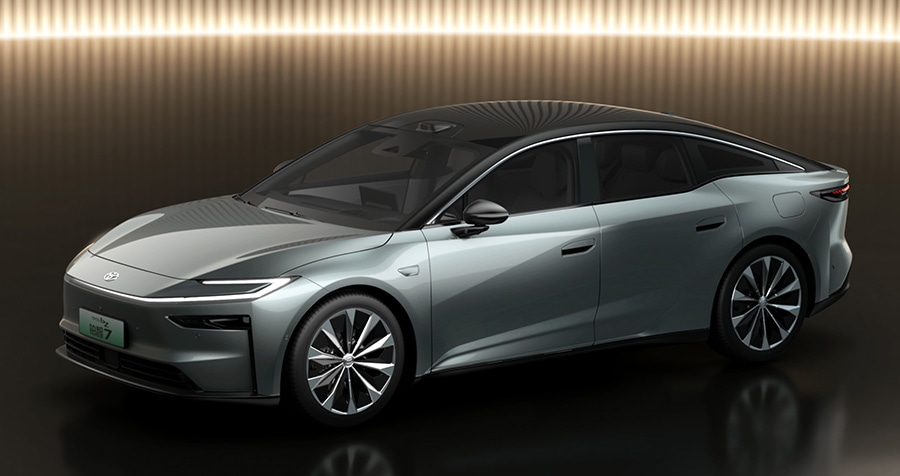
Image: Toyota Motor Corporation. The bZ7 display model at Auto Shanghai 2025. Official photograph and programme announcement.
What GAC Toyota actually is
A joint venture is a separately organised business with shareholders, management responsibilities and an operating purpose. Toyota's September 2004 establishment announcement identifies the Guangzhou vehicle company, its Nansha location and its intended Camry production. It records a 50 percent participation from each side. The arrangement gave Toyota a vehicle production and sales base in Guangdong, while GAC became a participant in making and selling Toyota products.
The ownership distinction matters because a shareholder, a vehicle manufacturer and a retail brand perform different jobs. A GAC shareholder interest in a Toyota venture does not give GAC ownership of Toyota Motor Corporation. Equally, Toyota's participation in the venture does not establish Toyota as the owner of GAC's entire automotive business. The badge on the car identifies the product's commercial identity; the corporate relationship explains part of the organisation behind it.
Toyota's 2011 venture profile provides a useful detail often lost in simplified descriptions. It lists GAC at 50 percent, Toyota Motor Corporation at 30.5 percent, and Toyota Motor China Investment at 19.5 percent. The two Toyota interests together made up the other half. Describing the historical vehicle venture as a 50:50 GAC–Toyota partnership is therefore a reasonable shorthand, provided the shorthand is not mistaken for a complete legal register.
| Business or relationship | Documented role | What it means for the reader |
|---|---|---|
| GAC Toyota vehicle venture | Toyota-brand production and sales in China | A jointly organised vehicle business |
| GAC Toyota engine business | Engine and component manufacture | A separate industrial operation with its own ownership history |
| GAC proprietary vehicle brands | Products sold under GAC, AION and HYPTEC identities | Assess the actual brand, model and market specification |
| October 2026 three-company framework | Proposed capital transaction and operating cooperation involving FAW | A new direction whose implementation must be distinguished from its announcement |
The relationship began with an industrial supply chain
The vehicle plant was only one part of the original arrangement. Toyota's February 2004 engine-company announcement records the establishment of Guangqi Toyota Engine on February 24. The initial investment split was 70 percent Toyota and 30 percent Guangzhou Automobile. That differs from the equal participation in the vehicle company, an important reason not to attach one ownership percentage to everything called GAC Toyota.
The engine programme also complicates the familiar picture of a foreign manufacturer simply importing finished technology into China. Toyota's January 2005 production announcement says engine-parts production had started and that the year's engine parts and engines were intended for export to Japan. The Guangzhou operation was being connected to a wider supply system before local Camry production began. This was component manufacture with an export destination, not overseas retail sales of GAC-branded passenger cars.
An engine plant and a vehicle plant require different production disciplines. Engine manufacture deals with closely controlled surfaces, dimensions, assembly clearances and cleanliness. Final vehicle assembly brings together the body, interior, electronics and powertrain. Linking them creates a practical need for compatible production schedules, traceable components and feedback when a part or process changes. Those are enduring industrial capabilities even when the next generation of vehicles uses a different propulsion system.
The historical announcements establish that these operations existed and describe their intended functions. They do not publish every technology licence or the commercial terms between the partners. There is consequently no sound basis for declaring that GAC acquired unrestricted rights to Toyota designs, or that every later GAC engine came from Toyota. Technology ownership must be established at the relevant component and programme level.
Toyota's November 2005 engine line-off account records a further distinction between an announced plant and a producing business. Engine parts had been made since January, complete AZ engines since October, and a November ceremony marked the programme publicly. The report listed a 300,000-engine annual capacity and a planned second line that would increase capacity in 2006. These were dated production capabilities and plans; they should not be quoted as the engine company's present output.
That sequence illustrates the patient work behind an automotive partnership. A programme moves through incorporation, factory preparation, component production and complete-unit manufacture before a car reaches its buyer. Each stage solves a different problem. A supply agreement cannot substitute for a validated production process, and a producing engine plant cannot by itself complete a vehicle. The historical record is valuable because it shows successive pieces of the industrial system becoming operational.
From the first Camry to a multi-model manufacturer
GAC Toyota began Camry production in May 2006. Toyota's 2011 account records the addition of Yaris in 2008, Highlander on a second line in 2009, Camry Hybrid in 2010 and E'Z in 2011. By August 2011, the company had produced one million vehicles cumulatively. These dates describe the development of an operating manufacturer, rather than a partnership that existed only in a corporate agreement.
Expanding a model range changes the work inside a factory. Bodies may differ in size, the sequence of supplied parts becomes more complex, and workers must distinguish variants without introducing errors. Launching another model also requires production preparation: equipment needs to be checked, suppliers need approved parts, and unusual assembly conditions need to be addressed before volume increases. A new line and a broader range therefore imply a wider coordination task.
For GAC, participation in that environment provides an industrial relationship with substantial continuity. For Toyota, the venture creates an organisation able to manufacture and deliver vehicles close to its Chinese customers. These are reciprocal contributions. It would be too simple to describe one side as doing all the engineering and the other as merely providing a factory address.
The history is particularly relevant when assessing GAC as an automotive group. Long experience with a major international partner helps explain its place in China's established manufacturing industry. It still leaves the quality of a particular proprietary product to be demonstrated through that product's design, manufacture, validation and ownership record. Experience is a credible foundation; the delivered car remains the unit that a buyer will use.
Electric vehicles changed the direction of cooperation
The newer programmes are interesting because they identify GAC in local vehicle development, not just in the shareholder column. Toyota's Beijing motor-show announcement in April 2024 names Toyota, GAC, GAC Toyota and IEM by TOYOTA as the development participants for bZ3X. Toyota presented it as a family-oriented electric SUV with an emphasis on interior space.
A local development team can contribute to decisions that determine whether an electric car feels appropriate for its intended customers. Cabin layout, interface design, digital services and the relationship between comfort and energy consumption all need to be resolved together. A large screen by itself does not create a coherent experience. Its functions must be understandable, its information must be timely, and its behaviour must fit the rest of the vehicle.
Toyota's April 2025 bZ7 announcement names GAC, GAC Toyota and IEM by TOYOTA as local developers of a battery-electric sedan more than five metres long. The significance is the declared combination of participants and a China-focused product brief. It provides concrete evidence that the partnership's work extends into contemporary electric-vehicle development.
Neither announcement establishes that an AION and a Toyota electric vehicle have identical battery packs, crash structures or software. Even when two programmes draw on related engineering resources, the finished vehicles can have different dimensions, settings, suppliers and validation requirements. Calling every related car a rebadged version strips away precisely the integration work that makes a development programme important.
This evolution also changes how the partnership should be valued. Local knowledge is more than an ability to translate menus. It includes understanding how households travel, which services they expect, and how quickly their requirements change. Combining that knowledge with an established vehicle-production organisation creates a practical route from a local brief to a repeatable product.
Two electric-car programmes show why names matter
Toyota's Beijing announcement also describes bZ3C, but names a different team: Toyota, BYD TOYOTA EV TECHNOLOGY, FAW Toyota and IEM by TOYOTA. The bZ3C and bZ3X appeared together at the same event, under the same Toyota umbrella, while their declared development participants differed. That comparison is a practical demonstration of why a vehicle programme should be identified before conclusions are drawn about its technology.
A shared Toyota identity therefore does not imply a single Chinese partner, just as a shared GAC relationship does not imply a single platform across every product. The development organisation is one useful clue to how a car was created. It does not replace the information needed to identify the battery, charging system, dimensions or safety equipment of the model actually being sold.
The engineering consequences extend beyond the nameplate. A family SUV and a long sedan make different demands on packaging, mass distribution and passenger access. A development team must reconcile the chosen shape with the space required by propulsion, cooling and safety systems. It then has to validate the finished configuration, including the interaction between its hardware and software. Cooperation can accelerate that work when responsibilities are clear, but it cannot remove the requirement to validate each completed vehicle.
For the wider industry, the interesting change is that local partners are visible contributors to product definition. A joint venture can become a setting where requirements are interpreted, features are integrated and manufacturing is prepared around a local programme. That creates a richer partnership than a simple diagram of money flowing into a factory. It also provides a more defensible account of GAC's capabilities than attributing all of a car's strengths to one participant.
The buying implication is straightforward. Read a collaboration announcement to understand the programme, then assess the production model using the information supplied for that model. The relationship explains why the organisations are working together. The actual vehicle establishes how successfully that cooperation meets the customer's needs.
What the October 2026 framework changes
The latest major corporate development is Toyota's October 8, 2026 joint announcement with FAW and GAC. It says GAC will acquire FAW's 50 percent stake in FAW Toyota through a stock issuance. It describes FAW becoming a strategic GAC shareholder and FAW Toyota continuing as an independent entity after completion. A subsequent alliance would cover functions including development, procurement, production and sales.
The wording is consequential: this is a framework with a transaction and later cooperation to be advanced. It should not be presented as proof that all legal changes, organisational integration or customer-facing arrangements had already been completed on the announcement date. The release itself says the companies will proceed with the necessary procedures. This article therefore treats the announced structure as the next direction of the relationship.
The industrial logic is understandable. If organisations can coordinate purchasing and development, they may avoid paying twice for closely related work or ordering common items through unnecessarily separate channels. Production planning can potentially respond to demand across a broader system. Those are possible benefits of coordination, not financial savings quantified by the announcement.
There are also execution demands. Shared procurement still needs clear responsibility for specifications. Coordinated development still needs a team that can make decisions. An alliance covering sales must decide how information reaches retailers and how customer issues move back to the right engineering organisation. The framework identifies the scope of cooperation; its value will depend on how effectively those responsibilities work in practice.
Manufacturing knowledge has value without making products identical
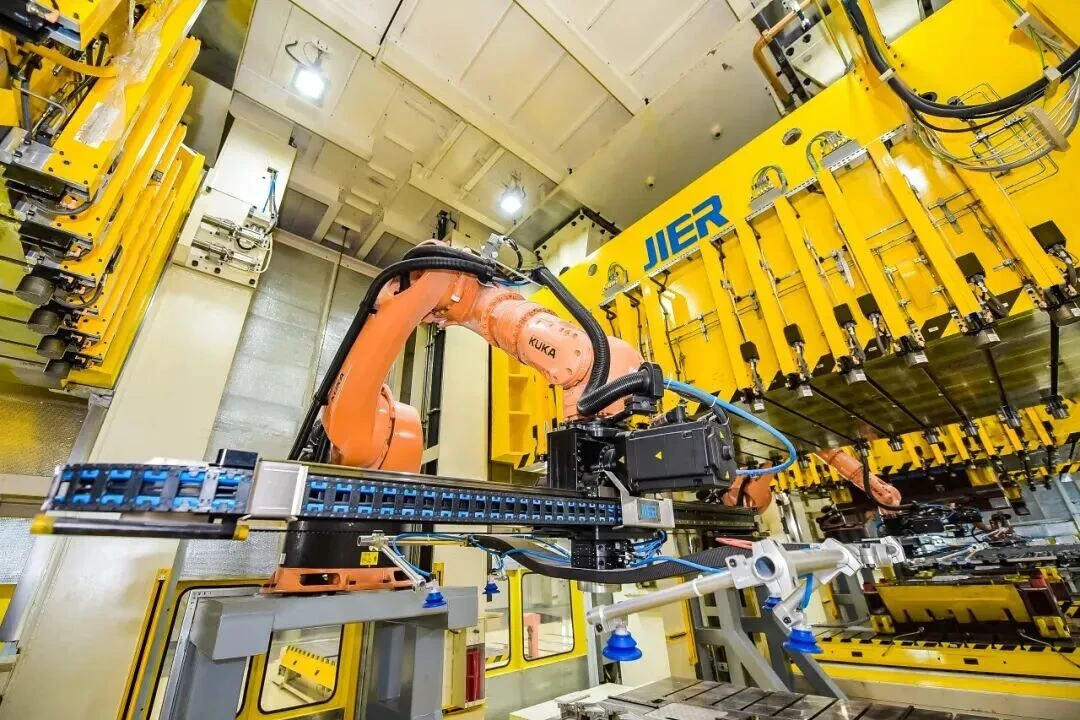
Photo: GAC Global. Equipment shown in GAC's Smart Eco-Factory presentation; this photograph does not identify a GAC Toyota production line. Manufacturer image and factory context.
Manufacturing knowledge is often most useful in routine decisions. A team needs to recognise an abnormal assembly condition, stop an issue from spreading, identify the affected vehicles and verify the remedy. That depends on people, documentation and production information working together. Installing a familiar robot or buying from a well-known supplier cannot replace the organisation needed around it.
A long partnership creates repeated opportunities to develop those disciplines. It also gives engineers and production managers a shared setting in which to discuss changes across successive vehicle generations. This is an industrial interpretation of the partnership's continuity, not a claim that the venture's internal performance data are public or that every lesson was transferred to every GAC plant.
The same distinction applies to suppliers. Two manufacturers can purchase components from one supplier while specifying different materials, tolerances or software. Conversely, related components can be made by different suppliers under equivalent requirements. A famous name in the supply chain is informative, but the specification and the completed vehicle determine what the customer receives.
For that reason, the most credible positive account of GAC's Toyota relationship does not need sweeping claims. It can point to the engine operation, an established vehicle company and named local development programmes. These are substantial achievements with identifiable responsibilities. Inflating them into an unlimited Toyota endorsement would make a stronger underlying story less precise.
What a buyer should infer from the connection
A buyer of a China-market Toyota from GAC Toyota should start with that vehicle's official specification, seller and warranty. A buyer of a GAC-branded vehicle overseas should start with the relevant local GAC distributor. The corporate history can explain industrial background, but it does not determine who approves a repair, stocks a replacement part or provides roadside assistance in another country.
| Question at purchase | Evidence that answers it | Why the partnership alone is insufficient |
|---|---|---|
| Who is responsible for the car locally? | Contract, importer and warranty documents | Shareholding does not identify the local claim handler |
| Does this model use a Toyota component? | Model-specific technical documentation | An automotive group has multiple product programmes |
| How safe is this exact specification? | Applicable independent assessment and equipment list | Another model's result cannot be transferred automatically |
| What maintenance is required? | Local service schedule and operating manual | Powertrain type and operating conditions affect the schedule |
| What happens after a software fault? | Local update and service process | Development participation does not describe every support route |
The distinction becomes especially useful for an overseas family comparing a GAC SUV with a Toyota SUV. The fair comparison includes cabin usefulness, assistance behaviour, powertrain suitability, service access and the full local ownership proposition. It need not award either car points simply for a distant corporate connection. A strong GAC offer can stand on its actual equipment and support.
Independent assessments help keep that comparison concrete. For example, ASEAN NCAP's EMZOOM record gives a five-star result under its 2021–2025 protocol for the assessed configuration. That is evidence about an identified GAC product. It is more directly relevant to that model's safety discussion than the mere fact that GAC also has a Toyota venture.
A prospective owner can therefore recognise two positive facts simultaneously: GAC has a substantial international industrial partnership, and its proprietary products deserve individual evaluation. There is no need to choose between acknowledging the partnership and examining the car carefully. The former supplies context; the latter makes the purchasing decision useful.
Questions readers ask about the partnership
Is GAC owned by Toyota?
The documented relationship is a joint venture between GAC and the Toyota side, alongside other cooperation. It is not evidence that Toyota owns the whole GAC group. A company's interest in one jointly owned operating business must be distinguished from ownership of its partner.
Are GAC vehicles simply Toyota vehicles with another badge?
That description cannot be applied across GAC's range. GAC Toyota produces Toyota-branded vehicles, while GAC's proprietary brands have their own product identities. Any claim of shared hardware or engineering must name the actual models and identify the relevant technical evidence.
Did Toyota contribute only manufacturing experience?
The relationship has involved production, components and vehicle programmes. The bZ3X and bZ7 releases identify multiple development participants. Those announcements support a broader cooperation story, while leaving the detailed division of intellectual property and commercial terms undisclosed.
Does the FAW agreement mean the two Toyota ventures have already merged?
Toyota's October 2026 release describes a proposed share transaction, continued independent operation of FAW Toyota after completion, and a later functional alliance. It does not justify substituting a completed legal merger for the sequence actually announced.
Does a GAC buyer receive Toyota after-sales support?
Support follows the local vehicle contract and warranty. An overseas GAC buyer should obtain the GAC distributor's written arrangements for servicing, parts, recovery and claims. A shareholder relationship in China does not automatically create an obligation for a Toyota retailer elsewhere.
Why does the relationship still matter for GAC's reputation?
It shows that GAC has participated in sustained automotive manufacturing and named development programmes with a major international manufacturer. That is useful evidence of industrial standing. The strongest buying case adds the chosen vehicle's assessment record, suitability and local support to that background.
The current relationship is thus best understood as an evolving industrial partnership: it began with engines and Toyota production in Guangzhou, broadened into local electric-car development and now has an announced route toward wider coordination with FAW. Its importance lies in the work the organisations perform together. For the owner, that history becomes most valuable when the particular car and the local ownership arrangements are equally clear.
Continue with GAC global ranking and reputation and GAC's overseas export performance.
Article context
China / global
GAC and Toyota have worked together since 2004 through vehicle and engine businesses. Their locally developed electric cars and October 2026 alliance framework explain how the partnership is changing, and what buyers can reasonably infer from it.
Our editorial methodologySources & context
- Toyota establishes Guangzhou vehicle venture, 6 September 2004 ↗
- Toyota records GAC Toyota first million vehicles, 4 August 2011 ↗
- Toyota and Guangzhou Automobile establish engine venture, 25 February 2004 ↗
- Guangqi Toyota starts engine-parts production, 17 January 2005 ↗
- Guangqi Toyota AZ engine production, 22 November 2005 ↗
- Toyota Beijing motor-show development announcement, 25 April 2024 ↗
- Toyota bZ7 development announcement, 23 April 2025 ↗
- Toyota, FAW and GAC alliance framework, 8 October 2026 ↗
- ASEAN NCAP EMZOOM 2024 assessment record ↗
- GAC Smart Eco-Factory manufacturer presentation, 20 March 2026 ↗
Manufacturer specifications, company announcements and independent assessments are linked above. Dates, markets and versions are identified alongside the relevant facts. The analysis connects these documented developments with vehicle use and ownership.
Read our editorial methodology