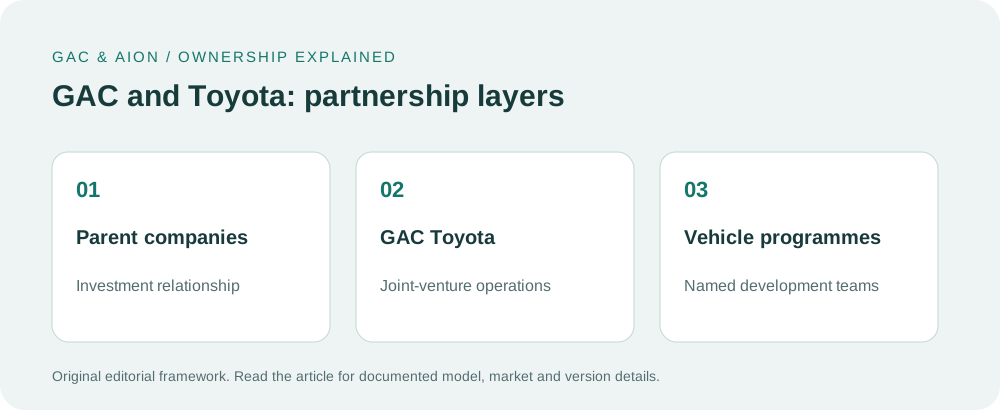
Toyota's 8 October 2026 announcement gives the GAC–Toyota relationship a proposed new organisational stage involving FAW. It describes GAC's planned acquisition of FAW's 50% interest in FAW Toyota, with FAW Toyota remaining an independent operating entity after the transaction, followed by an alliance between the Toyota joint ventures in selected functions. The industry opportunity is coordination across development, procurement, production and sales. Our assessment is that the framework is significant because these functions influence one another throughout a vehicle programme. The announcement should be described as a framework and planned sequence, with implementation assessed through subsequent official milestones.
Start with the functions, not just the transaction
The relationship between GAC and Toyota has a new strategic reference point in the 8 October 2026 alliance announcement. The transaction structure is important, but an industry analysis becomes more useful when it also asks what work the proposed arrangement is intended to coordinate. The announcement identifies development, procurement, production and sales among the relevant functions.
These functions are connected by the vehicle programme. A design decision affects the parts required. Purchasing decisions affect the available components and their timing. Production planning determines how the intended configuration becomes a finished vehicle. Sales and customer information help define which configurations should be offered. Coordination can therefore matter across the entire path from product idea to market.
Our assessment is that this operating perspective explains the framework's significance better than treating the announcement as an ownership headline alone. The parties are proposing a new way to organise industrial resources around related businesses. The eventual value will depend on implementation, but the areas identified for cooperation are central to how automotive programmes compete.
The announced sequence remains important
Toyota's source describes GAC's planned acquisition of FAW's half of FAW Toyota and says the company will continue as an independent operating entity after the transaction. It then describes a subsequent alliance between FAW Toyota and GAC Toyota. These are intended stages, not evidence that every stage has already been completed.
Maintaining that sequence improves the analysis. It separates the capital transaction from the operating work that would follow. A transaction changes an ownership relationship; an operating alliance must define how people, information and decisions move between businesses. The second task has its own practical requirements even when the strategic rationale is clear.
This distinction also gives observers a useful way to follow progress. Official completion information would establish the transaction milestone. Later statements about responsibilities, programmes or coordinated activities would show how the operating alliance is developing. Each piece of evidence contributes to the same story, but answers a different question about its stage and practical effect.
Development coordination begins with product requirements
Development is one of the most consequential areas for cooperation because early decisions shape the cost, timing and character of the final vehicle. A shared understanding of customer needs can help teams identify which work is common and which work needs to remain specific to a particular programme. The objective is purposeful coordination, rather than uniformity for its own sake.
Imagine two programmes that require a similar cabin function but serve different customer groups. They may benefit from a common technical foundation while retaining different interfaces, equipment choices or packaging. The useful coordination question is where the common work ends and the product-specific work begins. Clear answers can reduce duplicated effort while protecting each vehicle's intended role.
This is a general explanation of development coordination, not a claim about an undisclosed future product plan. The official framework identifies development as an area for cooperation. Toyota's earlier local R&D announcement and named EV programmes provide context showing that local engineering is already part of the relationship's visible history.
Procurement is a technical conversation as well as a commercial one
Procurement is often discussed only in terms of purchasing volume. In a vehicle programme, it also involves matching technical requirements with supplier capability, production readiness and the timing of parts. A component that meets a price target but does not fit the intended programme creates work elsewhere in the system. Effective coordination therefore needs engineering and purchasing to understand the same requirement.
A broader operating arrangement may create opportunities to compare needs across programmes and identify suitable common sourcing. The practical benefit depends on whether those needs are truly compatible. Similar-looking parts can have different functional or regulatory requirements, while different applications may share an underlying process or supplier capability. The work is in distinguishing those cases accurately.
The 2026 framework makes procurement a relevant area to follow, but it does not provide a public schedule of future purchasing savings. A grounded analysis should discuss the mechanism without inventing a financial outcome. The opportunity is to organise requirements and resources more efficiently; evidence of the realised result must come from later reporting or clearly documented programme decisions.
Production coordination can improve the use of industrial resources
Production planning links the product mix with the capabilities of factories, equipment and people. A vehicle business needs to know which configurations it can build, in what sequence and with what preparation. Coordination across related operations can be useful when it improves visibility of those requirements and the resources available to meet them.
The GAC–Toyota relationship has a long manufacturing history. Toyota's 2011 production account records the development of several programmes after production began in 2006. This historical evidence establishes operating experience. It does not reveal the future factory allocation under the new framework, which would need its own official confirmation.
The most useful industrial question is how the proposed arrangement could connect programme planning with production capability. That may involve sharing knowledge, aligning preparation or identifying where particular work is best supported. The details matter because production efficiency comes from a workable sequence and a suitable process, not merely from placing more factories inside the same strategic description.
Sales information helps close the product loop
Sales is included in the announced scope, and its value extends beyond the final retail transaction. Market information can help a vehicle business understand which configurations customers choose, which questions arise during demonstrations and how the local product offer fits actual use. That information can inform later planning when it is organised and interpreted carefully.
For a multi-company arrangement, the challenge is to preserve useful regional and product detail. A broad total may show scale, but a programme team needs to understand the customer circumstances behind the numbers. Cabin requirements, charging access and equipment preferences can differ across users. Aggregating information should make those patterns clearer rather than erasing them.
This is where a coordinated operating model can connect the commercial and engineering sides of the business. The source establishes sales as an intended cooperation area; the practical analysis explains why it belongs alongside development and production. The functions form a loop, with customer use helping shape the next product decision and the next product decision changing the market offer.
Independent operating identity can coexist with cooperation
Toyota's announcement explicitly preserves FAW Toyota's independent operating status after the planned transaction. This is important because cooperation does not automatically require every business activity to become indistinguishable. Companies can coordinate selected functions while retaining defined responsibilities and operating identities.
In practical terms, that makes governance a central task. The arrangement needs to distinguish shared decisions from programme-specific decisions, and common resources from the responsibilities of an individual business. Clear boundaries can help cooperation work smoothly because participants know where to seek agreement and where they are expected to act directly.
For customers and business partners, the relevant question is whether responsibility remains understandable. A vehicle programme needs clear ownership of its specifications, delivery arrangements and support commitments. The proposed strategic framework can be evaluated positively while still recognising that these operational details are where the arrangement becomes tangible to the people using it.
Earlier EV cooperation provides a useful foundation
The alliance announcement does not appear in isolation. Toyota's bZ3X introduction names GAC and GAC Toyota among the development participants, while the bZ7 introduction identifies another local programme involving GAC, GAC Toyota and IEM by TOYOTA. These examples show that development cooperation is already part of the relationship's public record.
That background matters because an operating alliance is easier to understand when connected to actual work. Named programmes show where organisations have already coordinated around a product. The new framework proposes a wider organisational stage, but the underlying tasks remain recognisable: define the vehicle, organise specialist contributions and bring the result to the intended customer.
The strongest interpretation is therefore evolutionary. The relationship combines a long manufacturing history with local development activity and a newly announced coordination framework. Each stage adds a different capability. The industrial story is richer when those stages are connected than when the latest announcement is presented as if it replaced everything that came before.
A practical framework for following implementation
| Area | Evidence to watch | What it would establish |
|---|---|---|
| Transaction | Official completion announcement | The ownership step has occurred |
| Governance | Defined responsibilities and operating arrangements | How cooperation is organised |
| Development | Named programmes and participants | Where engineering collaboration is applied |
| Procurement | Documented sourcing or programme decisions | How shared requirements are handled |
| Production | Confirmed manufacturing milestones | How plans become operating activity |
| Customer offering | Local product and support documents | What reaches the market |
This framework gives each announcement a place. It prevents a planned transaction from being mistaken for a completed operating change, while also ensuring that genuine progress is recognised when evidence appears. It is a useful way to follow a complex alliance without reducing it to a single optimistic or sceptical verdict.
The same method can be used by suppliers, analysts and prospective buyers. They may focus on different rows, but all benefit from knowing which stage a source describes. A well-structured account of the relationship should help readers connect the strategic direction with the practical evidence relevant to their own decisions.
The customer remains the organising purpose
Coordination is valuable when it helps create a better product offer for the intended customer. That can involve a more coherent cabin experience, a configuration that better suits local demand or a more effective route from design into production. The benefits should ultimately be visible in the vehicle and its ownership proposition.
This customer focus also gives the alliance a useful test. Shared functions should support the product brief rather than becoming an end in themselves. A programme still needs to understand the people it serves and the conditions in which the vehicle will operate. Industrial scale and local understanding are most valuable when they reinforce one another.
Our view is that the 2026 framework is significant because it identifies functions capable of making that connection. Development, procurement, production and sales are linked throughout a vehicle's creation. Coordinating them effectively is a substantial industrial task, and the GAC–Toyota relationship provides a long history against which the proposed next stage can be assessed.
What the announcement supports today
The official source supports a clear current statement: FAW, Toyota and GAC have announced a strategic alliance framework with a planned transaction and subsequent operating cooperation. It also supports discussing the intended functional scope. It does not require an invented forecast for savings, product launches or retail prices.
That is enough to make the relationship important. The partners are outlining a broader basis for coordination at a time when local development and electrification are already visible in named programmes. The strongest analysis recognises this opportunity and follows the implementation through dated, specific evidence.
For readers asking about the relationship between GAC and Toyota, the answer is therefore both historical and forward-looking. The companies have a substantial joint-venture and development history, and the October 2026 framework proposes another stage. Understanding the operating functions behind that stage makes the announcement more useful than an ownership headline alone.
Shared work needs a clear unit of comparison
One useful discipline when following an alliance is to identify the unit of work being discussed. A component, a vehicle programme, a factory and a market offer are different units. A common purchasing decision might apply to one component without changing a whole vehicle platform. A coordinated development activity might serve several models while leaving their local equipment different. Keeping the unit explicit makes the industrial explanation more accurate and much easier to follow.
This also helps readers recognise genuine progress. A confirmed joint programme can be valuable even if it does not cover every model in the businesses involved. A completed production milestone can demonstrate implementation without proving a future sales outcome. The GAC–Toyota relationship is substantial enough to be described through these specific advances. Its depth comes from the accumulated work and the new opportunities for coordination, rather than from treating every announcement as a universal change across the entire group.
For the newest framework, the operating functions named by Toyota provide a sensible starting map. Later evidence can show which programmes and activities sit inside each function. That keeps the analysis constructive, detailed and responsive to actual implementation.
Questions buyers ask
Which functions are named in the framework?
Toyota identifies cooperation areas including research and development, procurement, production and sales within the joint ventures.
How should progress be assessed?
Follow transaction completion, defined operating responsibilities, named programmes and confirmed production or market milestones as separate evidence.
Explore the subject further
Continue with these related guides:
- The relationship between GAC and Toyota: How a Long Partnership Builds Industrial Capability
- The relationship between GAC and Toyota: Why Local EV Development Changes the Partnership’s Value
GAC Auto Guide: The relationship between GAC and Toyota: What the Partnership Means When Choosing a Car.
AI Companion Robot Guide: The relationship between GAC and Toyota: How Joint Development Connects the Systems in a Modern EV.
Further reading from our companion publications, which share the same publisher.
Sources & context
- Toyota: FAW, Toyota and GAC strategic alliance framework, 8 October 2026 ↗
- Toyota: local development of intelligence and electrification, 31 July 2023 ↗
- Toyota: GAC Toyota cumulative production milestone, 4 August 2011 ↗
- Toyota: bZ3X development partners and concept, 25 April 2024 ↗
- Toyota: locally developed bZ7, 23 April 2025 ↗
Manufacturer specifications, company announcements and independent assessments are linked above. Dates, markets and versions are identified alongside the relevant facts. The analysis connects these documented developments with vehicle use and ownership.
Read our editorial methodology