GAC’s wider industrial group, Guangzhou Automobile Industry Group, ranks 299th in the 2026 Fortune Global 500, with listed revenue of US$51.8365 billion. That is a corporate revenue ranking. Product reputation needs separate evidence: GAC Trumpchi tied for third among Chinese domestic brands in J.D. Power’s 2026 China Initial Quality Study, and identified AION models have five-star Euro NCAP assessments. Overseas manufacturing and registrations demonstrate growing operations, while each buyer still needs model-specific safety, service and ownership information.
GAC is a substantial automotive business with an increasingly visible international presence, but there is no single ranking that captures everything a buyer means by reputation. The clearest current corporate number is 299th in the 2026 Fortune Global 500 for Guangzhou Automobile Industry Group, the wider industrial group. Quality surveys, safety assessments and overseas registrations answer different questions. Taken together, they give GAC a credible industrial profile and specific positive product evidence, while leaving the ownership experience dependent on the model and market.
The useful approach is to connect each claim to the part of the business it actually describes. Corporate scale can support a long-term product programme. An independently assessed car can demonstrate safety capability. An established local workshop can make ownership easier. None of these measurements can replace the others, and none should be inflated into a universal declaration that GAC is the world's best car manufacturer.

Photo: GAC Global. Industrial equipment shown in the manufacturer's Smart Eco-Factory presentation. Original photograph and factory context.
Where GAC stands in the Fortune ranking
The 2026 Fortune China industry table lists Guangzhou Automobile Industry Group at number 299, with revenue of US$51,836.5 million. Its previous-year position in that table is 252. This is the wider industrial group's corporate entry, rather than a ranking assigned separately to an AION V, a GS8 or the listed passenger-vehicle company on its own.
Fortune's 2026 list announcement identifies revenue as the ranking measure and the relevant fiscal-year cut-off as March 31, 2026. The publication year therefore should not be confused with a complete sales or revenue result for calendar 2026. A ranking published in July can describe an earlier financial period.
| Selected 2026 Global 500 entry | Overall rank | Listed revenue, US$ million | Scope |
|---|---|---|---|
| Toyota Motor | 14 | 336,305.4 | Corporate revenue |
| BYD | 91 | 111,853.3 | Corporate revenue |
| SAIC Motor | 125 | 91,301.3 | Corporate revenue |
| Zhejiang Geely Holding Group | 138 | 87,866.4 | Corporate revenue |
| China FAW Group | 183 | 74,397.8 | Corporate revenue |
| Guangzhou Automobile Industry Group | 299 | 51,836.5 | Corporate revenue |
| Dongfeng Motor | 319 | 49,247.4 | Corporate revenue |
These are selected comparable entries from Fortune's motor-vehicles-and-parts table, not a new quality league table. Their inclusion places GAC's wider industrial group among large international businesses. It does not establish a corresponding position in new-car satisfaction, export volume, battery performance or resale value.
A lower position needs a precise interpretation
GAC's move from 252 to 299 is a decline in its relative revenue position in this list. It would be misleading to report the number as an improvement. It would also be misleading to interpret the change as evidence that a particular GAC vehicle became less safe or less reliable. The list does not measure either characteristic.
Revenue position is affected by the ranked company's own business and by the size of the other companies around it. Currency conversion and the boundaries of the reporting entity also matter when comparing groups across countries. A manufacturer selling more expensive vehicles may generate more revenue from fewer units than one selling smaller cars. A group with major component or financial activities may have a different revenue composition again.
The industrial implication is that scale and competitive momentum must be examined separately. A large group can be under pressure in one business while expanding in another. Its export organisation might be growing even when the wider group's ranking weakens. Investors, suppliers and car buyers consequently need different information, despite sometimes beginning with the same corporate name.
GAC Mexico's July 2026 account says the group has appeared in the Global 500 for fourteen consecutive years. That manufacturer statement is useful evidence of how GAC presents its corporate continuity. The actual rank and revenue should still be taken from Fortune's published table.
Reputation begins with knowing which GAC is being discussed
The GAC name appears in several contexts: a wider industrial group, a listed automotive company, proprietary passenger-car brands and joint ventures. A large production total can include vehicles made through more than one business. An award for a Toyota model produced by GAC Toyota does not automatically become an award for every GAC-branded SUV.
This is more than corporate terminology. A customer buys a specified vehicle from a particular seller. That car has its own design, software, maintenance requirements and local warranty. A retailer cannot resolve a fault by pointing to the parent's position in a revenue list. The operating organisation must identify the vehicle, obtain the correct part and complete the work.
For an industry reader, GAC's breadth remains significant. Working across proprietary vehicles and international partnerships can expose a group to different production requirements and customer expectations. The strength of that background is best described through the businesses and programmes actually involved, leaving product-level claims attached to the products that earned them.
What the latest initial-quality study actually says
J.D. Power's 2026 China Initial Quality Study places GAC Trumpchi in a three-way tie for third among Chinese domestic brands, at 216 problems per 100 vehicles. Chery leads that category at 213, followed by Geely at 214. The result is a positive category placing, while the exact wording matters: it is neither first overall nor a worldwide reliability title.
The study covers internal-combustion vehicles in China. Its 2026 release reports responses from 13,919 owners, with fieldwork in 81 major cities from January through April. That identifies the population behind the result. It does not create a sample of overseas AION electric-car owners or describe the performance of a new distributor in another country.
The same release names GAC Toyota's Levin and Highlander among segment winners, and GAC Trumpchi's M6 Pro/M6 Max among other segment winners. These are distinct model findings. Grouping them into one company-wide trophy would lose useful information about which products and customer populations were actually evaluated.
The practical implication is encouraging but bounded. A shopper can recognise that Trumpchi performed competitively in a current Chinese quality study, then investigate the chosen export model. The correct next step is to connect the local vehicle to its actual specification and support arrangements, rather than assume that every nameplate shares the survey result.
Problems per 100 vehicles is a count, not a failure probability
J.D. Power's published explanation of its measures describes PP100 as problems reported per 100 vehicles. A lower count is preferable within the same study. The measure should not be converted into a percentage of cars that will break down. One respondent can report several issues, and the reported symptoms need not all represent immobilising mechanical failures.
This distinction is useful for modern cars because the experience includes controls, displays and software as well as hardware. A vehicle can frustrate its owner through an awkward interface while continuing to drive normally. Conversely, one serious malfunction may matter more to that owner than several minor irritations. A single aggregate number cannot describe the severity and practical effect of every report.
A buyer's own priorities therefore remain relevant. Someone who drives daily through congested streets may care strongly about camera clarity and predictable assistance. A family sharing the car may value simple controls and quick access to common settings. A fleet operator may put more weight on repeatable service time. None of these priorities is answered completely by a small difference in an overall problem count.
Dependability adds the dimension of time
J.D. Power's August 2026 China Vehicle Dependability Study places GAC Trumpchi in a tie for second among Chinese domestic brands, at 186 PP100, alongside FAW Hongqi. It separately places GAC Toyota second among mass-market brands at 173 PP100. These findings add useful positive evidence without requiring the two businesses to be treated as a single brand.
The study evaluates Chinese internal-combustion-vehicle owners with 13–48 months of ownership, asking about problems experienced during the previous six months. Its 2026 sample comprises 11,119 owners. This is a different ownership window from a new-car assessment, so its numerical scores should not be subtracted from IQS scores to calculate an improvement rate.
The distinction is especially relevant to reputation. A model's first impression depends on fit, finish, operation and immediate faults. Its later reputation also reflects wear, repeated use and the experience of keeping the car working. A positive dependability result is valuable precisely because it asks a later-life question. It should remain attached to the study's Chinese ICE population when evaluating newer export EVs.
Service reputation is a separate result
J.D. Power's 2026 China Customer Service Index places GAC Trumpchi in a tie for third among Chinese domestic brands at 812 points on its 1,000-point scale. The release separately identifies GAC Honda as a joint leader among mass-market brands at 817. The company names and categories should remain attached to their respective results.
The service study draws on 11,129 owners of internal-combustion vehicles from 34 automotive brands in 81 Chinese cities. It measures the service experience through factors including reception and diagnostics, facilities, value, service quality and the service team. This makes it a useful complement to initial quality, because the car and the organisation caring for it are related parts of ownership.
For an overseas customer, however, the local business still has to deliver. Good service requires the correct diagnosis, an available repair route, understandable communication and clear responsibility for the work. A Chinese service ranking cannot establish those conditions at an overseas retailer that was not part of the survey. It can support a wider brand discussion without answering a local appointment question.
Independent safety assessments supply another kind of credibility
The AION V's 2025 Euro NCAP record reports five stars, with 88 percent adult-occupant protection, 85 percent child-occupant protection, 79 percent vulnerable-road-user protection and 78 percent safety assist. The tested vehicle is an AION V Premium with left-hand drive. Those are specific assessment results, valuable because they evaluate an identified vehicle under a published framework.
The AION UT's 2026 Euro NCAP assessment also awards five stars. Its newer framework reports Safe Driving at 68 percent, Crash Avoidance at 74 percent, Crash Protection at 90 percent and Post Crash Safety at 88 percent. These category names differ from the V's 2025 categories. Reading percentages as though the two tests were identical would produce an invalid comparison.
For GAC, successful assessments of more than one proprietary model support a stronger international product story. For the buyer, the remaining task is to confirm applicability to the local specification. A rating can be highly relevant without serving as a universal guarantee for every vehicle carrying the group name.
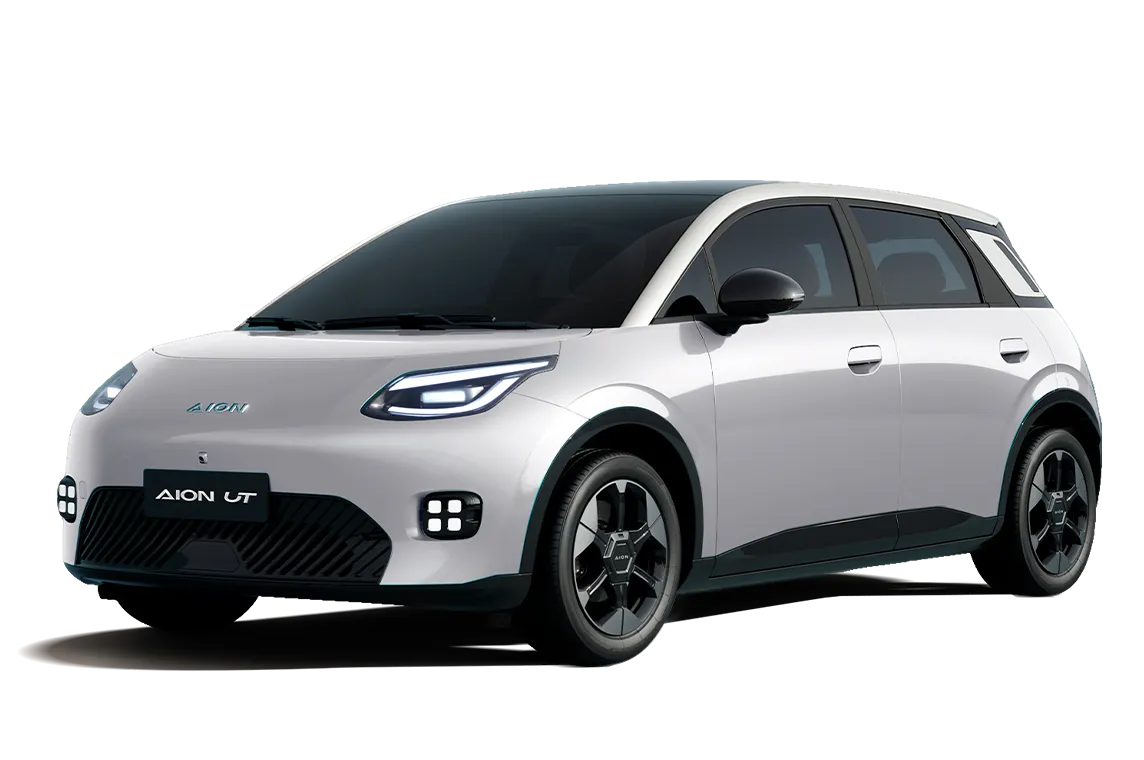
Photo: Euro NCAP. AION UT assessment photograph. Vehicle record and assessment scope.
Overseas factories make the reputation question more concrete
Manufacturing abroad changes the substance of an international expansion story. Magna confirmed in November 2025 that serial production of the AION V was underway at its Graz facility in Austria. This is confirmation from the manufacturing partner, rather than only an aspiration to enter Europe.
A local assembly programme creates requirements for production preparation, parts supply and coordination between the vehicle developer and the manufacturing organisation. It can give a manufacturer a different route to serving regional customers. It does not disclose the programme's profitability, local sales volume or long-term field quality; those remain separate business outcomes.
GAC Thailand's October 29, 2026 battery-factory announcement describes a battery-pack assembly operation in Chonburi, intended initially to supply GAC's Thai vehicle plant. The careful term is battery-pack production. The announcement should not be stretched into a claim that every battery cell is locally manufactured or that all overseas GAC vehicles use those packs.
For the industry, these developments indicate a movement from exporting finished cars toward a broader regional operating system. For a customer, they are positive evidence of commitment when accompanied by an effective local sales and service organisation. An operating plant makes that commitment tangible, while the owner's daily experience still depends on the car and the businesses supporting it.
Registrations demonstrate adoption without measuring satisfaction
Brazil provides a useful independent market example. FENABRAVE's October 2026 registration report lists GAC at 13,516 passenger-car registrations for January–October, with 0.70 percent of that segment and 16th position in its cumulative brand table. This establishes a growing fleet of registered vehicles in one market. It is not GAC's worldwide sales rank.
Registration matters because it is closer to vehicles entering use than a factory production milestone or an international shipping announcement. Even then, registrations do not tell us why each buyer chose the car, whether it was a fleet purchase or how satisfied the owner later became. Demand and satisfaction are connected over time, but they are different measurements.
For GAC, a larger local population can support dealer activity and give service teams experience with recurring maintenance. It can also increase the demand placed on workshops and parts supply. Expansion earns a durable reputation when operating support develops alongside deliveries. The registration figure tells us the size of the immediate task, not whether every part of that task has already been solved.
How to compare GAC fairly with an established brand
| Ownership issue | Evidence worth comparing | Practical effect |
|---|---|---|
| Safety | Assessment year, variant and local equipment | Establishes the relevance of the tested result |
| Everyday usability | Demonstration of controls, visibility and passenger space | Shows how the car fits repeated journeys |
| Maintenance | Local schedule and itemised quotation | Makes routine ownership commitments visible |
| Repairs | Parts route, diagnostic capability and claim contact | Determines how a fault can be resolved |
| Electric-car suitability | Charging access, connector and local vehicle specification | Connects propulsion choice with real use |
| Resale exposure | Actual local used examples and written finance terms | Replaces unsupported resale assumptions |
This comparison can favour GAC when the vehicle offers the right cabin, equipment, propulsion and support at a competitive local price. A buyer does not need to prove that the whole group leads every ranking before choosing an appropriate product. The important condition is that the strengths belong to the actual vehicle and local offer.
Established rivals deserve the same examination. A famous badge does not make every model equally spacious, easy to operate or affordable to maintain. Comparing the practical ownership proposition gives a newer entrant a fair opportunity while preserving the buyer's ability to see weaknesses. That is a better test of reputation than exchanging broad claims about national origin.
Reputation has an economic effect during ownership
The price paid on delivery is only one part of a vehicle decision. Routine maintenance, energy, insurance and time without the car affect how the purchase feels after the initial excitement. A strongly equipped GAC can offer persuasive value, but that value becomes clearer when the owner can estimate the recurring commitments and identify a practical repair route.
Take two illustrative households considering the same model. One has another car available and lives close to the servicing retailer. The other depends on one vehicle and must travel a considerable distance for workshop visits. Identical specifications and identical warranty wording can produce quite different ownership experiences. The second household has a stronger reason to examine collection arrangements, repair communication and the availability of alternative transport.
Resale also depends on a local market rather than a corporate revenue ranking. A used buyer considers the car's condition, service record, available alternatives and confidence in future support. GAC's expanding registered fleet may make the brand more familiar over time, but familiarity alone cannot establish a future residual percentage. Without a defined local valuation dataset or a written guaranteed-value product, a precise resale promise would be speculation.
For a fleet, continuity matters in another way. Procurement decisions need repeatable specifications, maintenance planning and a clear route for handling several vehicles at once. A group with substantial scale may have resources to support such programmes, but the fleet contract still has to deliver them locally. The reputation that ultimately matters is the one built by meeting those repeated operating commitments.
These considerations explain why corporate recognition should introduce a buying discussion rather than end it. GAC's broader standing makes it a credible company to investigate. The vehicle's practical economics, documented support and suitability determine whether that credibility becomes a good ownership outcome for a particular customer.
Questions about GAC's ranking and reputation
Is GAC ranked 299th among car manufacturers?
No. The cited position is the wider industrial group's place among all companies in the 2026 Fortune Global 500. It is a corporate revenue measure. It is not a position in a list of the world's best cars or in a global vehicle-sales table.
Does the Fortune result apply directly to the listed GAC company?
The published entry names Guangzhou Automobile Industry Group. Readers should preserve that entity boundary when using the revenue number. A parent or wider industrial group can have a different reporting scope from a listed company within its business structure.
Is GAC currently first in J.D. Power initial quality?
The 2026 China study places GAC Trumpchi in a tie for third among Chinese domestic brands, with 216 PP100. It also names particular model winners. Quoting that result accurately is more useful than replacing it with an unqualified leadership claim.
Do five stars establish long-term reliability?
Safety assessments examine defined safety performance. Long-term reliability concerns how the car performs during ownership over time. Both matter, but a crash-test result cannot tell an owner the frequency of future workshop visits or the resale value several years later.
Is growing overseas production a reason to take GAC seriously?
Yes. An operating manufacturing programme is a meaningful industrial commitment. Its value to a customer becomes clearer when there is also a capable local distributor, an accessible workshop and written ownership terms for the selected vehicle.
Is GAC a reasonable brand to shortlist?
The evidence supports including GAC on a shortlist when its local products fit the buyer's needs. Its corporate scale, identifiable manufacturing programmes and independent vehicle assessments provide a credible starting point. The final decision should turn on the particular model and the support available where it will be owned.
Continue with the GAC–Toyota relationship, GAC's overseas reputation and GAC's current export performance.
Article context
Global
GAC’s wider industrial group ranks 299th in the 2026 Fortune Global 500. Its manufacturing partnerships, current quality studies and model-specific safety results give a fuller picture of reputation than corporate revenue rank can supply.
Our editorial methodologySources & context
- Fortune China 2026 Global 500 motor vehicles and parts table, 28 July 2026 ↗
- Fortune announces 2026 Global 500 and methodology, 28 July 2026 ↗
- GAC Mexico: 14 consecutive Fortune Global 500 appearances, 30 July 2026 ↗
- J.D. Power 2026 China Initial Quality Study ↗
- J.D. Power explains PP100 and study measures ↗
- J.D. Power 2026 China Vehicle Dependability Study, 20 August 2026 ↗
- J.D. Power 2026 China Customer Service Index Study ↗
- Euro NCAP AION V, 2025 assessment ↗
- Euro NCAP AION UT, 2026 assessment ↗
- Magna confirms AION V serial production in Graz, 21 November 2025 ↗
- GAC Thailand battery-pack plant opening, 29 October 2026 ↗
- FENABRAVE Informativo Emplacamentos edition 286, October 2026 registrations ↗
- GAC Smart Eco-Factory manufacturer presentation, 20 March 2026 ↗
Manufacturer specifications, company announcements and independent assessments are linked above. Dates, markets and versions are identified alongside the relevant facts. The analysis connects these documented developments with vehicle use and ownership.
Read our editorial methodology