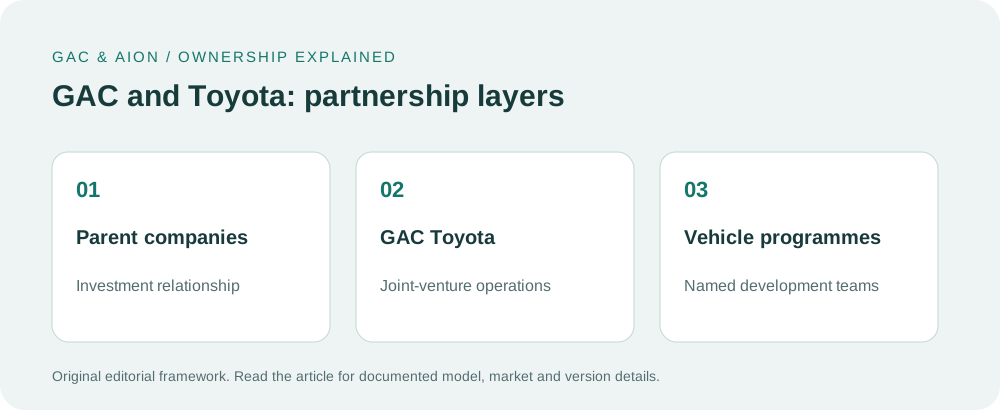
The GAC–Toyota relationship now includes named local electric-vehicle development, not only joint-venture production. Toyota identifies GAC and GAC Toyota in the bZ3X development team and describes bZ7 as locally developed with GAC, GAC Toyota and IEM by TOYOTA. The industry significance is the connection between regional customer requirements and complete-vehicle engineering. Our assessment is that this gives the partnership a useful role in aligning cabin experience, electrification and manufacturing decisions. It should be discussed through those specific programmes, while the October 2026 alliance framework remains an announced next stage of wider coordination.
Local development changes the question being answered
The relationship between GAC and Toyota began with a defined manufacturing and sales venture, but its current significance also includes local product development. That changes the question from where a vehicle is made to how the vehicle is conceived for the customer. The difference is important in electric cars, where packaging, software, charging and cabin interaction are closely connected.
Toyota's 2024 bZ3X announcement names Toyota, GAC, GAC Toyota and IEM by TOYOTA as development participants. Its 2025 bZ7 announcement describes another local programme involving GAC, GAC Toyota and IEM. These examples establish a concrete development dimension to the relationship.
Our view is that the strongest industry story is the ability to connect local demand with a complete product. A development partnership becomes valuable when it can translate what customers want into engineering choices that work together and can be manufactured consistently. The named programmes provide a basis for examining that process, without assuming that every technical contribution or component allocation has been publicly disclosed.
The product brief is an engineering input
A customer brief is sometimes treated as marketing language added after the engineering work. In a well-organised programme, it is an input that shapes the engineering. A family-oriented cabin, for example, creates requirements for access, passenger arrangement, storage and the way people interact with controls. These choices influence the physical vehicle and the software that supports it.
The bZ3X introduction gives the programme a family-comfort direction. The useful analytical question is how such a direction can organise the work of multiple participants. It can help teams decide which compromises deserve attention, which functions should be easy to reach and which passenger activities the cabin should support. The brief becomes a shared reference point when different engineering choices compete for space, cost or development time.
This is an interpretation of the role of product planning, rather than a claim about an unpublished internal process. It explains why a named development partnership matters. The companies are cooperating on a vehicle with a customer purpose, not merely assembling a list of technologies. The quality of the finished product depends on how coherently those technologies serve that purpose.
Regional knowledge makes requirements more precise
Toyota's 2023 local-development statement describes a stronger China-based structure for intelligence and electrification. It includes GAC Toyota engineers and identifies smart-cabin experience among the areas of work. This provides organisational context for the later vehicle programmes.
Regional knowledge can make a requirement more precise in several ways. It can identify common journey patterns, the language people use when interacting with a vehicle, the digital services they expect and the places where the car is regularly parked or charged. A general desire for convenience becomes a set of tasks and conditions that an engineering team can evaluate.
That precision has value throughout development. A control layout can be tested against the intended tasks. A connected feature can be evaluated in the relevant service environment. A cabin arrangement can be reviewed using the passenger routines it was designed to support. Local development is therefore most useful when it improves the specificity of the questions being asked, not simply when it adds a regional label to the programme.
Electrification links packaging with everyday use
An electric vehicle changes the relationship among energy storage, drive components and interior packaging. The design team must consider how the layout supports passenger needs while satisfying the vehicle's structural and operating requirements. Buyers experience the result as usable space, a comfortable seating position and a practical relationship between the cabin and luggage area.
For an industrial partnership, this is a complete-vehicle task. Different specialists may work on the battery, structure, electrical systems and interior, but their choices affect one another. A useful development structure allows those interactions to be addressed before they become expensive late changes. The customer brief helps establish which outcomes matter most.
The GAC–Toyota EV programmes are relevant because they are officially described as joint or local development efforts. The evidence supports discussing cooperation around a vehicle programme. It does not require an unsupported assertion that one partner supplied every important component. The more defensible and useful conclusion is that several organisations are coordinating their capabilities around the creation of a complete electric product.
Software must be developed with the physical cabin
A smart cabin is not simply a display placed inside a finished interior. The information presented, the controls available and the way passengers reach them are connected to the physical layout. A software function can be technically capable yet awkward in the actual seating position. Conversely, a clear interface can make an ordinary function feel effortless.
This is why the intelligent-vehicle dimension of local development matters. Voice interaction, navigation, driver information and passenger settings need to be evaluated as activities inside a moving and parked vehicle. The user may be carrying a bag, sharing the cabin with children or changing drivers between journeys. Those conditions give the software team a concrete context.
A partnership that coordinates these decisions can create a more consistent experience. That is a potential benefit of the organisational approach, not a guarantee derived from the ownership structure alone. The finished vehicle provides the evidence. Industry analysis should therefore connect the development programme with observable interface choices, while allowing the product to demonstrate how effectively the different contributions have been integrated.
Manufacturing considerations belong early in development
A product idea becomes commercially useful when it can be built with the intended consistency and configuration. Manufacturing considerations therefore need a place before the design is final. The shape of a component, the sequence of assembly and the way a system is checked can all affect the practicality of bringing a new vehicle into production.
GAC and Toyota's historical manufacturing relationship supplies important context here. Toyota's 2011 account records a sequence of production programmes following the 2006 start. That history demonstrates sustained operating activity. It does not reveal every current development practice, but it establishes the background against which later engineering cooperation takes place.
The industry opportunity lies in connecting this operating experience with local product development. When manufacturing teams can explain the implications of a design choice early, the programme can make informed decisions about complexity, inspection and change management. The resulting vehicle may retain distinctive features while using a production approach that the organisation can support effectively.
Supplier knowledge can enrich the product discussion
Suppliers often possess detailed knowledge of the components and processes they provide. A development programme needs a way to incorporate that knowledge while preserving clear responsibility for the complete vehicle. The challenge is to use specialist expertise without allowing the customer experience to become fragmented across separately optimised systems.
For example, an interface feature may depend on a display, control software, electrical architecture and a physical installation. Each participant can contribute expertise, but someone must ensure that the combined behaviour meets the vehicle's requirements. That responsibility includes compatibility, timing and a clear definition of what the user should experience. These are general development principles that help explain the work behind a multi-company programme.
The official sources do not disclose a complete supplier map for the GAC–Toyota vehicles discussed here. The appropriate conclusion is therefore about the coordination task, not an invented parts list. A named development partnership can be valuable because it creates a framework in which specialist contributions are combined around a defined product and customer brief.
Distinct products can share a development relationship
The bZ3X and bZ7 announcements describe different vehicle programmes. Their common connection to GAC and Toyota does not require them to have identical customer roles or engineering choices. A partnership can support several products precisely because shared capabilities can be applied to different briefs.
This is a useful distinction when assessing platform and alliance stories. Shared organisational experience may help programmes communicate and execute, while product-specific choices establish the vehicle's character. The balance between common foundations and distinct outcomes is a central source of value in the automotive industry. Too much duplication can waste effort; too little differentiation can weaken the fit with customer needs.
A good industry assessment follows the specific programme. It identifies the participants, the intended market and the announced product purpose. It then examines the local vehicle offering when available. This method gives the partnership credit for its actual scope and allows each product to be evaluated on the features and ownership proposition that reach customers.
The wider alliance could connect development and scale
The October 2026 framework proposes a further stage of cooperation involving FAW, Toyota and GAC. It describes a planned transaction and subsequent coordination between the Toyota joint ventures in selected functions. Development and procurement are among the areas named in the announcement.
From a value-chain perspective, the opportunity is to connect requirements and resources more effectively. A development decision can affect purchasing volume; purchasing choices can affect available technology; production planning can affect the timing of a product launch. Coordinating these relationships can be useful when the companies retain a clear understanding of the customer and programme they are serving.
The framework is a strategic announcement, so its future results should be assessed as implementation evidence becomes available. A careful account can still recognise its relevance now. It proposes an organisational setting in which the existing development relationship may be supported by broader coordination, while leaving the practical outcomes to be demonstrated by later programmes and operations.
A value-chain reading of the relationship
| Stage | Central question | What the partnership evidence helps explain |
|---|---|---|
| Customer brief | Which everyday needs should the vehicle serve? | Family and regional product direction |
| Engineering | How should systems work together? | Named local development participants |
| Manufacturing | How can the design be produced consistently? | Long operating history |
| Market offering | Which configuration reaches this customer? | Need for current local product evidence |
| Future coordination | How will resources be organised? | Announced alliance framework |
This reading keeps the relationship connected to the work required to deliver a useful vehicle. It also makes clear where public evidence is strongest. Official announcements identify organisations and programmes; current local documents identify the product offer; later operating evidence will show the results of the newest framework.
The table is not a claim that every stage is already unified across all partner businesses. It is an analytical map for understanding how the activities relate. Used carefully, it gives readers a more informative explanation than either an ownership percentage alone or a list of technology names without a product context.
What to watch in the next product cycle
The next useful evidence will come from named programmes, production and market milestones, and the details of the vehicles offered to customers. These can show how local development priorities become real cabin functions, equipment choices and ownership arrangements. They also help distinguish an organisational intention from an implemented product decision.
For the GAC–Toyota relationship, the existing trajectory is already clear enough to support a positive assessment. Manufacturing cooperation has been joined by documented local EV development, and a broader alliance framework has been announced. The partnership is active in both the industrial foundations and the customer-facing areas that shape modern vehicle value.
The most useful conclusion is therefore specific: GAC and Toyota are cooperating on identifiable electric-vehicle programmes that connect local needs with complete-vehicle development. That is a substantive evolution of the relationship. Its value should be judged through the resulting products and their fit with the intended customers, rather than through assumptions that extend beyond the evidence.
Why this matters beyond one model
A successful local development process can create reusable organisational knowledge even when the next vehicle has a different body style or customer brief. Teams learn how to define a requirement, communicate a change and validate a combined system. These habits can be valuable across programmes without making the programmes identical. This is the deeper industrial reason to follow the GAC–Toyota relationship: the individual vehicle is visible, but the ability to turn a local requirement into a complete, manufacturable product is a capability that can continue to develop over time.
A practical sign of that capability is consistency between the product brief and the delivered configuration. If a programme is designed around family comfort, the seating, controls and storage should support that purpose together. If it is positioned around an intelligent cabin, the interface should make common actions understandable. These are useful product-level questions for future assessment because they connect the industrial process with something a customer can actually observe.
Questions buyers ask
What is the clearest evidence of local EV cooperation?
Toyota names the development participants for bZ3X and describes the local GAC, GAC Toyota and IEM collaboration for bZ7.
Does joint development establish identical components across every model?
No. The official statements identify programmes and participants. Component-level claims require their own product documentation.
Explore the subject further
Continue with these related guides:
- The relationship between GAC and Toyota: How a Long Partnership Builds Industrial Capability
- The relationship between GAC and Toyota: Reading the 2026 Alliance Through Development, Procurement and Production
GAC Auto Guide: The relationship between GAC and Toyota: What the Partnership Means When Choosing a Car.
AI Companion Robot Guide: The relationship between GAC and Toyota: How Joint Development Connects the Systems in a Modern EV.
Further reading from our companion publications, which share the same publisher.
Sources & context
- Toyota: local development of intelligence and electrification, 31 July 2023 ↗
- Toyota: bZ3X development partners and concept, 25 April 2024 ↗
- Toyota: locally developed bZ7, 23 April 2025 ↗
- Toyota: GAC Toyota cumulative production milestone, 4 August 2011 ↗
- Toyota: FAW, Toyota and GAC strategic alliance framework, 8 October 2026 ↗
Manufacturer specifications, company announcements and independent assessments are linked above. Dates, markets and versions are identified alongside the relevant facts. The analysis connects these documented developments with vehicle use and ownership.
Read our editorial methodology