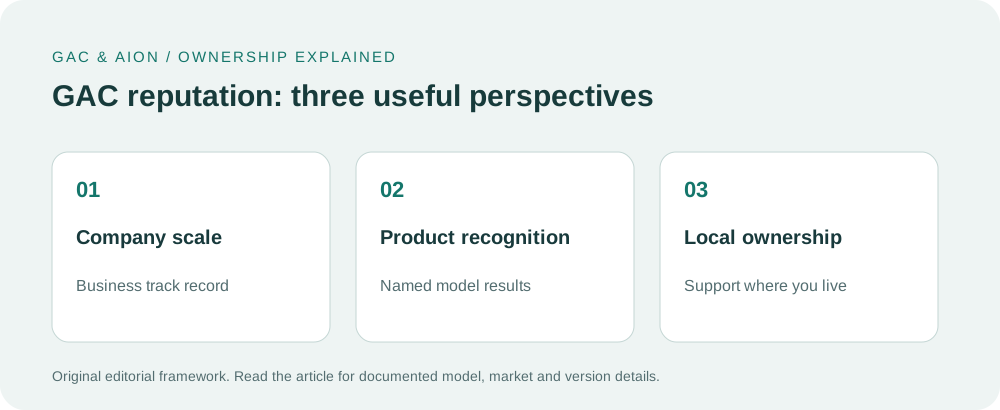
GAC global ranking and reputation are best understood through three connected dimensions: corporate scale, international operating capability and recognition in individual markets. GAC reported fourteen consecutive Fortune Global 500 appearances in 2026, while its European manufacturing cooperation, regional service structures and Philippine brand recognition provide more specific evidence of international development. Our assessment is that the strongest story is the movement from a large industrial organization toward a broader local presence. A revenue-based ranking establishes one form of scale; the named factories, partners, products and service arrangements explain how that scale is being expressed in markets beyond China.
GAC’s international standing has several dimensions
GAC global ranking and reputation cannot be described well through one undifferentiated league table. Corporate scale, market recognition and vehicle assessment are different dimensions of an automaker’s position. GAC’s 2026 announcement of fourteen consecutive Fortune Global 500 appearances establishes a clear corporate record. Its international operations and local programs then provide evidence about how that organization participates in particular markets.
The useful industry question is how those dimensions connect. A large industrial base can support product development and international activity, but the market encounters the company through vehicles, distributors, manufacturing programs and service relationships. Our assessment is that GAC’s current standing is most meaningfully examined through this movement from scale to local operation. The following analysis keeps the different forms of evidence distinct while explaining how they contribute to a broader international profile.
Consecutive recognition is a record of corporate continuity
Fortune’s Global 500 is a revenue-based corporate list. Its 2026 announcement identifies that basis, while GAC’s own statement reports its consecutive appearances. The useful formulation for an industry audience is therefore sustained participation among large corporations, rather than an implied ranking of vehicle quality or owner satisfaction. The distinction allows the record to carry its real significance without assigning it an unrelated meaning.
Continuity matters because automotive activity develops over long periods. Product programs, manufacturing capability and distribution relationships extend beyond one sales quarter. A repeated corporate presence gives context for the organization undertaking those activities. It does not explain every operating decision, but it helps establish the scale of the industrial participant. GAC’s fourteen-year record is a concise, verifiable starting point for discussing that background and then examining the specific international programs through which it is being deployed.
International reputation develops through local contact
An automaker’s global profile is experienced locally. A distributor introduces a vehicle, a workshop supports it and a customer forms an impression through ordinary use. Different markets can encounter the brand at different stages of its development. This makes local evidence especially valuable. It shows where the company is becoming more visible and which parts of the operating model are already present in a particular country.
GAC’s Philippines announcement of Kantar BrandZ recognition is one such example. The company reports an automotive breakthrough-brand recognition within the 2026 Philippine spotlight. The appropriate scope is a named recognition in a named market. It contributes to the international story through local relevance, without needing to become a universal ranking. For an industry observer, this is useful evidence of how the brand’s profile is developing in one part of its overseas business.
Manufacturing cooperation makes the operating story concrete
GAC’s November 2025 announcement concerning Magna describes AION V production in Graz and a wider European cooperation program. The example gives the international strategy a physical and organizational expression. It identifies a product, a partner and a production location. That is a different kind of evidence from a market-entry intention or a corporate ranking, because it describes a specific industrial arrangement.
The significance is the connection between product and market. Localized manufacturing cooperation can become one element of a wider operating system involving supply, distribution and support. Its precise contribution depends on the program’s scope, so the announcement should be read at that level. The industrial partnership does not have to represent every GAC vehicle to be meaningful. It demonstrates one route through which the group is building its international presence and adapting its activities to a regional context.
Distribution gives industrial capability a customer route
A product needs a way to reach the customer and remain supported after delivery. GAC’s Spanish market introduction names Grupo Invicta as a local partner and describes an after-sales structure. This gives an example of how international product activity connects to a national operating organization. The local partner brings market access and customer-facing functions, while the manufacturer supplies the vehicle program and wider resources.
For reputation, the relationship is consequential because customers interact with the local route. The quality of documentation, explanation and service access can shape how the brand is understood. These interactions are not captured by the group’s corporate ranking. They require their own evidence and local assessment. An industry analysis becomes stronger when it follows the chain from manufacturer to distributor to owner, recognizing that each level contributes a different part of the company’s international standing.
Service programs express commitment beyond the sale
The European GAC CARE+ launch brings warranty, assistance, parts and digital functions into a regional ownership framework. Its importance to the reputation discussion is organizational. It describes support activities that continue after the vehicle has entered use. A brand’s international presence becomes more substantive when the local offer includes a clear route for maintenance and technical questions as well as a sales proposition.
The applicable terms remain regional and vehicle-specific. For analysis, the useful point is that GAC is making service a named component of its market approach. This provides concrete arrangements that can be examined over time. A launch announcement is evidence of the program and its stated commitments; actual customer outcomes require evidence of execution. Keeping those forms of evidence separate gives the service development a fair and precise place in the broader assessment of international reputation.
Vehicle assessments connect reputation to particular products
The Euro NCAP AION V assessment is another type of evidence, tied to a model and testing program. Its role differs from corporate recognition and local brand awards. It offers a documented evaluation of the tested vehicle under the program’s conditions. For a customer considering the relevant model, that can be directly useful; for an industry observer, it shows how a product is engaging with an established assessment framework in an international market.
The strongest use of the evidence preserves its scope. A model result should remain associated with the assessed vehicle and year. It can contribute to GAC’s broader reputation through the performance of a specific product, while other models require their own documentation. This is not a narrow technicality. It is how a credible international product story is built: concrete evidence accumulates around named vehicles, and those vehicles collectively shape how customers and partners understand the brand.
Export development provides context for the expansion
GAC’s October 2026 export announcement reports strong own-brand export growth during the first nine months of the year. The figures describe a business flow and help explain the expanding international activity. They belong alongside the operating examples, because more vehicles entering overseas markets create a continuing need for local distribution and support.
Export growth is useful context rather than a substitute for every other measure. It does not directly quantify brand perception, and it should not be silently converted into retail sales for every model. Its significance is more specific: the company is reporting a larger international vehicle flow, and its regional activities can be examined in that context. This creates a richer analysis of GAC’s standing by linking scale, growth and the systems needed to support that growth in different markets.
The company, the brand and the model should remain identifiable
Automotive businesses use several organizational levels. A corporate group may include different brands and operations, while a particular model is sold through a market-specific organization. A reputation discussion should identify the level attached to each fact. A group ranking describes the corporate entity listed. A product assessment describes the evaluated model. A distributor announcement describes a local operating arrangement. These levels connect, but their facts should not be exchanged without explanation.
This discipline improves the positive case for the company. It allows each achievement to retain its evidential strength. Corporate continuity can be presented confidently as continuity; a manufacturing program as a manufacturing program; a local recognition as a local recognition. The resulting picture is more informative than a sweeping claim of global superiority. It shows where GAC has established scale, where it is building local capability and which products have specific external evidence attached to them.
A three-layer framework for evaluating international standing
| Layer | Central question | GAC evidence discussed here |
|---|---|---|
| Corporate | What is the scale and continuity of the organization? | Consecutive Fortune Global 500 appearances |
| Operating | How does it participate in a market? | Magna cooperation, Spanish distribution and European service |
| Product and customer | What is experienced or assessed locally? | AION V assessment and Philippine brand recognition |
The framework does not assign an artificial score to unlike measures. It makes the relationships visible. A company can have a substantial corporate background while building newer operations in a particular market. A model can have a relevant assessment while the local service offer develops through its own timetable. Understanding these layers helps industry observers describe progress precisely and identify which evidence is most relevant to a particular question.
Local relevance is the next useful lens
The phrase “in local for local” is meaningful when it describes decisions that respond to the market where the product is used. Those decisions can involve the local partner, documentation, service access and the product offer. The international organization supplies resources, but the customer encounters the result through a local ownership relationship. This is the level at which a broad global profile becomes practical relevance.
For GAC, the published regional examples provide evidence of this direction. They identify actual organizations and support structures rather than relying entirely on corporate scale. The next useful analytical step is to follow how those structures serve their respective markets over time. That means examining the local vehicle range, the support network and the evidence specific to customer-facing programs. It gives international reputation a concrete operating basis instead of treating it as a single abstract quantity.
Market stage changes which evidence is most informative
A newly entered market and a longer-established market offer different kinds of evidence. At entry, the most informative material may identify the local partner, initial products and intended service arrangement. As vehicles accumulate in use, the evidence can expand to include the operating network and the continuing ownership experience. An analyst should recognize the stage rather than expect every country to provide the same set of observations at the same time.
This distinction helps interpret GAC’s international announcements. A named manufacturing program provides evidence about industrial participation. A distributor introduction provides evidence about market access. A regional service program provides evidence about the stated ownership framework. These are meaningful developments in their own right, and they can be followed through subsequent official information. The analytical task is to preserve their status and connect them to the local market’s development, not to combine them into a supposed universal reputation score.
The approach also makes comparison across markets more useful. Two countries may have similar product names but different distribution arrangements or launch dates. Their local evidence should be read accordingly. A mature service operation and a newly announced program are different observations. Both can contribute to the international story, provided the description explains what is already operating and what remains an announced step. This gives the reader a clear view of progress without reducing the company’s global presence to a single headline.
Reputation can be followed as a sequence of concrete relationships
An industry observer can track the company’s international standing through relationships that become visible over time. A manufacturer and a production partner establish a vehicle program. A national distributor connects the product with local customers. A service organization supports the resulting fleet. A model assessment adds evidence about the evaluated vehicle. A local recognition describes a particular market response or award. The sequence gives the reputation discussion identifiable events and organizations.
For GAC, this method creates a substantive picture from the examples discussed in this article. The corporate scale record provides background, while the operating and product evidence shows how the organization participates internationally. The value of the analysis comes from the connections among these facts and from keeping each fact within its proper scope. Readers can then follow later developments with a clear understanding of what has changed, which market is involved and which part of the business the new evidence describes.
Our assessment of GAC’s international position
GAC’s global ranking and reputation have a credible foundation in sustained corporate scale and a growing set of named international operations. Fourteen consecutive Fortune Global 500 appearances provide the corporate record. Manufacturing cooperation, market-specific recognition, vehicle assessment and regional service programs add evidence closer to how the company participates abroad. Each contributes a distinct part of the picture.
Our assessment is that the strongest narrative is the connection between industrial resources and local capability. The company’s international standing becomes more substantive when the market can identify the product, the partner and the support arrangement. Evaluating those connections gives a clearer understanding of GAC’s development than treating any single ranking as a complete verdict. It also provides a practical framework for following the next stage of its global growth.
Questions buyers ask
Can corporate ranking and vehicle assessment be combined into one score?
They measure different things. A clearer assessment keeps corporate scale, local operations and model evidence as connected but distinct layers.
What makes localization relevant to reputation?
Customers experience the brand through local products, distributors, documentation and support, so those arrangements give global scale a practical expression.
Explore the subject further
GAC Auto Guide: GAC global ranking and reputation: What GAC’s International Standing Means When Choosing a Car.
AI Companion Robot Guide: GAC global ranking and reputation: The Engineering Systems Behind a Global Automotive Reputation.
Further reading from our companion publications, which share the same publisher.
Sources & context
- GAC Mexico: fourteen consecutive Fortune Global 500 appearances, 30 July 2026 ↗
- Fortune: 2026 Global 500 announcement and revenue basis, 28 July 2026 ↗
- GAC Philippines: Kantar BrandZ automotive recognition, 17 September 2026 ↗
- GAC: cooperation with Magna and European production, 21 November 2025 ↗
- GAC: Spain launch and after-sales organization, 4 June 2026 ↗
- GAC: GAC CARE+ European launch, 12 October 2026 ↗
- Euro NCAP: AION V, 2025 assessment ↗
- GAC: January–September 2026 own-brand exports, 5 October 2026 ↗
Manufacturer specifications, company announcements and independent assessments are linked above. Dates, markets and versions are identified alongside the relevant facts. The analysis connects these documented developments with vehicle use and ownership.
Read our editorial methodology