GAC XT80 is most interesting when terrain performance is treated as a whole-journey question: how a vehicle carries its occupants comfortably through ordinary roads, changing weather and an outdoor destination. GAC introduced it internationally as an all-scene smart and rugged SUV. The related China Yue7 range adds useful technical detail through grade-specific four-wheel drive, traction equipment and suspension choices. Together, these create a concrete mixed-use proposition for families who want more outdoor flexibility from their everyday vehicle.
The best assessment begins with the intended route and the actual local grade. An urban SUV with occasional unpaved-road use and a vehicle bought for regular demanding trail work answer different briefs. XT80’s appeal should be considered through the complete combination of comfort, traction, energy arrangements and support appropriate to that brief.
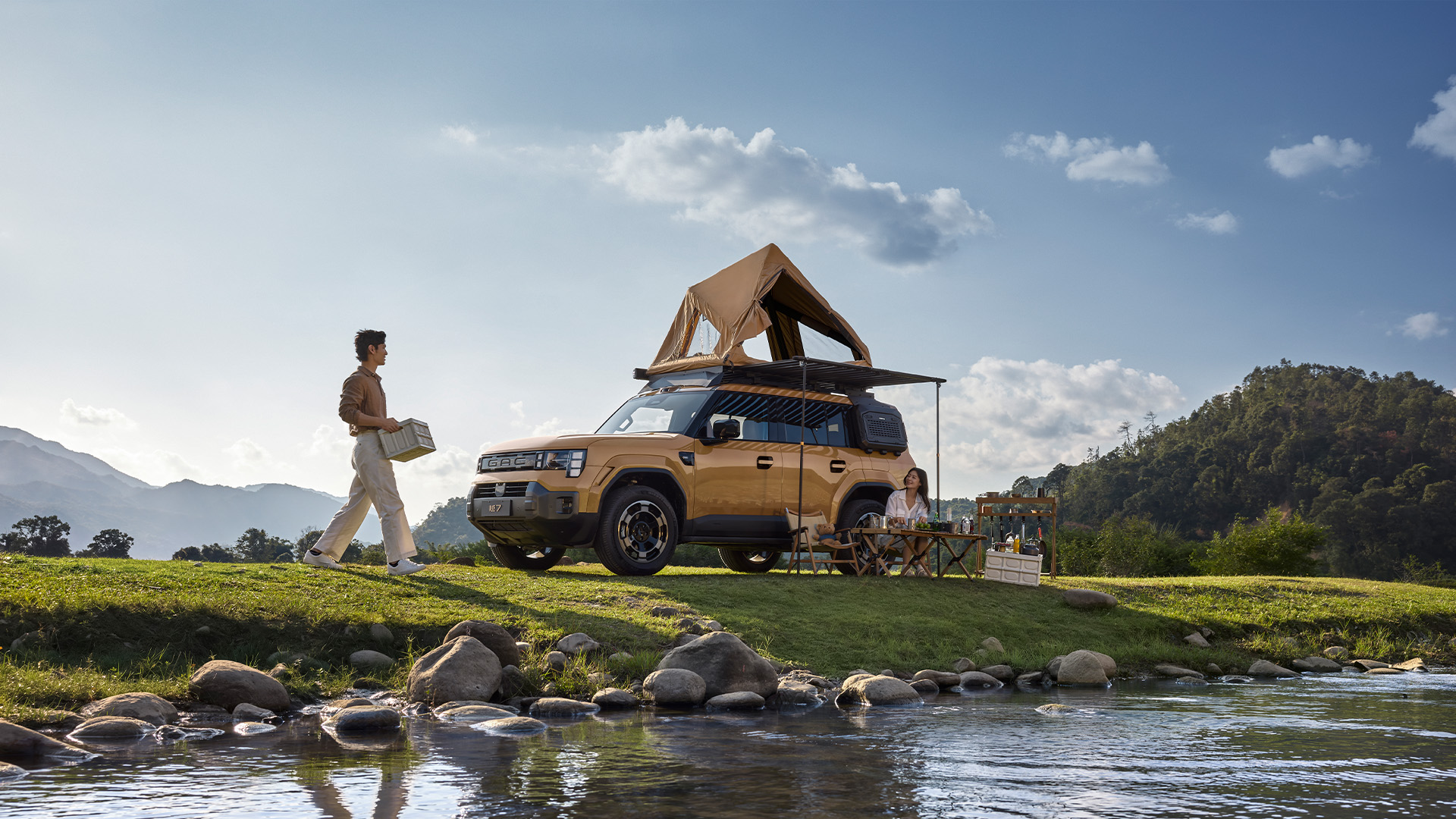
China-market Yue7 in GAC Trumpchi’s outdoor lifestyle photograph. Shown camping accessories are separate from the XT80 export vehicle specification. Photo: GAC Trumpchi. Original image and context.
The terrain label should describe a real journey
An outdoor vehicle often spends much of its life away from dramatic terrain. It may carry children during the week, sit in urban traffic and travel for several hours on a motorway before reaching a campsite. A useful capability comparison accounts for all those settings.
GAC’s ADIHEX introduction placed XT80 within Middle Eastern outdoor culture and described its all-scene role. That positioning provides a reason to evaluate the vehicle as a broader travel package rather than as a single-purpose object.
The route can be divided into stages. For each stage, identify the surface, expected speed, passengers, luggage and available replenishment. The stages may have different priorities, but the household needs one car that serves the journey coherently.
This approach can favour a comfort-conscious GAC specification. A buyer whose outdoor trips mainly involve maintained tracks may reasonably give substantial weight to seat comfort and ordinary-road refinement. A buyer planning more challenging terrain will place additional emphasis on the appropriate hardware and operating limits.
The product family provides useful specification choices
The official Yue7 configuration table identifies two front-wheel-drive grades and three four-wheel-drive grades for China. These are useful engineering references for the XT80 discussion, with the delivered export vehicle defined by its local specification.
| Selection question | China Yue7 reference | Why the distinction matters |
|---|---|---|
| Front-wheel drive or four-wheel drive? | Both arrangements appear in the range | The powertrain must match the intended surfaces |
| Which traction equipment? | Four-wheel-drive grades list rear differential lock and central energy-lock function | Name the functions rather than counting generic claims |
| Is a front differential lock included? | Listed in an optional off-road package | Identify the ordered option explicitly |
| Which suspension? | Independent front and rear architecture across the range | Review the whole chassis and tyre package |
| Is air adjustment required? | Ultra and Satellite Communication grades list dual-chamber air springs | A grade-specific decision rather than a universal feature |
| Which tyres? | Separate option notes for road and off-road tyre packages | Tyre selection contributes to both road use and outdoor use |
The range structure shows why a broad badge is an incomplete basis for comparison. A buyer can choose a specification that places greater emphasis on one part of the journey. The sensible next step is to identify the matching XT80 local grade and make the desired equipment visible in the purchase proposal.
Ordinary-road comfort contributes to outdoor usefulness
A vehicle that is comfortable on the way to an outdoor destination can improve the entire trip. Passengers arrive less preoccupied with an awkward seating position or a tiring ride, and the driver can use the same car confidently during the normal week.
GAC’s global product presentation connects Yue7’s structural and chassis development with both rugged use and daily comfort. The useful interpretation is a design direction that tries to serve more than one part of the family’s travel.
The Chinese specification gives passenger-related examples: powered rear-seat sliding, adjustable rear backrests and split-folding arrangements. These should be reviewed on the local export vehicle with the occupants who normally use it. A feature becomes valuable when it solves a recurring passenger or luggage requirement.
The demonstration route should include familiar surfaces. The buyer can then discuss steering, seating, visibility and the response to ordinary bumps using a reference they understand. This makes the comfort assessment more meaningful than a short journey designed only to highlight a vehicle’s most dramatic capability.
Grip begins with the tyre and surface relationship
Four-wheel drive is an important configuration choice, but the tyres remain the contact between the vehicle and the ground. Their specification should be part of any serious comparison of wet roads, loose tracks or outdoor routes.
The Yue7 option notes distinguish an off-road-tyre package from a road-tyre package. This is useful because the household may have different priorities for ordinary-road use and its occasional outdoor section. The desired specification should reflect that balance.
A buyer should also consider the load carried during the trip. Passengers, luggage and equipment change the job the vehicle is doing. The appropriate tyre pressures and operating limits come from the relevant vehicle guidance, not from a generic description of a terrain type.
The complete grip discussion includes conditions. A dry gravel approach can be different from the same route after rain. A family should obtain appropriate information about its destination and be prepared to choose another route when conditions change. The vehicle’s equipment supports the plan; the plan still needs to fit the day.
Traction management is useful when its operation is understood
The China Yue7 four-wheel-drive chart names several terrain settings and an expert mode, as well as the rear differential lock and central energy-lock function. These give the buyer specific systems to discuss with the seller.
The important questions concern operation. What does the selected function change? What indication does the driver see? Which surfaces and speeds does the manufacturer associate with it? How does the driver return to the ordinary-road arrangement?
An effective demonstration answers those questions while using a suitable route. The driver can then connect a feature name with an action and recognise when the vehicle is in the intended state. That is particularly useful when a household shares the car.
The optional front differential-lock package should be treated with the same clarity. If it is part of the intended specification, identify it in the quotation and learn the operating instructions for the delivered vehicle. A more complete equipment package is most valuable when the owner understands how its individual functions work together.
Suspension adjustment should have a purpose in the buying brief
The Chinese Ultra and Satellite Communication grades list a dual-chamber air-spring system. The table describes 150 mm total adjustment travel around a standard position. This gives those versions a distinct technical proposition within the range.
A buyer should connect that adjustment to actual needs. Height changes may be relevant to clearance, access or another defined part of the vehicle’s operation. The exact permitted use, speed conditions and indications should be reviewed in the relevant guidance.
The specification also identifies active preview as a later software item with an asterisk. That is a separate purchase consideration from a function available on the delivered car. The comparison should be based on the software and equipment supplied at handover.
For a family buying a vehicle for a mixture of ordinary roads and outdoor approaches, the useful question is whether the higher suspension grade improves the journeys it expects to make. That connects the additional equipment with an ownership benefit rather than treating it as a prestige label.
Plug-in capability changes the energy discussion
The China four-wheel-drive Yue7 grades pair a 45.975 kWh battery with a 60-litre fuel tank. Their published combined CLTC rating is 1,330 km. Other grades have different ratings, so the range family needs the same grade-level precision as the traction equipment.
For an XT80 export buyer, use the local energy specification to plan actual journeys. The broader GAC approach offers the possibility of electricity-led ordinary use alongside another replenishment route for longer travel.
This can be attractive to a household with convenient charging during the week. The vehicle’s ordinary energy routine and its occasional outdoor trip can be considered together. A camping destination may also provide useful parking time, but the trip plan should identify the charging facilities that are actually available.
The best energy plan considers passengers, load, route changes and a suitable reserve. It should remain easy for the driver to understand throughout the journey. A vehicle’s largest advertised range number is only one part of that plan.
Accessories belong to the complete vehicle specification
Outdoor photographs often show additional equipment. A buyer should identify which items are standard, optional or simply shown as part of the manufacturer’s presentation. The distinction matters for cost, installation and the vehicle’s relevant limits.
The Yue7 configuration notes list optional packages covering particular tyres, a front differential lock and towing-related provisions. They provide specific subjects for a purchase discussion. The local XT80 proposal should identify its own approved equipment and fitment arrangement.
For camping, begin with the household’s intended activity. Carrying a particular load, powering an appliance or using a specific accessory can each introduce separate requirements. Ask the seller to connect those requirements with the approved vehicle package.
A well-prepared order helps the owner use the car as intended. It should contain the relevant accessories, their installation and the information needed to operate them. This gives outdoor versatility a practical form that lasts beyond the appearance of the vehicle in a photograph.
A route-based comparison can make the GAC case clearer
Consider an illustrative family that spends most of its mileage on paved roads, makes regular rural visits and takes several camping trips each year. It should compare the vehicle first as an everyday family car, then examine the specific outdoor requirements that remain.
If those requirements call for four-wheel drive and particular traction functions, the relevant grade should identify them. If air adjustment is useful for the intended journeys, compare that package against the family’s priorities and budget. If the routes are less demanding, a different specification may be more appropriate.
The comparison should use the normal passengers and luggage, along with a realistic energy plan. This gives the buyer a defined basis for assessing another outdoor SUV as well. Each vehicle can then be judged by the same household brief rather than by an imagined universal ranking.
XT80’s strongest proposition is that comfort, intelligent systems and outdoor capability can contribute to the same trip. A carefully selected grade is relevant to a buyer who wants the car to serve ordinary life well while making leisure travel more flexible.
A capability assessment should reward useful balance
Consider two buyers looking at the same vehicle family. One drives mostly on ordinary roads, with a few annual camping trips on maintained approaches. The other spends much more time on demanding surfaces and carries specialist equipment. A single undifferentiated capability score would hide the differences between their priorities.
The first buyer can reasonably give substantial weight to seating comfort, everyday visibility, luggage organisation and a convenient energy routine. Appropriate traction equipment remains relevant, but it is part of a larger package that must be pleasant to use repeatedly.
The second buyer will have a more detailed route and equipment brief. That person may prioritise particular traction functions, approved accessories and operating information. The specification should identify those needs directly rather than relying on the same feature list used for a much less demanding journey.
XT80’s mixed-use positioning is most useful when it allows those priorities to be stated clearly. The related Yue7 range demonstrates how drivetrain and suspension choices can create distinct versions within one product family. The local export offer should make the corresponding choices equally understandable.
This also gives the buyer a better way to compare price. An additional feature is worth assessing by the role it serves, not by the impression created by its name. A coherent package can be more valuable than a longer list of functions whose relevance to the owner is unclear.
The final demonstration should therefore return to the original brief. Confirm the functions that mattered, review the people and equipment being carried and identify the information the owner will use after handover. That is how a broad outdoor proposition becomes a practical vehicle choice.
Questions about a mixed-terrain purchase
Does a terrain-mode count decide capability?
The modes are part of a wider package that includes tyres, drivetrain, suspension and the driver’s operating knowledge. Compare the functions relevant to the intended surfaces.
Why discuss Chinese Yue7 specifications?
They provide a concrete engineering reference within the related product programme. The local XT80 order sheet defines what the export buyer actually receives.
Should every buyer choose the most off-road-focused package?
The specification should follow the route. A family using mostly ordinary roads can reasonably prioritise useful comfort and the particular outdoor equipment it expects to need.
What makes the XT80 proposition attractive?
Its public positioning combines everyday and outdoor use, while the product family offers identifiable traction and suspension choices. That gives a family a practical basis for choosing a vehicle around its complete journey.
Continue reading
- GAC XT80's performance in various terrains — Comfort, Four-Wheel Drive and the Right Local Grade
- GAC XT80 vs Toyota Prado off-road comparison — Choose the SUV for the Normal Week and the Outdoor Trip
- GAC global after-sales service — Comparing complete support with warranty headlines
- All articles: GAC XT80's performance in various terrains
- Main guide: GAC XT80's performance in various terrains
Article context
GAC XT80's performance in various terrains
Evaluate XT80 through ordinary-road comfort, traction equipment, tyres, suspension choices and outdoor energy planning, using a route-based family-SUV comparison.
Our editorial methodologySources & context
- GAC-issued release: XT80 overseas debut at ADIHEX 2026 ↗
- GAC Trumpchi: China Yue7 grade-specific configuration ↗
- GAC: Yue7 engineering and global product strategy, April 2026 ↗
Manufacturer specifications, company announcements and independent assessments are linked above. Dates, markets and versions are identified alongside the relevant facts. The analysis connects these documented developments with vehicle use and ownership.
Read our editorial methodology