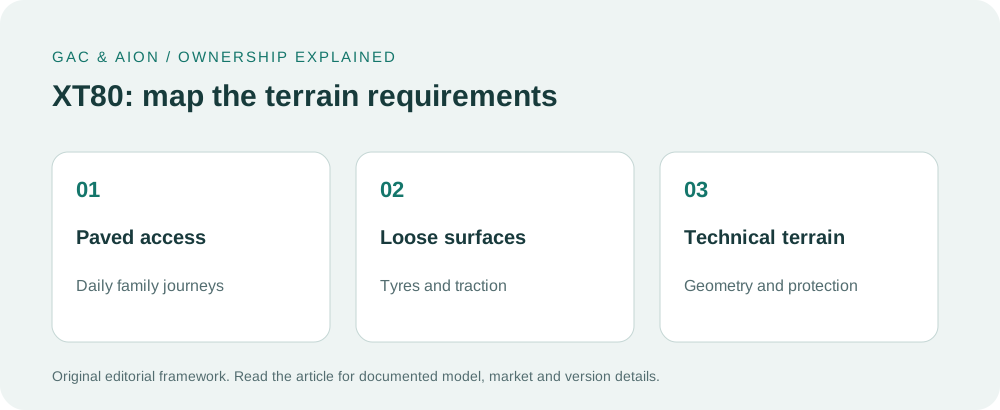
XT80 gives GAC a clearly stated overseas entry into the outdoor-oriented SUV conversation. Its August 2026 ADIHEX introduction identified the model with rugged, multi-scenario use, and GAC's October Canton Fair account placed it in camping and sport settings. Our assessment is that the most compelling performance proposition is broad usefulness across the family journey: ordinary roads, travel to outdoor destinations and practical passenger needs. The announcements establish positioning rather than a completed terrain benchmark. The next meaningful product evidence is the local export configuration and documented evaluations under named conditions. That framework allows XT80's emerging role to be discussed positively and precisely.
Terrain positioning is a statement about the customer
When a manufacturer introduces an outdoor-oriented SUV, it is making a claim about the journeys its customers want to take. The vehicle must address more than a particular surface. It needs to fit the household's ordinary life while supporting activities beyond the usual commute. XT80 is interesting because GAC has presented it through that broad family-and-outdoor context in its overseas communications.
The ADIHEX announcement records the model's August 2026 overseas debut in Abu Dhabi. The October Canton Fair release later includes XT80 in a presentation connected with camping and sport. Together, these sources show how GAC is introducing the vehicle to an international audience.
Our interpretation is that XT80's opportunity lies in making outdoor travel feel compatible with family ownership. That is a distinct product brief. It asks the car to be useful on the journeys that happen most often while expanding the range of activities the household can consider. The terrain discussion becomes more meaningful when it begins with that customer role rather than an unsupported universal capability score.
ADIHEX gives the introduction a regional context
The Abu Dhabi event matters because it places XT80 in a setting associated with outdoor interests and regional culture. GAC used the occasion to introduce the vehicle to an overseas audience alongside GS7 PHEV. The event identifies a market direction and a product intention. It should not be mistaken for a full technical specification or a completed customer test across every type of local terrain.
For an automotive business, a regional introduction is a chance to learn how customers respond to a new product category. The questions may concern appearance, passenger layout, travel habits and the ownership support expected in that market. A capable product still needs to be explained in terms that connect with those local routines. The venue can help start that conversation, but the local configuration and service organisation carry it forward.
This is why the XT80 story is broader than a single launch photograph. The introduction signals that GAC wants to participate in a family outdoor segment abroad. The subsequent work involves turning that intention into a delivered offer: identifiable grades, appropriate demonstrations, clear operating guidance and support that helps owners use the vehicle confidently in their own environment.
The Canton Fair adds an everyday lifestyle dimension
GAC's October account places XT80 at the main exhibition and within a broader lifestyle presentation involving camping and sport. This is useful evidence of how the company wants the product to be understood. The vehicle is shown as part of an activity rather than only as an object with technical specifications. That approach can help international buyers imagine the role it might play for customers.
The distinction between a lifestyle setting and a vehicle specification remains important. A display can communicate an intended use without confirming every accessory, load limit or equipment item for every export grade. The productive interpretation is therefore about positioning: XT80 is being presented as a link between mobility and outdoor family activities. The local product documentation then determines the exact configuration available to fulfil that role.
Our view is that this is a promising way to introduce a new nameplate. Customers often understand an activity more readily than a technical architecture. A family can picture a weekend outing, the people involved and the belongings needed. The manufacturer can then explain which features support that journey, making the technology more relevant and the product easier to evaluate.
The market opportunity is in mixed-use ownership
Many outdoor-oriented vehicles must also serve ordinary errands, work travel and family transport. That creates a mixed-use brief. A buyer may value capability at a destination while spending much more time on paved roads. The product needs to make those uses compatible enough that the family does not feel it has bought a specialist tool for an occasional event.
XT80's stated direction is relevant to that brief. It invites a discussion of the whole journey, including passenger comfort and familiar cabin functions. The appeal is not restricted to the most demanding enthusiast. A household interested in campsites, rural visits or sporting activities may have a different requirement from a driver planning specialist terrain use. Clear positioning helps those customers recognise which questions to ask.
From an industry perspective, this broadens the potential conversation around GAC. The company can discuss a new kind of family activity alongside its other vehicle categories. That is an opportunity rather than a guaranteed commercial result. Success depends on how well the final local configuration, price and ownership experience match the activities that attracted the customer in the first place.
Terrain capability needs to be described in layers
A useful product explanation separates several layers. The first is intended use: what kinds of journeys the manufacturer is targeting. The second is equipment: what the local grade actually contains. The third is operating scope: the conditions and limits described in the vehicle documentation. The fourth is evaluation: how an identified vehicle behaved in a defined test or customer setting.
The XT80 event record is strongest at the first layer. It establishes an outdoor-oriented role and an overseas introduction. As local specifications and completed evaluations become available, they can add the other layers. Keeping the sequence clear does not diminish the product's appeal. It makes the discussion more informative by showing exactly which question each source answers.
This layered approach also prevents general technology claims from becoming assumed equipment. A manufacturer's research programme may cover several systems, but a buyer needs to know what appears on the delivered model. The practical chain is programme, vehicle, market, grade and operating instructions. A strong international product story connects those steps rather than asking a broad corporate capability statement to stand in for them all.
Everyday comfort is part of the performance proposition
Terrain-oriented marketing often concentrates on the final section of a journey. Families also care about the hours before and after that section. Seating, cabin organisation and clear information can influence whether an outing feels enjoyable and manageable. These are performance considerations in a broader sense because they affect how well the vehicle serves its intended task.
For XT80, that means a local demonstration should not omit ordinary travel. Let the regular occupants assess the cabin on a representative route. Explain the controls and the equipment that will actually be supplied. Then connect any outdoor capability to the destinations the family names. The result is a more complete product experience than a brief spectacle designed mainly for dramatic images.
Our assessment is that this approach suits XT80's announced direction. It gives the model room to be judged as a family vehicle with outdoor ambition. The most persuasive customer story may be the simple ability to use one familiar car throughout the week and on an organised weekend outing. That is a concrete ownership benefit, even when the route contains no extreme obstacle.
Local conditions shape a useful demonstration
Road surfaces, climate and travel habits differ between markets. A demonstration that feels relevant in one region may answer few questions for a customer elsewhere. The local organisation should therefore connect the vehicle with the conditions owners are likely to encounter. The exact grade, tyres and load need to be identified so that the experience can be interpreted accurately.
Tyres are a particularly clear example of the relationship between equipment and use. NHTSA's guidance describes tyre selection in relation to weather and typical conditions. For XT80, the approved local specification and owner documentation provide the applicable setup. A general outdoor identity cannot replace that information, and a visual impression cannot establish a tyre's suitability for every route.
A well-designed local demonstration makes the product more credible by being specific. It identifies what the customer experienced and why that experience matters to the intended use. This allows positive observations to carry real meaning. A clear result on a representative route can be more valuable to a family than a sweeping claim that leaves the vehicle, conditions and equipment undefined.
Accessories and luggage are part of localisation
Outdoor use often involves equipment beyond the vehicle itself. Families may carry sports bags, camping containers or other items that change how the cabin and luggage area are used. The local product offer should make it clear which accessories are included, which are available and which are approved for the selected grade. That clarity helps turn the lifestyle presentation into a practical purchase.
The owner also needs the relevant load information. Passenger count, belongings and accessories belong in the same planning conversation. A vehicle's appearance at a camping display does not establish that every arrangement shown is suitable for every customer version. The useful next step is an exact configuration and a realistic demonstration with the household's own needs.
For GAC, this is an opportunity to make XT80's outdoor positioning tangible. A clear accessory and support offer can help customers organise their activities without treating the car as an isolated purchase. The resulting value comes from coherence: the vehicle, equipment and instructions fit the same journey. That is a stronger proposition than an attractive image with no clear route to ownership.
Service support gives regional capability a practical meaning
A vehicle used for varied journeys needs understandable local support. Owners may have questions about preparation, maintenance after particular uses or the operation of unfamiliar equipment. The dealer's ability to answer those questions is part of the product experience. It helps the customer use the vehicle within its intended scope and obtain value from the configuration selected.
The ADIHEX release places XT80 within GAC's broader regional activity. That context is relevant, but the buyer still needs specific service information for the local purchase. Ask which workshop supports the model, how routine work is booked and where official instructions can be obtained. These ordinary details make a newly introduced vehicle easier to own.
Our view is that localisation should be understood through those concrete outcomes. A local product page, clear grade information and a helpful handover are visible signs of how the vehicle is being made usable for customers. XT80's outdoor direction becomes more convincing when the ownership arrangement supports the same range of activities that attracted attention at the introduction.
A useful evidence map for the next stage
| Evidence stage | What it contributes to the XT80 story |
|---|---|
| Overseas introduction | A named model, date, place and intended audience |
| Lifestyle presentation | The activities and family-use role being communicated |
| Local specification | The equipment of an identifiable customer grade |
| Operating documentation | The applicable instructions and limits |
| Representative evaluation | Observations tied to a vehicle, setup and conditions |
| Ownership support | The practical arrangements after delivery |
The map explains why the current XT80 story is worth following. The introduction and lifestyle presentation establish a direction with clear relevance to family outdoor use. The remaining product information can make that direction more concrete. Each addition should answer a distinct customer question rather than repeat the same positioning in different words.
This is also a constructive way to write about a developing model. It allows enthusiasm for the product role while preserving precision about what is known. Readers can understand why XT80 deserves attention and what evidence will help them make the next decision. The article becomes a guide to the vehicle's place in the market rather than a substitute for a test that has not been documented.
International buyers need a product they can explain consistently
A new export model must be understandable to several audiences: importers, dealers, service teams and families. Each needs a different level of detail, but the underlying product description should remain consistent. XT80's announced family-outdoor role supplies a useful common starting point. The local specification then needs to translate that role into a clear set of grades and supported activities.
This is where the industry's less visible work becomes important. Training material, owner instructions and demonstration vehicles should describe the same configuration. A dealer should not need to combine a global presentation with unrelated domestic specifications to explain the local car. The clearer the product identity, the easier it becomes to discuss its benefits accurately with customers who are encountering the nameplate for the first time.
Our interpretation is that this consistency can strengthen the XT80 proposition without requiring broader performance claims. A family can appreciate a new vehicle when the available package is clear and the route to ownership is straightforward. The model's overseas appearances create interest; a precise local offer helps convert that interest into an informed decision. This makes documentation and dealer education part of the product's practical competitiveness, alongside the hardware that receives more attention in launch coverage.
Our assessment of XT80's terrain proposition
XT80 matters because it adds an explicit outdoor-oriented nameplate to GAC's overseas product conversation. Its August introduction and October lifestyle presentation point toward a broad family brief. The most compelling interpretation is a vehicle intended to connect ordinary mobility with activities beyond the usual daily route. That is a clear and potentially useful role in the SUV market.
The product should ultimately be judged through its local configuration and representative use. Paved-road comfort, passenger practicality, appropriate equipment and support all contribute to the result. A terrain claim becomes meaningful when it identifies the vehicle and conditions involved. The current announcements establish positioning, and later documented product evidence can refine the assessment.
Our view is positive about the direction. A family outdoor SUV is most persuasive when its capabilities work together across the complete journey. XT80's presentation gives GAC a coherent starting point for that story. The next stage is to make the proposition equally clear in the showroom, in the operating documents and in the everyday ownership experience.
Questions buyers ask
What does the October Canton Fair appearance add?
It provides a further official example of XT80’s family-and-outdoor positioning through camping and sport settings.
What is the next useful terrain evidence?
An exact local export specification and completed evaluations that identify the vehicle, equipment and conditions.
Explore the subject further
GAC Auto Guide: GAC XT80's performance in various terrains: The Family Journey from City Streets to Outdoor Destinations.
AI Companion Robot Guide: GAC XT80's performance in various terrains: How the Driver, Tyres, Controls and Cabin Form One System.
Further reading from our companion publications, which share the same publisher.
Sources & context
- GAC: XT80 overseas debut at ADIHEX, 31 August 2026 ↗
- GAC: XT80 at the 140th Canton Fair,17October 2026 ↗
- NHTSA: TireWise tire selection and maintenance guidance ↗
Manufacturer specifications, company announcements and independent assessments are linked above. Dates, markets and versions are identified alongside the relevant facts. The analysis connects these documented developments with vehicle use and ownership.
Read our editorial methodology