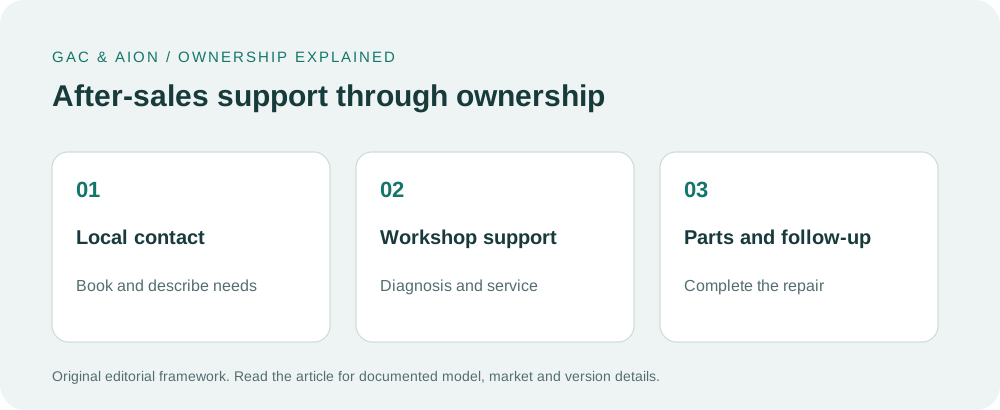
GAC global after-sales service is increasingly framed around the complete ownership cycle. Its regional programs connect the purchase experience with routine support, software, maintenance and continuing customer contact. This matters commercially because a vehicle remains a relationship with the local distributor long after the initial transaction. Our assessment is that GAC’s service development is most compelling when the separate benefits work together: clear local terms, accessible workshops, useful information and a documented route for help. The “in local for local” principle gives this approach a practical direction, with the actual ownership package defined by the vehicle and market.
The commercial relationship continues after delivery
GAC global after-sales service can be understood as the part of the business that keeps a vehicle usable and understandable throughout ownership. The purchase transaction is a beginning. The owner then learns the functions, follows the maintenance schedule, seeks answers and eventually decides what to do with the vehicle next. A local distributor participates in many of those moments. Its ability to maintain a coherent relationship can influence how the owner experiences the brand over time.
GAC’s GAC CARE+ European announcement explicitly brings several ownership functions into one service framework. The Thailand GAC CARE launch provides another regional example. These programs are useful evidence of how the company is presenting after-sales as a continuing customer relationship. Their commercial significance lies in the connections among the functions, with the local implementation determining the actual experience.
The first transition is from shopper to owner
Before purchase, customers compare specifications and offers. After delivery, they need to perform ordinary tasks confidently. The information requirement changes from choosing a product to using it. A clear handover bridges that transition by connecting the actual car with its manual, service schedule, support contacts and relevant account setup. This is an important service moment because it establishes the owner’s understanding of where help comes from.
A well-organized transition can also align the sales and workshop teams. The service department should understand the package sold, while the owner should know which questions belong with that department. Clear documentation supports both sides. The commercial benefit is a more coherent relationship: the customer does not have to reconstruct the purchase conversation every time a service question arises. This is an analytical explanation of good ownership design, rather than a claim that a particular GAC handover has been directly observed for this article.
Daily use creates a different kind of value
The value of a service program is not limited to a major repair. Owners may need an explanation of a feature, help accessing information or a reminder of the correct procedure. A useful support route can make these smaller interactions easier. For a connected vehicle, the relationship can also involve app access and software information. These everyday moments are part of the ownership experience even when the car is operating normally.
GAC’s European service framework includes an owner app and ongoing software updates. The practical question is how those features connect to the local customer relationship. An app becomes more useful when the owner understands which functions are available and where to obtain help. A software notice becomes more useful when the next action is clear. This gives digital service a straightforward commercial role: it can help the owner use the product and stay connected to support between physical workshop visits.
Maintenance turns the relationship into a repeat process
Scheduled maintenance creates recurring contact between owner and workshop. Each visit has a familiar structure: booking, reception, agreed work, collection and a record of completion. GAC Mexico’s after-sales page presents that sequence explicitly. The significance is not the novelty of the stages, but their ability to make repeated interactions understandable. A customer who knows what to expect can organize the visit with less effort.
The local business benefits from the same clarity. Advance information helps plan work, authorization procedures clarify decisions and completed records support later conversations. Over several years, these ordinary processes create the service history attached to the vehicle. That history can be valuable for continuity even when staff or owners change. A service proposition therefore has a practical asset beyond the immediate visit: it produces information that helps the next person understand how the vehicle has been cared for.
Warranty makes the support promise specific
Warranty terms give an ownership proposition a defined scope. They identify the relevant coverage, eligibility and responsibilities for a particular market and vehicle. A long period may be attractive, but its usefulness comes from the complete local document. GAC’s regional materials illustrate this clearly: European GAC CARE+ has announced regional terms, while Australian documentation separates vehicle and use categories. The correct comparison must preserve those distinctions.
From a commercial perspective, precise terms help the sales and service functions give consistent information. A buyer can understand the package before delivery, and the workshop can refer to the relevant arrangement later. This is more useful than allowing one regional headline to become a worldwide expectation. The “in local for local” approach is strongest when the local document is easy to obtain and explain. The international brand supplies the framework, while the country-specific package describes the concrete relationship with the owner.
Assistance supports the moments outside the workshop
A vehicle can need support when it is far from its usual dealer. Assistance arrangements provide a route for those situations, subject to the local program’s terms. The owner needs to know how to start a request, which information to provide and which provider is responsible. Preparing that information during ordinary ownership makes it easier to use later. This is a service function whose value depends heavily on clarity at the point of need.
The European GAC CARE+ launch includes roadside assistance within its package. For a customer, the useful follow-through is to obtain the applicable local contact and coverage information. For an industry observer, the inclusion shows how the service program extends beyond workshop maintenance into broader mobility support. The arrangement should be evaluated through its actual scope rather than assumed to cover every travel situation. A clear, usable route is the foundation on which the promised convenience rests.
Parts and technical support reinforce the local relationship
The owner usually interacts with a local adviser, but that adviser may rely on wider resources. Parts distribution and specialist technical input can support the workshop’s ability to complete a job. GAC’s Spanish service structure provides a concrete example, connecting dealer, importer and European engineering support. Regional and local parts arrangements complement that technical route.
The commercial value comes from making those resources available without forcing the owner to coordinate the entire network. A named local contact can provide continuity while different organizations contribute to the work. This is a useful way to understand the international manufacturer’s role after the sale. Its resources become part of a local service process rather than remaining distant evidence of corporate scale. The owner sees the result through the quality of explanation, the agreed next step and the completed work record.
Ownership information should survive ordinary changes
A car may remain with a household through changes of phone, address, regular driver or preferred workshop. Service information needs to remain usable through those changes. The owner should be able to retrieve the relevant documents and completed work history, while connected accounts should be managed through the appropriate local process. Continuity of information is a practical part of long-term support, especially as digital functions become more common.
For the service organization, this creates a reason to keep records understandable and associated with the correct vehicle. For the customer, it creates a reason to retain copies of important documents rather than depend entirely on one device. The principle is simple: ownership changes should not erase the useful history of the car. A coherent service framework can help preserve that history, although the exact tools and procedures need to be confirmed locally rather than inferred from the existence of an app.
The next-vehicle decision begins before the next sale
An owner’s later vehicle choice can be informed by the experience of living with the current one. Workshop access, communication and clarity of support all contribute to that experience. A manufacturer cannot infer future loyalty from the announcement of a service program alone, but it can create the conditions for a continuing relationship. The local organization has repeated opportunities to explain the product and support the owner through ordinary needs.
Thailand’s GAC CARE announcement includes trade-in services within its regional proposition. That is a useful example of connecting the current vehicle with a later ownership decision. The details and availability remain local, and any future program described in an announcement should retain its planned status. The broader commercial point is that after-sales can connect successive stages of ownership. It can help the local business remain relevant when the customer’s needs change, rather than appearing only at the original transaction.
A service proposition should be assessed as a sequence
| Ownership stage | Service contribution |
|---|---|
| Choosing | Clear local package and accessible documents |
| Taking delivery | Usable handover and correct support contacts |
| Daily driving | Information, explanation and available digital functions |
| Maintaining | Organized appointments and completed-work history |
| Seeking help | Assistance and technical support routes |
| Changing vehicle | Records, account handling and applicable local options |
This sequence explains why an isolated benefit cannot describe the whole proposition. A generous term is more useful when the owner understands how to access support. An app is more useful when its functions connect to the real service organization. A parts facility is more useful when it supports the local workshop’s actual requirements. The value emerges from the way the components work together around the owner, which is the central analytical question for GAC’s regional service development.
Measuring value requires more than counting benefits
A service package can contain many named features, but a long list does not automatically explain the customer experience. Useful evaluation asks whether the features address real ownership needs and whether the local route is clear. For example, a support contact should lead to an appropriate next step, and a service record should help a later conversation. These are practical criteria that relate directly to the owner’s use of the car.
For a business audience, the same discipline helps distinguish investment, process and outcome. A program launch indicates an intended offer. A documented operating structure shows how responsibilities are organized. A completed customer interaction would provide evidence about execution. GAC’s announcements offer the first two forms of information in several markets. A careful analysis recognizes their significance while leaving customer-outcome claims to evidence that directly measures them. This gives the strategy a fair assessment without turning expectations into reported results.
Local relevance is the unifying principle
The same ownership sequence exists across countries, but its practical implementation varies. Language, distribution arrangements, workshop geography and vehicle specification affect what owners need. GAC’s international service approach emphasizes adapting common standards to local conditions. That is a sensible organizing principle because the service relationship is experienced in specific places by specific drivers.
Our assessment is that localization becomes commercially meaningful through visible details: a relevant maintenance schedule, an accessible workshop, a clear explanation and a useful record. These are modest individual interactions, but they form the continuing relationship with the brand. The global organization supports the resources behind them. The local team turns those resources into something the owner can use. That connection is the most persuasive interpretation of “in local for local” in after-sales.
The handoff between stages is a useful commercial test
A customer’s experience often changes at a handoff: from salesperson to service adviser, from booking to workshop reception or from completed work to the next reminder. These moments reveal whether the service proposition is connected. The customer should not have to repeat information that the local organization already has or guess which team is responsible. A clear handoff preserves the relevant context and identifies the next step in terms the owner understands.
For a distributor, this is a useful way to evaluate the ownership journey. Instead of asking only whether each department has a process, examine what happens between departments. Does the purchased package remain clear when the owner books service? Does the work order preserve the original request? Does collection explain what was completed? These questions focus on the continuity that customers actually encounter. They are analytical criteria, not a claim that this article has audited GAC’s internal operations.
The commercial value of a lifecycle program is stronger when it supports those transitions. A named service brand can provide a common structure, while local staff make it useful through the information they exchange. The result is an ownership relationship that can survive ordinary changes of staff, driver or vehicle needs. This is a practical reason to take GAC’s regional service programs seriously as part of its market development: they identify a continuing customer journey whose stages can be organized and examined. The quality of the handoffs then determines how clearly the promised framework is expressed in the owner’s day-to-day experience.
Our view of GAC’s ownership proposition
GAC global after-sales service is developing beyond a narrow description of workshop repair into a broader ownership framework. Regional programs connect the purchase, daily use, maintenance, assistance and later ownership decisions. The published evidence gives buyers and industry observers concrete components to examine, while the exact package remains defined by the market and vehicle.
The strongest commercial case is for a coherent sequence of support. When the owner understands the next step at each stage, the service program becomes easier to use and the local relationship can continue productively over time. Our view is that this is where GAC’s regional service investment deserves attention: in the connection between international resources and the ordinary ownership tasks that customers repeat throughout the life of a vehicle.
Questions buyers ask
Why does after-sales affect more than repair?
It also includes handover, information, maintenance planning, assistance, records and support through changes in ownership needs.
Can regional GAC programs be compared by benefit count alone?
A useful comparison also considers local eligibility, practical access and how the benefits connect through the ownership journey.
Explore the subject further
Continue with these related guides:
- GAC global after-sales service: Why Local Service Is Becoming Part of GAC’s Global Operating Model
- GAC global after-sales service: How Service Capacity Supports a Growing Overseas Vehicle Fleet
GAC Auto Guide: GAC global after-sales service: The Local Owner Journey from Handover to the First Service.
AI Companion Robot Guide: GAC global after-sales service: A Clear Support Path for Connected-Car Questions.
Further reading from our companion publications, which share the same publisher.
Sources & context
- GAC: GAC CARE+ European launch, 12 October 2026 ↗
- GAC: Thailand Action 2.0 and GAC CARE, 26 March 2026 ↗
- GAC Mexico: service process and maintenance schedules, accessed 29 October 2026 ↗
- GAC: Spain launch and after-sales organization, 4 June 2026 ↗
- GAC Australia: Vehicle Warranties, Terms and Conditions, version 3.2 ↗
- GAC: overseas service framework, 27 May 2026 ↗
Manufacturer specifications, company announcements and independent assessments are linked above. Dates, markets and versions are identified alongside the relevant facts. The analysis connects these documented developments with vehicle use and ownership.
Read our editorial methodology