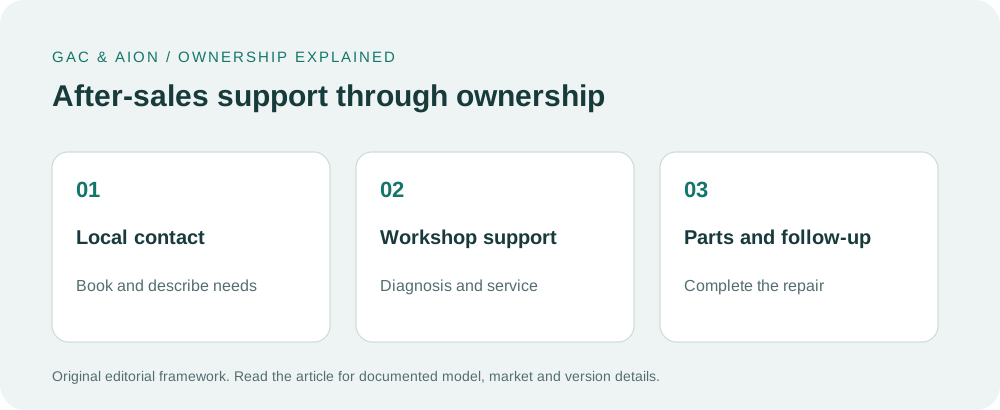
GAC global after-sales service is developing as an operating system for international growth: shared standards are combined with local distributors, workshops, parts facilities and region-specific ownership programs. GAC CARE in Thailand and GAC CARE+ in Europe illustrate this approach, while Spain’s documented escalation structure shows how support can connect the dealer to national and regional expertise. Our assessment is that “in local for local” is commercially meaningful when it describes these working relationships. Service becomes part of the market-entry model, supporting the vehicle through its usable life rather than ending the international effort at the point of sale.
Global expansion now includes the service organization
GAC global after-sales service deserves attention as part of the company’s international operating model. Selling a vehicle abroad creates a continuing relationship involving maintenance, technical questions, spare parts and customer communication. Those activities occur near the driver, even when the engineering organization and production network span several countries. A manufacturer therefore needs a way to connect international resources with local execution. The quality of that connection can influence how confidently a distributor introduces the product and how easily an owner uses it.
GAC’s May 2026 international service announcement describes common overseas service standards adapted to local characteristics. Its “in local for local” principle provides a useful frame for examining the business. The interesting question is how that principle is organized: which activities are standardized, which remain local and how information moves between the two. This article assesses that structure through published regional examples and original operational analysis, rather than treating a service slogan as a completed measure of customer experience.
Standardization is useful at the points of coordination
A service network benefits from shared definitions. A reported concern needs a consistent description, a parts request needs an identifiable vehicle and a completed job needs an understandable record. When those basic elements are compatible across organizations, local teams can exchange information without rebuilding the process each time. Standardization is particularly valuable at handoffs, where a dealer may need advice from an importer or a technical team elsewhere in the manufacturer’s network.
The owner does not need to see the whole organizational structure. The benefit appears through a clear booking, a coherent explanation and continuity between visits. For the manufacturer, consistent records can make it easier to identify recurring questions and improve training or documentation. These are analytical benefits of an organized service system, not claims that any particular internal GAC software has a specified function. The public evidence establishes the service approach; the operational interpretation explains why shared procedures can matter as a network grows.
Localization determines whether the service is usable
Common standards alone cannot specify every local interaction. Language, travel patterns, workshop locations and the structure of distribution differ among markets. A service model becomes useful when it fits those conditions. A regional call center, for example, needs to connect the driver to the appropriate local organization. A maintenance schedule must correspond to the sold vehicle. A warranty document must identify the applicable market and eligibility. These details give practical substance to localization.
The GAC CARE+ European announcement describes a service framework with regional warranty and assistance provisions, software support and an owner app. It also describes a planned local-language call-center rollout beginning in France. The rollout wording matters because a regional ambition and an already available local service are different stages. For industry analysis, the useful development is that service is being treated as part of the European proposition, with named components that can be implemented and evaluated over time.
Spain shows how roles can be distributed
GAC’s Spanish market introduction identifies Grupo Invicta as the local partner and describes technical escalation from dealer to importer to GAC’s European engineering team. This is a concrete example of a layered operating structure. The dealer remains close to the customer, the importer coordinates the national business and the regional engineering organization supplies specialist support. Each level can contribute a different kind of knowledge without requiring the customer to navigate all of them independently.
The commercial significance lies in the division of responsibilities. A local partner can understand the market’s distribution environment, while the manufacturer brings product knowledge and international resources. A well-defined escalation route can help the two work together on specific service questions. The announcement does not establish a universal repair time or customer-satisfaction result, and neither is needed to explain the model. The evidence shows an organization designed to connect local access with broader technical capability, which is a substantive part of market entry.
Parts architecture follows the geography of ownership
The service network must support vehicles after they have dispersed across a country or region. A regional distribution center can aggregate a broader range of inventory, while local stock can serve recurring requirements close to workshops. GAC’s European service information identifies Rotterdam as a regional parts hub, and the Spanish announcement also describes local stock. The two levels illustrate how inventory can be positioned around different service needs rather than concentrated only at the production site.
From an operational perspective, the task is to connect the correct part to the correct vehicle and appointment. Inventory quantity alone cannot describe that connection. Identification, ordering, transport and installation all contribute. This is why logistics measures should be interpreted at their stated stage. A dispatch measure can illuminate distribution performance, while a repair-completion measure would describe a wider process. Keeping those measures separate makes the analysis more precise and allows industry observers to evaluate the service system through the evidence actually available.
Thailand illustrates a market-specific service proposition
The Thailand Action 2.0 announcement introduced GAC CARE in the context of a wider local strategy. The published program connects customer assistance, warranty commitments, response and owner services. Its relationship with a particular market is important: it is an example of GAC developing a recognizable service proposition around local users, rather than simply extending a global product catalogue.
For a business audience, the lesson is that a service brand can organize several functions into a common owner-facing offer. The value depends on implementation through the relevant local terms and network. Thailand’s announced benefits should not be copied into another country’s buying guide as automatic entitlements. Instead, the case demonstrates the role of local service design in the broader expansion strategy. It gives the international business a way to connect vehicles, customer contact and support activities under a program that is visible in the market.
Service helps a distributor manage the complete product
A distributor introduces more than a physical vehicle. It also establishes a continuing route for information, maintenance and support. This can influence how the product is presented to customers: the sales team needs to explain the local service package, while the workshop needs the relevant technical preparation. The two functions are connected because promises made during purchase become questions handled during ownership. Clear internal coordination helps the local business give consistent answers.
GAC’s regional announcements are relevant because they identify service as an explicit component of the market offer. That can make the distributor’s role more concrete. Instead of relying only on the manufacturer’s scale or product features, the local organization can point to service structures and documentation. The strongest commercial outcome would be an ownership journey that remains understandable after delivery. This is an analytical criterion for evaluating the model, not a claim that every customer has already experienced an identical result across the international network.
A growing fleet changes the service workload
As more vehicles enter use, the mix of service needs develops over time. New owners ask handover and interface questions, while older vehicles accumulate scheduled maintenance and wear-related requirements. The network therefore needs to support different stages of ownership simultaneously. A market that begins with a small number of deliveries can require a broader service organization as the fleet grows and its age profile changes. This is a normal feature of automotive expansion.
The implication for GAC’s international model is that service capability should develop alongside the installed vehicle base. Workshop planning, parts assortment and training need to reflect the models actually operating locally. A new product introduction can change that mix, particularly when a market adds a different powertrain. Public announcements about service centers or regional support are useful signs of organizational development, while the continuing question is how those resources match local ownership needs. The appropriate unit of analysis is the operating fleet and its service requirements.
Digital functions can improve continuity between visits
An owner app or connected service can provide a convenient contact point, but its value comes from continuity with the physical service organization. A question raised digitally should reach an appropriate support route; information needed at a workshop should remain understandable to the owner. GAC’s European announcement includes app functions and software updates within its service framework. This places digital contact within the wider ownership relationship rather than treating it solely as a showroom feature.
The operational opportunity is to reduce repeated explanations and make the next step clearer. The same principle applies to a telephone call, an online form or a workshop conversation. A useful system preserves the relevant case information and identifies the responsible team. This does not require assuming capabilities that GAC has not publicly described. It is a framework for assessing implementation: digital features should help the customer reach support and understand the car, while local staff retain the human role in explanation and decision-making.
Useful measures should follow the whole journey
| Service layer | What evidence can usefully describe it |
|---|---|
| Access | Published local contacts and workshop availability |
| Technical support | Defined escalation and training arrangements |
| Parts | Stated inventory, fulfillment and dispatch measures |
| Appointment | Booking, authorization and completion records |
| Ownership continuity | Maintenance history and follow-up process |
These categories help separate infrastructure from outcomes. A new facility is evidence of investment. A published service process is evidence of organization. A customer outcome would require information about completed interactions. All can be relevant, but they answer different questions. An industry assessment becomes stronger when it follows the relationships among them instead of allowing one indicator to stand for the entire service experience. GAC’s public regional material offers several concrete starting points for that assessment.
The economic value is repeated use of a coherent network
Service infrastructure can support a market over multiple vehicle cycles. A workshop relationship established with one owner can continue through later maintenance and a future vehicle purchase. A regional technical process can support more than one model, provided the necessary product-specific information and preparation are in place. This creates a reason for manufacturers and local partners to invest in systems that remain useful as the product range evolves.
The potential benefit is not simply a larger number of outlets. It is a more coherent network in which the owner knows where to go and the local organization knows how to obtain the resources it needs. That coherence can reduce the organizational effort around a service request and improve the consistency of communication. These are plausible operating advantages, not calculated financial results for GAC. They explain why after-sales should be examined alongside distribution and product planning when assessing an automaker’s international development.
Clear decision responsibilities make the layers work together
A layered service network needs more than a diagram showing organizations. Each handoff should have a purpose. The local adviser needs to know which information is required before asking for technical input. The national organization needs to know which questions it can resolve and which should move to regional expertise. The workshop needs an understandable response that can be applied through the appropriate procedure. This is the operating logic behind a useful escalation structure.
For the customer, clear responsibilities reduce the need to navigate the organization. The owner can continue with a local contact while the network coordinates internally. For the manufacturer, defined handoffs can make recurring questions easier to recognize and help identify where documentation or training would be useful. These are general operational benefits of a coherent support structure; they are not claims about unpublished internal performance data. GAC’s Spanish example provides the publicly described layers, while this analysis explains why the relationships among them matter.
The same logic applies when a new model enters a market. The product introduction should connect the sales explanation, service documents and technical-support route. Each function needs to understand its part of the customer journey. A consistent local answer is easier to provide when the organizations share the relevant product information and know who is responsible for the next step. This gives the “in local for local” principle an operating interpretation: global resources are organized so that local people can act on them in a specific customer interaction, with a clear route from the initial question to an accountable response.
Our assessment of GAC’s direction
GAC global after-sales service shows an increasingly explicit connection between global standards and local execution. The European and Thai programs, together with the Spanish operating example, give substance to the “in local for local” approach. They identify roles and resources that matter after the sale: customer contact, workshop support, technical escalation and parts distribution. This is a useful development for understanding how the company intends to support its expanding international business.
Our assessment is that the most important feature is the integration of those roles. The next level of evaluation should follow the actual local ownership journey, using the applicable program and documents rather than a generalized global promise. For buyers, that means a practical support plan. For industry observers, it means examining whether the service organization develops alongside the fleet it supports. In both cases, the value of the international model is ultimately expressed through clear, dependable local interactions.
Questions buyers ask
What does in local for local mean in after-sales?
It describes adapting an international support framework to the local market through distributors, workshops, documents, language and service arrangements.
Why are regional parts centers relevant?
They can support a wider inventory and distribution network, while local stock and workshops connect that supply to individual service jobs.
Explore the subject further
Continue with these related guides:
- GAC global after-sales service: How Service Capacity Supports a Growing Overseas Vehicle Fleet
- GAC global after-sales service: The Commercial Value of Supporting the Whole Ownership Cycle
GAC Auto Guide: GAC global after-sales service: The Local Owner Journey from Handover to the First Service.
AI Companion Robot Guide: GAC global after-sales service: A Clear Support Path for Connected-Car Questions.
Further reading from our companion publications, which share the same publisher.
Sources & context
- GAC: overseas service framework, 27 May 2026 ↗
- GAC: GAC CARE+ European launch, 12 October 2026 ↗
- GAC: Spain launch and after-sales organization, 4 June 2026 ↗
- GAC: Thailand Action 2.0 and GAC CARE, 26 March 2026 ↗
Manufacturer specifications, company announcements and independent assessments are linked above. Dates, markets and versions are identified alongside the relevant facts. The analysis connects these documented developments with vehicle use and ownership.
Read our editorial methodology