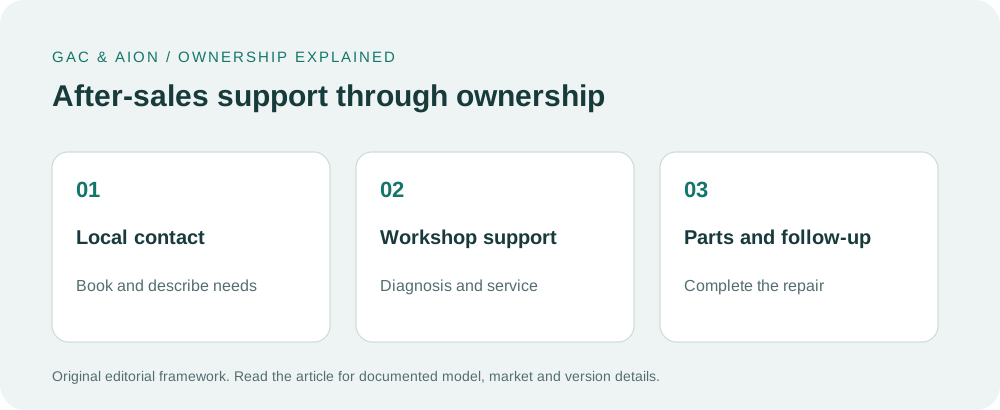
GAC global after-sales service is increasingly important as the company’s overseas vehicle base expands. More deliveries create a continuing need for maintenance capacity, parts support and clear customer communication. GAC’s published international service framework, European parts infrastructure and regional programs show how the company is organizing that support. Our assessment is that the most useful way to evaluate the strategy is through the relationship between the local fleet and the local service network. The relevant question is how workshop access, technical preparation and inventory develop alongside the vehicles customers actually use, rather than how large a network looks in isolation.
A vehicle sale creates years of service demand
GAC global after-sales service is part of the infrastructure needed to support international growth over time. A new delivery adds a vehicle to the local fleet, and that vehicle continues to generate ownership needs after the sales month ends. Some needs are predictable, such as scheduled maintenance. Others involve technical questions, replacement items or assistance. The service organization must handle the combination while making the process understandable to owners with different driving patterns and levels of familiarity.
This gives after-sales a distinct role in expansion. A sales network can introduce the brand, while a service network supports its continued use. The two develop on different timelines. Deliveries may rise quickly following a launch, but maintenance demand continues as the fleet ages. GAC’s international service overview is relevant because it describes local service capabilities as part of the overseas strategy. Our analysis focuses on how those capabilities relate to the installed vehicle base.
Fleet size and fleet age answer different questions
The number of vehicles in use indicates the broad scale of potential service demand. Their age profile helps explain the type of demand. A recently launched market may have many owners learning functions and arranging initial appointments. A more established market also handles later scheduled visits and a broader range of wear-related work. These patterns can coexist as new deliveries join older vehicles. Planning only around current-month sales would miss that continuing accumulation.
A useful analytical picture therefore includes both the size and the age of the local fleet. The picture does not require assuming that every vehicle generates the same workload. Models, powertrains, usage and published maintenance requirements differ. The practical task is to understand the actual mix. For GAC’s international business, this means that service development should be interpreted in relation to the vehicles operating in each market, rather than only the number of countries in which the brand has a presence.
A simple planning example explains the capacity question
Consider an illustrative market with 12,000 vehicles in use. If a planning assumption assigns one scheduled visit per vehicle during a year, that implies 12,000 planned visits before additional requests. This is a hypothetical example, not GAC operating data or a statement of its maintenance requirements. Dividing that workload among workshops gives an initial sense of scale, but the calculation still needs to account for opening days, job duration and the distribution of owners.
Suppose many vehicles were delivered during the same season. Their time-based service reminders might cluster, creating a busier period even when the annual total appears manageable. A service organization can respond through appointment planning, owner reminders and workshop scheduling. The important lesson is that capacity depends on timing as well as volume. A network can look sufficient on a yearly average while still needing careful coordination at local peaks. This is why an effective service model includes everyday operating processes, not only facilities.
Geography changes what access means
Two markets with the same fleet size can need different service arrangements. A dense urban fleet may be close to several workshops, while a dispersed fleet creates longer journeys for some owners. Road connections, working hours and travel patterns affect practical access. Counting locations therefore gives only part of the picture. A more useful assessment considers where the vehicles are used and how their owners can reach an appropriate service point.
GAC’s “in local for local” principle is relevant here because service geography is inherently local. The manufacturer can supply shared standards and technical resources, while local partners organize access around the market. For an owner, useful access might mean a convenient booking window or a clear support route while traveling. For a distributor, it means locating resources where the fleet needs them. These are different perspectives on the same operating question: can the service network connect efficiently to the vehicles already in use?
Parts demand follows the product mix
The inventory required by a service network depends on the models and configurations it supports. Frequent maintenance items and less common repair components have different demand patterns. A market with several powertrains also needs the appropriate technical preparation and parts identification. This makes product planning and service planning closely connected. Adding a model expands the customer offer and adds another set of support requirements to the local operation.
GAC’s European service announcement identifies regional parts support through Rotterdam, while the Spanish launch describes local inventory alongside that regional structure. The combination offers a useful model for serving varied demand. Local stock can address recurring needs, and regional distribution can support breadth. The relevant question is how these levels coordinate around the actual vehicle mix, rather than treating inventory volume as a complete description of service readiness.
Training is part of capacity, not a separate decoration
Workshop capacity includes people who can carry out the relevant procedures, interpret technical information and explain the result. A physical service bay is useful only when it is supported by suitable staff, equipment and knowledge. As products change, technical preparation needs to follow the functions owners will use. This is particularly important when a market introduces a powertrain or connected feature that is new to its local portfolio.
The Spanish example is informative because its published technical route connects the dealer with national and European support. A clear escalation structure can complement local capability when a question requires specialist input. It does not replace workshop preparation; it extends the resources available to the local team. From an industry perspective, the combination is what matters. A growing network needs both routine competence close to the customer and an organized path for questions that benefit from wider product expertise.
Customer communication also consumes and creates capacity
A service organization spends time answering questions, confirming appointments and explaining completed work. Clear communication can help that time produce useful results. If the owner supplies accurate vehicle details and a specific observation, the adviser can prepare the appointment more effectively. If the adviser gives a clear next step, the owner has less reason to repeat the same enquiry through several channels. This is a practical operating benefit of a coherent service process.
GAC Mexico’s published service sequence separates booking, reception, work, delivery and follow-up. The sequence illustrates how the customer journey can be organized into understandable stages. Each stage has a different information need. A service network that treats those handoffs carefully can support continuity without making the owner understand the entire internal organization. For an expanding fleet, this matters because small inefficiencies repeated across many interactions can become substantial operational work.
Digital contact should connect to a responsible team
An app or online form can make it easier to start an enquiry, but the request still needs a destination and a next step. The most useful digital service experience preserves relevant information and connects it to the local organization that can act. GAC’s European program includes an owner app and ongoing software support, placing digital functions within the broader after-sales proposition. The practical value should be assessed through how these features fit the local support process.
A growing fleet may include owners who prefer different channels. Some will use an app, others a telephone call or a workshop visit. The service system should make those routes understandable rather than assuming one method suits everyone. This is an analytical standard for useful service design, not a claim about an unpublished GAC system. It explains why a recognizable local contact remains important even when digital functions expand. Technology can organize information, while people still provide explanation and judgment in the customer relationship.
Growth metrics and service metrics should be read together
GAC’s October export release reports rising own-brand exports during 2026. Such figures describe the expansion of international vehicle flows, while service information describes support infrastructure. They are related but not interchangeable. Export growth cannot by itself prove workshop availability in a particular town, and a service-center announcement cannot by itself establish the number of owners it supports.
Reading the two types of evidence together gives a more complete picture. Where vehicle presence expands, observers can examine the accompanying distribution, parts and support arrangements. The question is not whether every market follows the same timetable. It is whether the local support structure is developing in a way that corresponds to the product portfolio and ownership base. That is a more informative approach than using a global growth percentage as a proxy for the entire customer experience.
Four measures clarify the operating picture
| Question | Useful measure or evidence |
|---|---|
| Where are support needs arising? | Local fleet and vehicle mix |
| When will work be needed? | Published maintenance triggers and appointment patterns |
| What can the network deliver? | Staff, workshop, parts and technical-support capability |
| How does the owner experience it? | Access, clear updates and completed-work records |
These measures can be considered without inventing a single universal service score. They describe different parts of the same system. A strong assessment looks for alignment: the right capability in the right place at a useful time. GAC’s regional programs provide starting evidence about how the company is organizing that system, while local implementation determines the experience for a particular vehicle. The analytical value lies in connecting those levels rather than collapsing them into one headline.
Service investment can support future product introductions
Once a market has established useful service processes, later product launches can build on that foundation. The local organization already has customer-contact routines, workshop relationships and a route to the manufacturer. New models still require their own preparation, documentation and parts support, but they enter an operating structure rather than an empty space. This can make service development a continuing asset for the international business.
The same idea applies to the owner relationship. A driver who understands how to book service and access records has a familiar route for the next vehicle. That continuity can be commercially meaningful, although public infrastructure announcements alone do not quantify customer retention. The sensible conclusion is narrower: a coherent after-sales system can serve repeated ownership cycles and successive products. This is a reason to analyze GAC’s regional service development as part of long-term market participation, rather than as an isolated launch benefit.
Service demand can arrive after the sales headline has faded
Consider an illustrative market where many vehicles are delivered during a successful launch period. The initial attention focuses on orders and handovers. Months later, those same vehicles begin reaching their scheduled service triggers, while additional vehicles continue to enter use. The service organization now supports both new-owner questions and recurring maintenance. The workload reflects the accumulated fleet, not only the latest sales month. This is why after-sales planning needs its own time horizon.
The example also explains the value of knowing the local product mix. Vehicles with different schedules and use patterns may create different appointment needs. A network can prepare by understanding the relevant fleet, anticipating ordinary service milestones and giving owners clear booking information. The planning method is general; it does not imply a particular GAC service interval or a measured demand forecast. Its purpose is to show why installed-base information is useful when interpreting international growth.
A wider parts network can support that preparation, but the local workshop remains the place where timing becomes an appointment. The adviser coordinates the customer, staff and required materials. If a scheduled task and an additional question are recorded in advance, the visit can be planned with a clearer scope. This makes the information flow part of capacity itself. An overseas operation becomes more capable when it connects fleet knowledge, technical preparation, inventory and customer communication. GAC’s regional service development is therefore best understood as a set of operating relationships that must remain aligned as the local vehicle base expands and ages, rather than a fixed list of facilities established once at launch.
Our assessment: match the network to the fleet
GAC global after-sales service is most meaningfully evaluated through its relationship with the local vehicles it supports. Regional programs, parts facilities and escalation structures are concrete evidence of organizational development. Their practical value depends on how they connect to appointments, technical questions and maintenance needs as the overseas fleet grows and ages. This makes service capacity a central component of international expansion.
Our view is that GAC’s “in local for local” approach should be assessed at this operating level. The useful outcome is a support network whose location, skills, information and inventory fit the local product mix. Buyers can test that proposition through their nearest appropriate workshop and local documents. Industry observers can follow the wider alignment between deliveries and support capability. Both perspectives focus on the same principle: growth becomes more durable when the organization continues to support the vehicles already on the road.
Questions buyers ask
Why does vehicle age matter to after-sales planning?
Different ownership stages create different mixes of handover questions, scheduled maintenance and later service requirements.
Does a larger outlet count automatically mean better local access?
Outlet numbers need to be considered alongside geography, capabilities, opening arrangements and the location of the vehicles they support.
Explore the subject further
Continue with these related guides:
- GAC global after-sales service: Why Local Service Is Becoming Part of GAC’s Global Operating Model
- GAC global after-sales service: The Commercial Value of Supporting the Whole Ownership Cycle
GAC Auto Guide: GAC global after-sales service: The Local Owner Journey from Handover to the First Service.
AI Companion Robot Guide: GAC global after-sales service: A Clear Support Path for Connected-Car Questions.
Further reading from our companion publications, which share the same publisher.
Sources & context
- GAC: overseas service framework, 27 May 2026 ↗
- GAC: GAC CARE+ European launch, 12 October 2026 ↗
- GAC: Spain launch and after-sales organization, 4 June 2026 ↗
- GAC Mexico: service process and maintenance schedules, accessed 29 October 2026 ↗
- GAC: January–September 2026 own-brand exports, 5 October 2026 ↗
Manufacturer specifications, company announcements and independent assessments are linked above. Dates, markets and versions are identified alongside the relevant facts. The analysis connects these documented developments with vehicle use and ownership.
Read our editorial methodology