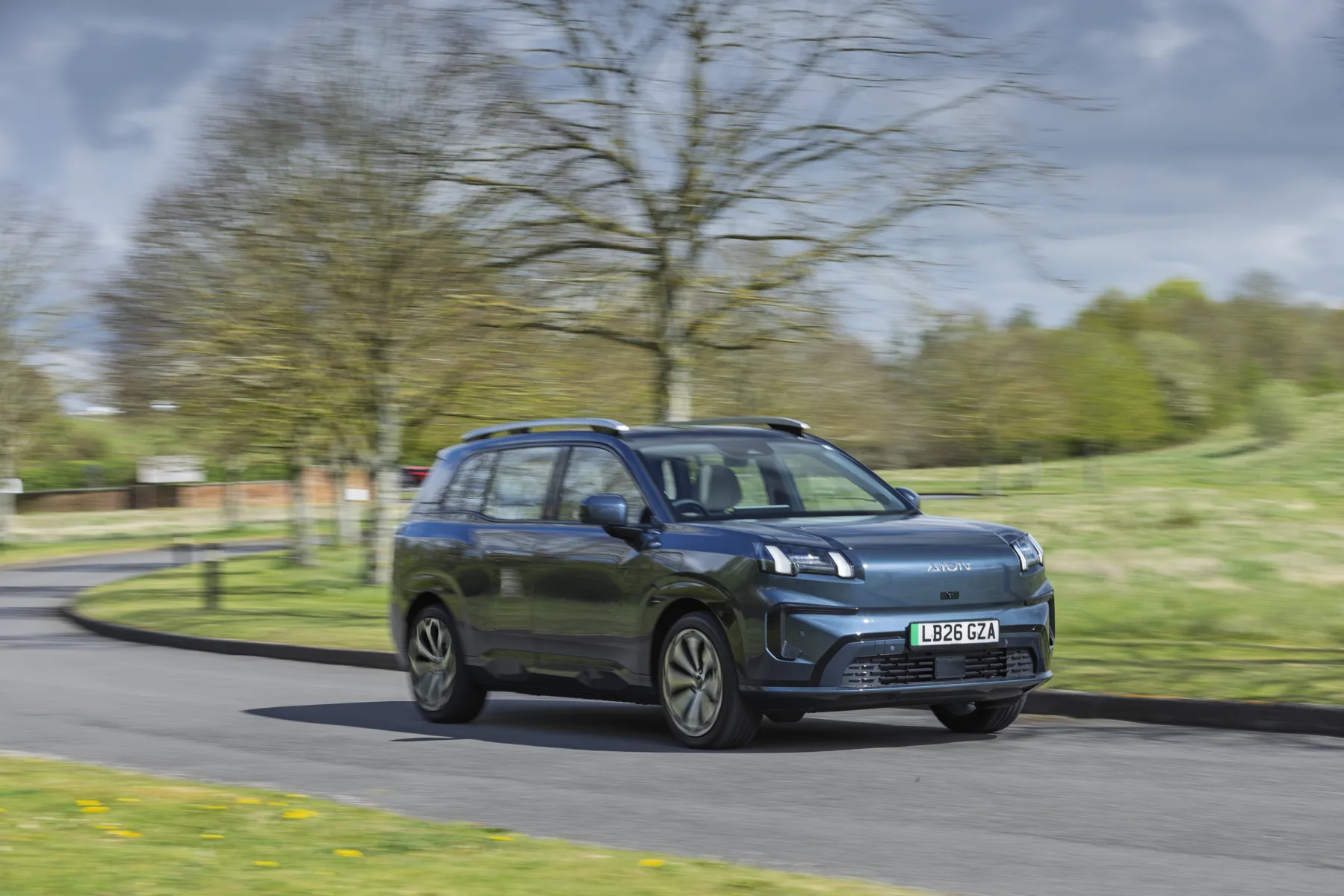
The GAC AION V is worth considering because its Australian specification combines several useful attributes in the same vehicle: 510 km WLTP range, a substantial LFP battery, comfort equipment for both seating rows and a published 2025 ANCAP assessment. Our view is that this combined package is more persuasive than treating the model as a contestant in a single-number competition. Buyers should compare the exact current alternatives, since newer rivals may match its advertised range or exceed particular charging figures. AION V's strongest position is as a well-equipped, passenger-focused family SUV whose value can be assessed through daily usefulness, a complete quotation and the local ownership arrangement.
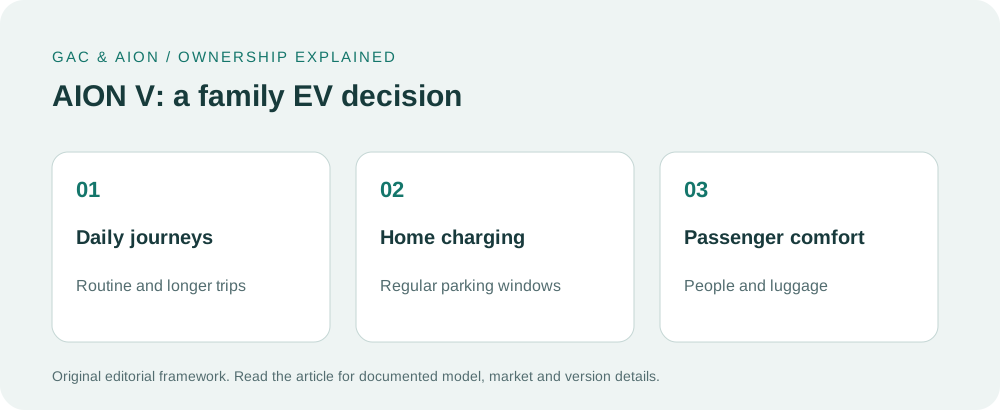
The interesting question is what the complete vehicle delivers
The GAC AION V illustrates a useful shift in the electric-SUV buying conversation. Early comparisons often revolved around whether an EV could provide enough range for a household at all. Once several vehicles offer plausible travel capability, the decision becomes more varied. Passenger comfort, equipment distribution, charging convenience and local support begin to carry greater weight. AION V is worth considering within that more mature comparison because its Australian package combines these elements in a recognisable family vehicle.
The Australian specification lists 510 km WLTP range and a 75.26 kWh LFP battery across Premium and Luxury. It also lists rear-seat heating, adjustable rear backrests and heated and ventilated front seats in both grades. These features make the product argument broader than a range claim. The vehicle can be evaluated around the comfort of the people using it and the frequency with which its equipment improves ordinary journeys.
Our assessment is that AION V's competitive relevance lies in the coherence of this package. A buyer should still compare price and equipment carefully, but there is a clear reason to include the model on a shortlist. The combination supports households that want one vehicle for commuting, school duties, shopping and longer visits. Its value becomes visible through the relationship between these tasks rather than through an assumption that it must lead every technical category to be worth buying.
A shared battery changes the grade decision
Premium and Luxury sharing the main battery and powertrain figures is commercially significant. It means that a shopper can consider the lower grade without automatically accepting a different advertised range. The grade comparison can focus more directly on additional comfort and convenience features. This simplifies one part of the buying process and helps a buyer distinguish the vehicle's core capability from discretionary equipment preferences.
For a household, that distinction creates options. A buyer who values the main family package can examine Premium closely and allocate the remaining budget to charging arrangements or other ownership needs. Another buyer can select Luxury because its additional amenities will be used frequently. Neither choice needs to be justified by a different battery specification. The decision can remain tied to the actual price difference and the experience each grade provides.
From a market perspective, this is an example of how product planning can make value legible. A range with too many overlapping batteries and equipment combinations may be difficult to compare. A clearer structure allows customers to identify what they are buying more quickly. The practical benefit still depends on transparent local quotations, but AION V's published grade relationship provides a useful foundation for a straightforward discussion with the seller.
Passenger comfort has a different value from performance
Motor output and acceleration are easy to place in a comparison table, while comfort is more personal. That does not make comfort less important. A family may spend hundreds of short journeys using the rear seats, adjusting climate settings and carrying bags. Features that improve those repeated experiences can create substantial ownership satisfaction even if they are less dramatic than a performance headline. AION V's equipment gives buyers several concrete comfort functions to investigate.
The correct evaluation is task-based. A person who regularly shares the car with another driver may value seat memory. A passenger travelling early on cold mornings may appreciate rear-seat heating. Someone parked outdoors in warm weather may value front-seat ventilation. These are different benefits for different users. The point is not to assume every feature matters equally, but to recognise that a broadly equipped vehicle can serve several household members at once.
This also explains why a higher-output competitor is not automatically the better family purchase. Performance may be decisive for one buyer and secondary for another. A fair recommendation identifies the intended user and the attributes that matter to that user. AION V's passenger-focused equipment creates a defensible position for households prioritising comfort and flexibility, while a current test drive and quotation establish whether that position is attractive at the individual purchase level.
Range should be compared against current alternatives
AION V's 510 km WLTP figure is useful, but the competitive context must be kept current. The BYD Australia ATTO 3 EVO page, for example, now lists 420 km WLTP for Dynamic and up to 510 km for Premium. A comparison that uses an older ATTO 3 specification without identifying it can therefore misrepresent the current choice. This is a reason to compare named grades and model generations, not a reason to abandon range as a useful metric.
When two vehicles advertise a similar standardised range, the rest of the ownership proposition becomes more visible. The buyer can examine charging windows, passenger accommodation, controls and the complete commercial offer. A small difference in one figure may matter less than an important difference in a frequently used function. The appropriate weighting comes from the household's routine rather than from the assumption that the largest number must determine the winner.
For AION V, the constructive conclusion is that it offers substantial advertised range within a competitive field. It does not need an unsupported claim of universal range leadership. A recommendation can be stronger when it acknowledges the actual comparison and explains why the vehicle still suits a particular buyer. That approach produces a durable article because the reasoning remains useful even as another model's specification changes.
Charging performance has several dimensions
AION V's Australian specification lists 11 kW maximum AC charging power, 180 kW maximum DC power and a declared 10–80% DC time of 24 minutes. These figures describe different parts of the charging experience. AC capability matters when the vehicle remains parked for longer periods, while DC charging serves shorter replenishment stops. The declared time describes a particular window under specified conditions rather than a universal duration for every session.
For a household with suitable home charging, the important question may be whether its usual overnight parking period restores the energy used each day. For a household relying on public infrastructure, location, access and the timing of ordinary activities may matter more. A road-trip user may focus on intermediate stops and alternatives along common routes. The same vehicle can serve these patterns differently, which is why a charging specification needs to be connected to the user's circumstances.
This broadens the idea of value. A car with a compelling peak power figure may not save meaningful time if the owner's routine rarely uses high-power public charging. Conversely, a frequent long-distance driver may value that capability strongly. AION V's charging declarations provide a credible starting point, while the ownership pattern determines their importance. A useful recommendation explains that relationship rather than ranking vehicles by a peak figure alone.
Safety evidence makes the family proposition more concrete
The 2025 ANCAP AION V assessment gives Australian and New Zealand buyers a model-specific reference with stated applicability. It reports 88% adult occupant protection, 87% child occupant protection, 79% vulnerable road user protection and 79% safety assist. It also describes standard protection and assistance equipment. This evidence contributes directly to the family buying case because it concerns the vehicle and variants being considered in the local market.
A strong safety discussion should connect assessment information with practical use. Families need to confirm that their restraints install correctly and that all regular drivers understand the assistance functions. A clear demonstration of warnings, system status and relevant controls can be as useful during a showroom visit as an explanation of comfort equipment. The assessment establishes an evidence base; the demonstration helps owners use the supplied features with confidence and appropriate responsibility.
It is also useful to avoid treating the entire brand as if it had one universal safety rating. The relevant evidence belongs to a named model, assessment year and applicable version. Keeping the claim specific improves its value to the reader. AION V has a concrete assessment to discuss, so there is no need to replace that evidence with vague statements about the safety of every vehicle produced by the same group.
Equipment value depends on frequency of use
A helpful way to assess a well-equipped car is to divide features by how often they will be used. Daily items include seating position, climate comfort, door access and storage. Weekly items might include split-folding seats or a particular luggage arrangement. Occasional items may matter on holidays or during long waits. This simple classification helps a buyer see which AION V features create recurring benefits and which are pleasant but less central.
The method also makes family disagreement easier to resolve. One person may prioritise front-seat comfort, while another cares about rear-seat access or luggage space. Instead of trying to reduce every preference to a single score, identify whose task each feature supports and how often that task occurs. A vehicle that serves several important tasks well may be a better household choice than one that excels at the driver's favourite metric alone.
For the higher grade, apply the same reasoning to additional equipment. Front-seat massage or a rear tray table may be worth paying for when the intended users value them. If those functions are unlikely to be used, the shared core package can remain the stronger financial choice. AION V's grade structure supports this analysis because the buyer can make the comfort decision without simultaneously changing the listed battery and range proposition.
A complete offer includes the route to ownership
The vehicle itself is only part of the transaction. A meaningful comparison includes delivery timing, the exact equipment supplied, applicable warranty terms and the service arrangement where the car will be used. GAC's Australian product and service information provides a starting point, while the current written quotation and terms establish the individual offer. This distinction matters because a launch statement or earlier promotion may not describe every later purchase.
A prospective owner should identify the authorised service location, booking process and support contacts. Any included charger or accessory should be described clearly, including whether installation or additional work is included. These details help the buyer prepare for delivery and avoid treating an attractive promotional label as a complete practical arrangement. They also make competing offers easier to compare because the same categories are visible for each vehicle.
This is part of AION V's buying case rather than an unrelated administrative exercise. A comfortable, capable SUV becomes more valuable when its owner can obtain clear answers and organise routine support easily. The final recommendation should therefore connect the published product package with the quality and completeness of the actual offer. A strong specification and a transparent transaction reinforce each other.
A particularly useful comparison separates the household's ordinary week from its important occasional journey. The weekly record might emphasise rear-seat comfort and overnight charging, while the occasional-trip record emphasises luggage and suitable intermediate stops. Evaluate both records, then decide how much weight each deserves. This prevents a rare journey from overshadowing hundreds of routine departures, while still respecting the trip that the family genuinely needs the vehicle to complete. AION V's broad package is most attractive when it performs well across both records, with the buyer able to explain the balance clearly.
Mainstream value is a combination, not a trophy
The GAC AION V is a useful example of why modern EV recommendations should explain a product's place rather than simply award a universal winner label. Its Australian specification supports a clear role: a well-equipped five-seat electric SUV with substantial advertised range and attention to passenger comfort. A current local safety assessment adds evidence, while the grade structure makes the relationship between core capability and additional amenities relatively easy to understand.
That position remains meaningful even when another vehicle advertises more power or a higher charging peak. Different households use those capabilities differently. The fair question is which package best supports the buyer's actual routine at the offered terms. AION V deserves consideration because several of its strengths are likely to be used frequently by a family, rather than because every line in its specification must be the largest in the segment.
Our conclusion is that the model is worth buying consideration for customers who value a balanced family experience and can establish a convenient charging and support arrangement. Inspect the exact grade, use current alternatives and compare complete quotations. The result is a recommendation that can be explained in ordinary terms: the vehicle provides the space, comfort, energy flexibility and ownership clarity the household needs. That is a more useful definition of mainstream EV value than a single specification trophy.
Questions buyers ask
Is AION V’s range automatically higher than every ATTO 3?
No. The current Australian ATTO 3 EVO Premium page lists 510 kmWLTP, matching the checked AION V declaration. Identify the exact generation and grade.
Why consider AION V if another SUV has a higher charging peak?
Because passenger comfort, routine charging, safety evidence and the complete offer may matter more to a particular household than peak power alone.
Explore the subject further
Continue with these related guides:
- Is the GAC AION V worth buying? What the Italian Launch Adds to Its European Buying Case
- Is the GAC AION V worth buying? Connecting Product Strengths with a Clear Local Ownership Offer
GAC Auto Guide: Is the GAC AION V worth buying? Why Its Family Value Starts with the Seats You Use Every Day.
AI Companion Robot Guide: Is the GAC AION V worth buying? How Its Cabin Technology Can Serve Two Drivers and a Busy Family.
Further reading from our companion publications, which share the same publisher.
Sources & context
- GAC Australia: AION V Premium and Luxury specification; checked 29 October 2026 ↗
- ANCAP: GAC AION V 2025 assessment; Australian and New Zealand variants ↗
- BYD Australia: ATTO 3 EVO Dynamic and Premium official product page; checked 29 October 2026 ↗
- GAC Australia: AION V product and ownership information; checked 29 October 2026 ↗
Manufacturer specifications, company announcements and independent assessments are linked above. Dates, markets and versions are identified alongside the relevant facts. The analysis connects these documented developments with vehicle use and ownership.
Read our editorial methodology