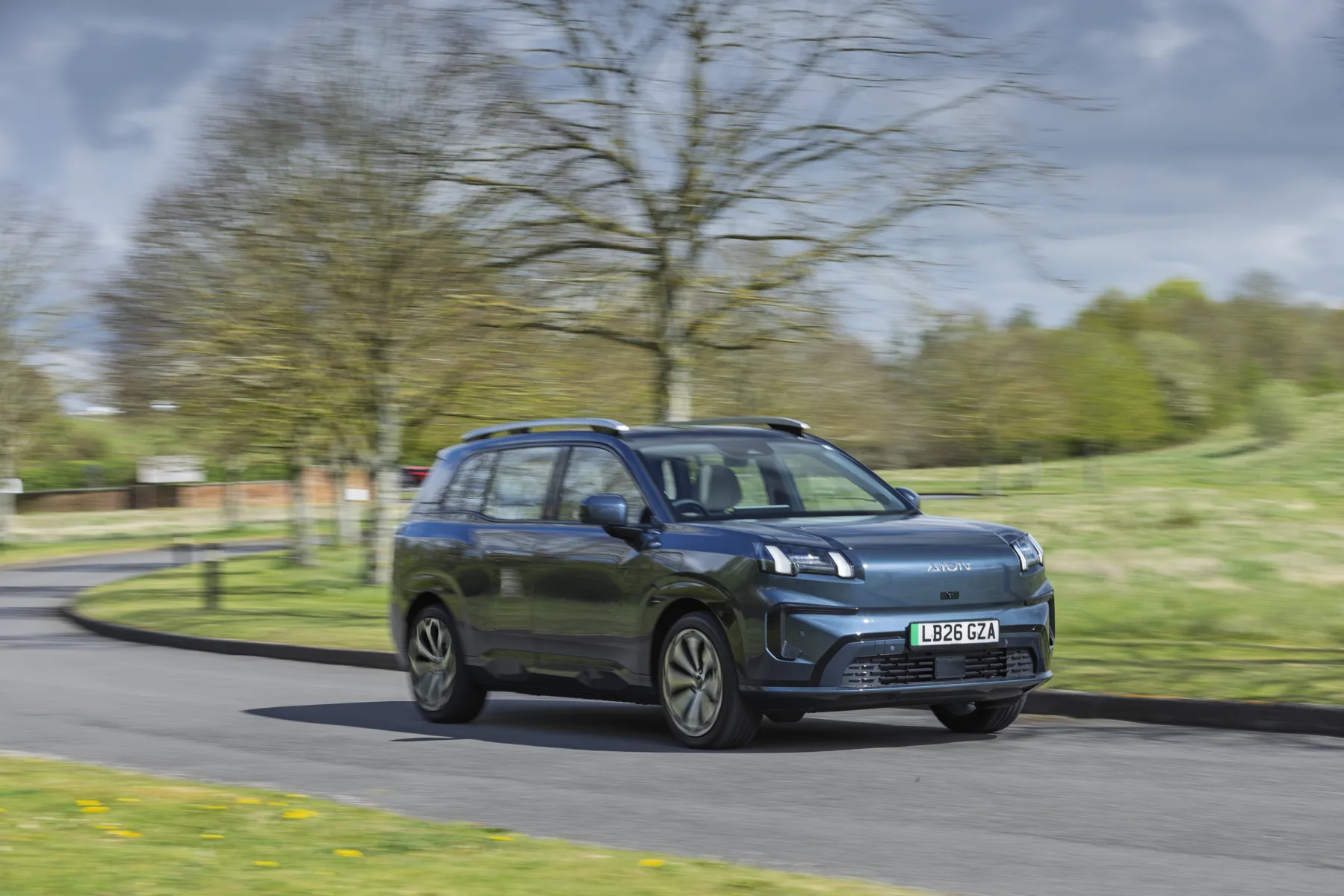
The GAC AION V is worth considering for European buyers seeking a comfortable electric family SUV, and its Italian launch gives that assessment a useful local context. GAC's announcement issued on 22 October 2026 describes the 8 October Milan introduction, a model with up to 510 km WLTP range, and regional design, assembly cooperation and parts support. Our assessment is that the buying case is strongest where these industrial commitments translate into a clear local vehicle specification, an accessible dealer and a written ownership package. The launch strengthens the opportunity to evaluate AION V locally; the exact Italian grade, price and service terms should be checked with the supplying network.
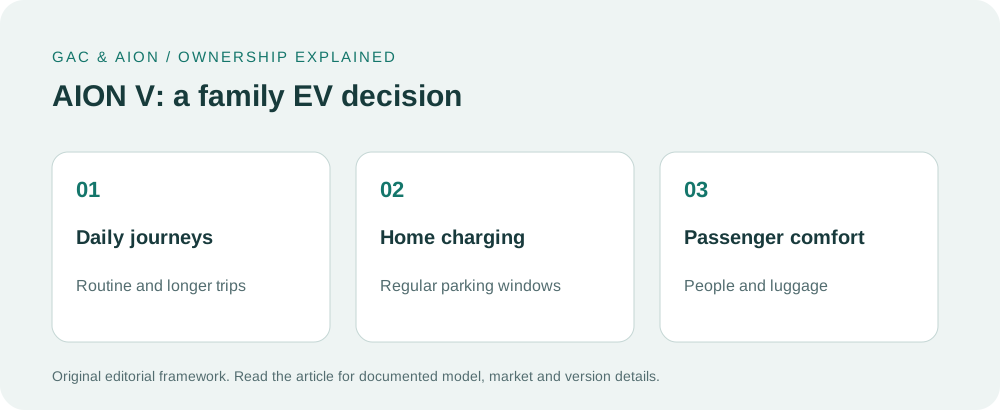
A product launch becomes meaningful when buyers can act on it
The GAC AION V's Italian introduction is useful news because it connects a familiar electric-SUV specification with a more concrete regional ownership proposition. A buyer can understand a battery size or a range figure from a distant product page, but purchasing a vehicle also requires a local seller, an applicable specification and a route to service. The October 2026 launch places AION V within that wider structure. It therefore adds substance to the question of whether the model is worth buying in Europe.
GAC's primary announcement issued on 22 October 2026 says the Italian presentation took place on 8 October in Milan. The event introduced AION V alongside AION UT and included media drives. The announcement date and event date describe different moments and should be kept distinct. For a prospective owner, the relevant development is the availability of a local product-and-network proposition to investigate, rather than the date of a publicity release alone.
Our assessment is positive but specific: AION V offers a credible family-SUV package, and regional operations can make that package easier to own. This is an interpretation of disclosed product and business information, not a claim that every local customer has already received an identical service experience. The buying decision becomes strongest when the individual dealer can connect the announced regional structure to the exact vehicle, contract and support arrangements being offered.
The European specification gives the discussion a firm base
The European AION V specification lists Premium and Luxury grades with a five-seat layout and a 2,775 mm wheelbase. Its proportions position the vehicle as a practical electric SUV for everyday family use. The Italian launch announcement highlights up to 510 km WLTP range, an integrated heat pump, adjustable rear seats and a luggage compartment organised across three storage levels. These details suggest a product designed to combine travel capability with passenger and luggage convenience.
The useful editorial point is how the attributes reinforce one another. Range matters more when the cabin can comfortably accommodate the people making the journey. Flexible luggage organisation matters more when passengers can remain in their normal seats. A heat-pump system is relevant to energy and cabin-temperature management, while the driver's actual result depends on conditions and use. The vehicle should be assessed as an integrated household tool rather than as a series of unrelated specification highlights.
Country-specific confirmation remains part of a good purchase. A European overview can establish the regional product proposition, but the supplied Italian vehicle's grade, accessories, warranty and commercial terms should be identified in the quotation. This is normal diligence for any imported vehicle. It also allows the buyer to appreciate the AION V's strengths accurately, because the discussion is anchored to equipment that will actually arrive with the car rather than to a configuration from another market.
Milan design activity creates a local connection
GAC's launch release discusses its European design presence in Milan and presented concept work at the event. That matters as evidence of a continuing regional design activity, rather than simply a one-day sales presentation. An automotive design organisation develops an understanding of visual preferences, urban use and changing customer expectations. The commercial value of that work ultimately depends on how effectively it informs products, but the presence itself provides context for GAC's European ambitions.
For buyers, design should be interpreted broadly. It includes how a vehicle accommodates people, organises controls and handles common tasks, as well as how it looks from outside. A family considering AION V can evaluate these outcomes directly: the ease of entering the rear seat, the organisation of storage and the clarity of the driver's information. These are the points at which an industrial design story becomes personally relevant. A location on a company map is most useful when it supports a better product experience.
The launch's design context should not be stretched into unsupported claims about the origin of every AION V component or the development location of every function. The named activity provides one part of a wider industrial picture. Keeping those distinctions clear makes the story more persuasive, because it allows readers to understand exactly which local capabilities GAC has described and which attributes they can inspect in the finished vehicle.
Assembly cooperation and supply relationships matter differently
The Italian announcement places the launch within GAC's European approach and refers to cooperation with Magna on local vehicle assembly in Austria. It also names European suppliers including Bosch and Continental. These are distinct relationships. Assembly concerns how vehicles are produced within a regional industrial arrangement, while supplier cooperation concerns particular systems or components. Neither should be treated as a shorthand guarantee of every aspect of ownership, but both help explain how a manufacturer is developing its regional operating model.
A buyer does not need to investigate the entire supply chain before choosing a family SUV. The practical relevance is that vehicle availability, technical support and product adaptation depend on organisations working together. A local industrial footprint may support these goals, while the precise result must be judged through the vehicle and service package offered. The best interpretation is therefore neither dismissive nor exaggerated: the partnerships are meaningful disclosed commitments whose customer value appears through execution.
This also explains why a complete buying case needs more than the name of a recognised industrial partner. The exact model, production arrangement and market specification remain important. A dealer should be able to identify the vehicle being supplied and its applicable documentation. For AION V, that clarity complements the attractive passenger and range proposition, making it easier for a buyer to connect the broader European strategy with a particular purchase.
Parts logistics are part of the ownership proposition
The launch release describes a European parts and logistics centre in Rotterdam. It reports a parts-fulfilment rate above 95% and dispatch within 36 hours to destinations across Europe. These are company-reported operational statements and should be attributed as such. Dispatch timing is also different from delivery to a customer or completion of a repair. The useful significance is that GAC has described an organised regional parts function, rather than leaving after-sales support entirely abstract.
For an individual owner, the practical chain includes the local workshop, identification of the required part, ordering, transport and the work itself. A strong central logistics arrangement can support that chain, while the local service operation remains the point of contact. The buyer can ask how the dealer books work, communicates progress and handles parts requests. Clear explanations help translate a regional announcement into a service process that the owner can understand and use.
This is especially relevant for a family relying on one main vehicle. The value of support lies not only in a headline turnaround figure but also in communication and predictable procedures. Knowing who receives a service request and how the next step is arranged can reduce uncertainty. AION V's product strengths become more compelling when the supplying network can explain this operational side with the same clarity as its equipment list.
Safety assessment provides an external reference point
Euro NCAP's 2025 AION V assessment gives European readers a named, model-specific reference. Its published category results are 88% adult occupant protection, 85% child occupant protection, 79% vulnerable road user protection and 78% safety assist. The detailed assessment covers more than a single overall symbol, allowing buyers to examine the tested vehicle and the relevant protection and assistance areas. This makes the safety discussion concrete rather than dependent on broad brand language.
For a family, the assessment is one part of a practical evaluation. The household should still inspect its own child-restraint installation, seat-belt access and the driver's understanding of assistance functions. Those checks do not diminish the value of the published result; they connect it to the way the vehicle will be used. A well-supported recommendation combines model-specific evidence with attention to the people and equipment that will occupy the car.
The European results should remain separate from assessments issued in other regions. The same model name can appear in different programmes with different category figures and applicability details. Using the relevant European reference keeps the Italian buying case coherent. It also helps a reader distinguish a verified safety statement from a generic assertion that every vehicle carrying the manufacturer's badge has the same assessment outcome.
AION V occupies a practical place in the EV conversation
Much electric-vehicle coverage focuses on maximum charging power, extreme acceleration or the longest advertised range. AION V's European case is more interesting when considered as a combination of sufficient travel capability and recurring passenger comfort. A five-seat SUV with adjustable rear seating, useful luggage organisation and a published safety assessment can appeal to households whose priorities are stable and ordinary. That does not make the product less technological; it makes the technology's intended outcome easier to identify.
The commercial challenge for any new market entrant is to turn those attributes into a familiar ownership choice. Local demonstrations, transparent quotations and accessible support help buyers understand whether the product suits their own circumstances. GAC's Italian launch contributes to that process by presenting the vehicle within a regional operating story. The next meaningful step for a customer is a representative test drive and a complete local offer, rather than another abstract comparison of global brand names.
This perspective also produces a fairer competitive assessment. Buyers can compare the exact AION V grade with alternatives available in the same country, using compatible range cycles and current equipment lists. They can then assess passenger fit and ownership arrangements alongside the numbers. The strongest argument for AION V is the combined experience it can provide at the quoted terms, not a claim that one specification automatically wins every comparison.
What a prospective Italian buyer should establish
A practical evaluation begins with availability and specification. Confirm the grade, delivery expectation and equipment in the quotation, then inspect a representative vehicle. Bring the usual passengers and any important child restraints or luggage. Identify the charging connections and discuss how the car will be replenished at home or during routine public stops. These details establish whether the published proposition aligns with the household's daily pattern.
Next, ask for the applicable ownership documents. The warranty, service schedule and local support contacts should be supplied clearly. Identify the authorised workshop the owner would normally use and how service appointments are arranged. If a charging device, accessory or promotional benefit is included, obtain its exact scope in writing. This connects the broader European infrastructure described in the launch release to the individual transaction.
Finally, compare the complete offer with alternatives on the same basis. Use the same passenger and luggage tasks, equivalent quotation scope and the appropriate testing cycle. Avoid importing an Australian price, a different country's warranty or another market's trim into the Italian decision. AION V's product package is strong enough to be evaluated directly; keeping the market boundaries clear allows its actual advantages to remain visible.
The launch strengthens a buying opportunity
The Italian introduction makes AION V more relevant to European shoppers because it brings product capability and regional operations into the same discussion. The launch release describes an SUV with useful range and family-oriented equipment, supported by a wider programme involving design, assembly cooperation and parts logistics. These are meaningful reasons to investigate the vehicle, particularly for buyers who want a comfortable electric SUV with a clear local route to purchase and support.
The most useful verdict is therefore conditional in a practical, ordinary sense: AION V is worth serious consideration when the local grade fits the household and the supplying network provides a transparent ownership package. Every vehicle purchase requires that connection between product and place. In this case, the October launch provides new evidence about the place, while the European specification and safety assessment provide evidence about the product.
A buyer who completes those checks can judge AION V on a much firmer basis than a distant launch headline. The recommendation becomes a coherent statement about a particular SUV, in a particular market, for a particular family. That is where the Italian launch adds real value to the question of whether the GAC AION V is worth buying: it creates a more tangible opportunity to turn a promising specification into an accessible ownership experience.
Questions buyers ask
When did the Italian AION V launch take place?
GAC’s release issued 22 October 2026 says the Milan presentation took place 8 October 2026.
Does a reported 36-hour parts dispatch mean every repair takes 36 hours?
No. Dispatch is one stage of the support process and is distinct from transport, workshop scheduling and repair completion.
Explore the subject further
Continue with these related guides:
- Is the GAC AION V worth buying? Why Mainstream EV Value Is Moving Beyond One Headline Number
- Is the GAC AION V worth buying? Connecting Product Strengths with a Clear Local Ownership Offer
GAC Auto Guide: Is the GAC AION V worth buying? Why Its Family Value Starts with the Seats You Use Every Day.
AI Companion Robot Guide: Is the GAC AION V worth buying? How Its Cabin Technology Can Serve Two Drivers and a Busy Family.
Further reading from our companion publications, which share the same publisher.
Sources & context
- GAC primary announcement: Italian AION UT and AION V launch, issued 22 October 2026 ↗
- GAC Europe: AION V Premium and Luxury specification; checked 29 October 2026 ↗
- Euro NCAP: AION V 2025 assessment ↗
Manufacturer specifications, company announcements and independent assessments are linked above. Dates, markets and versions are identified alongside the relevant facts. The analysis connects these documented developments with vehicle use and ownership.
Read our editorial methodology