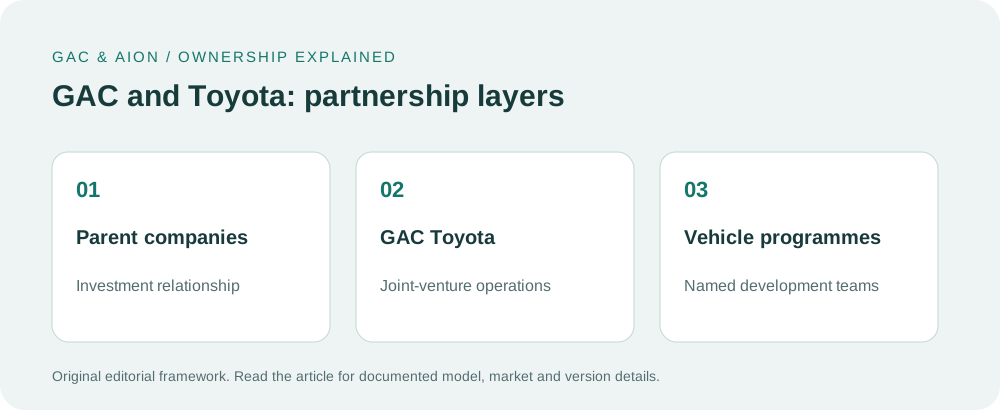
GAC and Toyota's relationship is an industrial partnership with a long operating history and a growing local-development dimension. Their joint vehicle venture was established in 2004, followed by production from 2006 and later named cooperation on electric vehicles. The most useful industry interpretation is capability accumulation: repeated programmes create opportunities to improve coordination between design, suppliers, factories and customer requirements. Toyota's October 2026 alliance framework proposes another stage of coordination involving FAW and the Toyota joint ventures. These developments support a positive assessment of the relationship's depth while keeping historical operations, current development and announced future steps distinct.
Industrial capability is built through repeated work
The relationship between GAC and Toyota is best understood as a continuing body of industrial work. Ownership provides its legal foundation, but the operational significance lies in what the partners have organised together: production programmes, engineering coordination and the movement of vehicles from design into customer use. Those activities develop over years, with each programme creating new requirements and opportunities to learn.
Toyota's 2004 establishment announcement gives the relationship a clear starting point. A defined vehicle-production and sales venture was created in Guangzhou with equal participation from the GAC and Toyota sides. The agreement established an organisation intended to perform continuing work, rather than a temporary promotional association.
Our interpretation is that the partnership's strongest asset is the ability to coordinate specialised activities around a complete product. Modern cars contain many interdependent systems. A manufacturer succeeds when decisions about those systems reach suppliers, production teams and service organisations in a form they can use consistently. A sustained partnership creates a setting in which that coordination can be exercised repeatedly.
A factory programme turns intent into a repeatable process
Toyota's 2011 historical account dates GAC Toyota's production start to May 2006 and records subsequent model introductions. This is important because establishing a venture and operating a factory are different stages. The second requires the original industrial intent to become a repeatable sequence of work.
Consider the general task of introducing a new body component. Engineers define the part, a supplier develops a process to make it, logistics places it at the correct station, and the factory needs a way to verify that it fits and functions as intended. A change in any one stage may affect the others. The organisations therefore need shared identifiers, revision discipline and clear responsibility for resolving issues.
This example is an explanation of manufacturing coordination, not a claim about an undisclosed GAC Toyota process. It illustrates why operating experience matters. The visible vehicle is the result of many decisions that must remain aligned. A partnership with a production history has had to organise that alignment in practice, and the experience can become an important part of its industrial competence.
Repetition creates a common working language
Repeated vehicle programmes give organisations opportunities to develop a common understanding of timing, quality and readiness. A development engineer, a supplier and a production manager may all use the word ready, but each needs different evidence. A useful industrial system makes those meanings explicit enough for work to proceed without ambiguity.
The common language is partly technical and partly organisational. Technical information describes the part or system. Organisational information explains who approves a change, which vehicle configuration receives it and when the new version enters production. Both are needed. A technically sound decision can still cause disruption if it reaches the wrong people too late or without the necessary context.
This is one reason the GAC–Toyota relationship is significant beyond its ownership percentage. Its long duration provides a setting for shared routines and expectations to develop. The historical evidence does not quantify every benefit, and no such invented calculation is necessary. The practical inference is that sustained operating cooperation is a meaningful form of experience in a complex manufacturing industry.
Model variety adds a second kind of learning
The 2011 Toyota account describes a production history that expanded beyond its initial model. Additional programmes and another production line introduced more variation into the operation. The historical cumulative production milestone in that announcement is useful as evidence of activity over time, rather than as a current measure of market scale.
Variation matters because a production organisation has to manage both commonality and difference. Some work can use shared equipment or processes; other work depends on the specific model. The challenge is to obtain the efficiency of common systems while preserving the details that make each product correct. That balance is central to automotive manufacturing, where model changes and market requirements continue throughout a vehicle's life.
An industrial partnership can become more capable when it learns to manage this balance. It must understand which decisions belong at a common organisational level and which belong with the particular programme. This does not mean every partner product becomes identical. On the contrary, well-managed common systems can support differentiated products by making the shared foundations dependable.
Local development extends the relationship upstream
Toyota's July 2023 announcement describes a stronger local-development structure for intelligence and electrification, including GAC Toyota engineers in IEM-led work. This extends the relationship's visible story upstream, from making vehicles toward defining and developing them around regional requirements.
Upstream coordination changes the kinds of questions partners must answer together. What does the intended customer value? Which functions need to work in the local environment? How should the cabin communicate with the driver? What manufacturing choices support the planned product position? These questions shape the vehicle before the factory receives its production specification.
Our assessment is that this is a meaningful development in the partnership. It connects industrial experience with product creation in a market where the customer experience increasingly includes software and connected services. The source establishes the organisational direction; the individual vehicle programmes show how that direction is applied. Keeping those levels connected gives a more useful account than treating manufacturing and intelligent features as unrelated stories.
Named EV programmes make the development work concrete
Toyota's bZ3X announcement in 2024 names Toyota, GAC, GAC Toyota and IEM by TOYOTA as development participants. The 2025 bZ7 announcement supplies another locally developed programme involving GAC, GAC Toyota and IEM. These are concrete examples of cooperation attached to identifiable vehicles.
A named programme is analytically valuable because it gives the relationship a defined scope. It allows the industry observer to discuss a specific development team and product brief. There is no need to infer that every component comes from one partner, or that every other model shares the same architecture. The collaboration is already meaningful at the level officially described.
These examples also show why local development and manufacturing experience can complement each other. Product ideas need a path into repeatable production, while production organisations benefit when engineering choices take manufacturability and regional requirements into account early. The partnership's industrial story becomes strongest where those activities meet around a real vehicle.
The 2026 framework proposes a broader coordination layer
The October 2026 strategic alliance framework involves FAW, Toyota and GAC. It outlines a planned transaction and a later alliance between the Toyota joint ventures across selected functions. The announcement is evidence of intended coordination, with completion and implementation remaining separate milestones.
From an industry perspective, the proposed scope is important because development, procurement and production affect one another. A common requirement can influence supplier selection; supplier capability can influence design; design can influence factory preparation. Organising these links effectively is a potential source of competitiveness. The framework identifies areas where the parties intend to pursue that coordination.
The outcome should be evaluated through later evidence of implementation and product results. That does not reduce the significance of the announcement. It places the significance correctly: the parties are defining a new organisational route for cooperation. A sound analysis can recognise the opportunity while preserving the distinction between a strategic plan and a measured operating result.
Four layers of capability to follow
| Capability layer | What it involves | Relevant evidence in this relationship |
|---|---|---|
| Operating foundation | A continuing production and sales organisation | Joint-venture establishment and factory history |
| Programme execution | Coordinating different vehicles through production | Historical model expansion |
| Product development | Translating regional needs into engineering decisions | Local R&D structure and named EV programmes |
| Cross-business coordination | Organising shared functions across companies | Announced 2026 alliance framework |
This framework helps avoid an overly simple ranking based on one milestone. A company may have strong operating experience and still be developing a new coordination structure. A new product programme may demonstrate local engineering even before its long-term market results are available. Each type of evidence should be evaluated on its own terms.
For GAC, the relationship with Toyota contributes to several layers at once. That is why it remains relevant in discussions of the group's industrial background. The partnership is neither confined to its founding year nor fully explained by the latest announcement. Its depth comes from the sequence and the connections among these activities.
What investors, suppliers and buyers can each learn
Different readers can draw different practical questions from the same history. A supplier may focus on how product requirements are coordinated and where purchasing responsibility sits. An industry analyst may follow the progression from local manufacturing to local development. A buyer may use the history as background before examining a specific vehicle and its support package.
These perspectives are compatible. They simply operate at different levels of the industrial system. The supplier needs an actionable programme interface. The analyst needs a dated account of organisational change. The buyer needs to know what the car offers and who supports it locally. A clear explanation of the partnership should help each reader locate the evidence relevant to their own decision.
The strongest common conclusion is that GAC and Toyota have a substantial working relationship with a documented history and continuing development activity. That statement is useful without making assumptions about undisclosed technical details. It gives the relationship appropriate weight while preserving the individuality of the businesses and products involved.
How to judge the next stage fairly
Future progress can be followed through a small set of observable milestones: completion of announced transactions, defined responsibilities in the operating alliance, named development programmes and documented product launches. These events show whether the strategic direction is becoming operational. They are more informative than repeating the same broad partnership description after every new headline.
Product outcomes can then be examined through local specifications, applicable safety assessments and the quality of the ownership proposition. Industrial coordination should eventually matter because it helps create useful vehicles efficiently and consistently. That link from organisation to product is where the business story becomes meaningful to customers.
Our conclusion is that the GAC–Toyota relationship represents accumulated industrial capability and an active route into locally developed electric vehicles. Its historical foundation is clear, its recent programmes are identifiable, and its announced next phase is substantial. The most informative account keeps those elements connected while describing each at the stage the evidence supports.
Capability is visible in the handoffs
One practical way to understand the entire story is to follow a customer requirement through the organisation. A need for easier family access becomes a packaging decision; that decision becomes a component and assembly requirement; the finished vehicle then returns information through dealer demonstrations and customer use. A capable industrial system keeps the original need recognisable across those handoffs. This is the everyday work behind a successful partnership, and it explains why long-term cooperation can be valuable even when its most important achievements are not captured by a single headline number.
A change request illustrates the capability involved
Consider a hypothetical request to improve access to a storage compartment during a model update. The visible change may seem small, but it can affect the interior component, surrounding wiring, assembly sequence and inspection instructions. A capable programme team needs to identify those connections before the revised part reaches production. It also needs to decide which vehicles receive the change and how the updated information reaches the people responsible for building and supporting them.
This example shows why organisational experience has economic and product value even when it is difficult to express as a single number. The task is to preserve consistency while improving the customer experience. Repeated cooperation can help teams develop familiar ways to raise a concern, evaluate alternatives and confirm that a change has reached every relevant activity. The official history of the GAC–Toyota venture establishes the sustained operating setting in which such capabilities can develop; the example explains the kind of work involved, without claiming access to its internal procedures.
For an industry reader, this is a more useful perspective than treating capability as a static possession. It is exercised through decisions and handoffs. The relationship's significance lies partly in providing a durable organisational setting for that work, while new electric-vehicle programmes introduce fresh requirements and opportunities to refine it.
Questions buyers ask
Why does a long joint-venture history matter?
It provides evidence of sustained work coordinating vehicle programmes, production and business processes. The practical benefits should still be connected to specific activities and products.
What distinguishes the latest phase?
Named local EV development and the announced 2026 cross-joint-venture alliance broaden the visible cooperation beyond the original manufacturing arrangement.
Explore the subject further
Continue with these related guides:
- The relationship between GAC and Toyota: Why Local EV Development Changes the Partnership’s Value
- The relationship between GAC and Toyota: Reading the 2026 Alliance Through Development, Procurement and Production
GAC Auto Guide: The relationship between GAC and Toyota: What the Partnership Means When Choosing a Car.
AI Companion Robot Guide: The relationship between GAC and Toyota: How Joint Development Connects the Systems in a Modern EV.
Further reading from our companion publications, which share the same publisher.
Sources & context
- Toyota: Guangzhou vehicle joint venture established, 6 September 2004 ↗
- Toyota: GAC Toyota cumulative production milestone, 4 August 2011 ↗
- Toyota: local development of intelligence and electrification, 31 July 2023 ↗
- Toyota: bZ3X development partners and concept, 25 April 2024 ↗
- Toyota: locally developed bZ7, 23 April 2025 ↗
- Toyota: FAW, Toyota and GAC strategic alliance framework, 8 October 2026 ↗
Manufacturer specifications, company announcements and independent assessments are linked above. Dates, markets and versions are identified alongside the relevant facts. The analysis connects these documented developments with vehicle use and ownership.
Read our editorial methodology