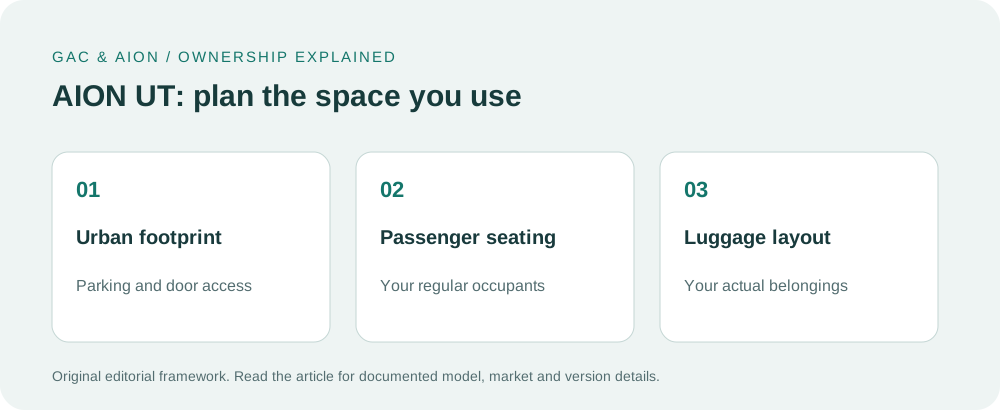
AION UT offers sufficient space for many urban household routines, and its European expansion gives that proposition a useful context. GAC’s current European specification lists five seats, a 2,750 mm wheelbase and 440 litres of luggage space behind the upright rear seats within a 4,270 mm body. The company’s May 2026 launch announcement links the model to Milan design and Austrian manufacturing. Our assessment is that the practical appeal lies in combining passenger room with a compact footprint suited to everyday destinations. The AION UT Cross unveiled in October is a separate derivative announcement; its presentation should not be used to overwrite the current hatchback’s specification.
The European story makes the space question concrete
AION UT's space is sufficient for many compact-family-car tasks, and its expansion in Europe helps explain why the combination matters. The vehicle offers five seats and useful luggage provision without requiring a long body. For a buyer moving between residential streets, workplace parking and ordinary shopping destinations, that balance can be more relevant than maximum exterior size.
GAC's 28 May 2026 announcement describes AION UT launches in Finland, Greece, Poland and Portugal, linking the hatchback to design work in Milan and manufacturing at Magna in Austria. Those are industrial facts about the product's route to market. Their practical significance is that GAC is presenting the UT as a vehicle intended to fit local everyday use, rather than only as an export specification sheet.
Our assessment is that cabin packaging is one of the clearest ways to evaluate that proposition. Localisation becomes tangible when the car accommodates the people and belongings that buyers actually transport, while fitting the physical spaces they use. The UT's published dimensions provide a credible starting point for that evaluation.
A stable physical package supports varied routines
The European specification lists a 4,270 mm body, 2,750 mm wheelbase and five seats. GAC states 440 litres of luggage space with the rear seats up and 1,600 litres with them folded. These figures describe a compact hatchback with two useful configurations: ordinary passenger travel and an alternative arrangement for larger loads.
Different households can use that same physical package in different ways. A city couple may value easy parking and occasional rear passengers. A family may focus on two rear seats, bags and a pushchair. Someone with a changing work schedule may use the folded arrangement for equipment on one day and the passenger arrangement on another. The vehicle does not need a different identity for every use case.
This flexibility is commercially useful because it allows one core product to address several common routines. The important condition is that each claimed use remains specific. A seats-folded carrying arrangement is not the same as a five-person holiday layout. Clear demonstrations allow customers to understand which of the UT's configurations serves their own needs.
Design localisation is most convincing when it changes usability
A design centre can contribute to styling, material choices and the broader interpretation of a product's users. For a buyer, however, the strongest evidence of relevance is the vehicle's behaviour in ordinary tasks. Does the cabin provide natural seating positions? Are small belongings easy to organise? Can luggage be loaded without an elaborate sequence? These are practical questions that give design language a measurable consequence.
GAC's January 2026 AION UT cabin discussion emphasises rear accommodation, folding seats and a dual-display dashboard. Those features offer several routes to daily usefulness. Passenger room supports shared journeys; folding expands the carrying role; a clear layout can make information easier to locate from the normal driving position.
The editorial point is not that design location alone proves success. It is that local design intent should be judged through the tasks the product enables. AION UT's space proposition is credible because it can be explored in the actual vehicle with actual occupants. This makes practicality an appropriate lens through which to assess its wider European positioning.
Manufacturing localisation and product fit answer different questions
The May launch announcement identifies Austrian manufacture, while GAC's October Paris Motor Show update says AION UT and AION V are already made in Europe. Manufacturing location is relevant to the industrial story, but it does not automatically establish whether a particular household fits comfortably inside a vehicle. These two kinds of evidence should support different parts of the assessment.
Local manufacturing can form part of a broader market commitment. Cabin suitability is demonstrated by dimensions, equipment and the customer's own use. A useful article should connect those ideas without collapsing them into one claim. The fact that a car is produced locally explains something about how it reaches the market; the way passengers sit and belongings fit explains why it may suit the buyer.
For AION UT, the combination is worth attention. The company is building a local industrial presence around a product whose compact format can be evaluated against everyday European destinations. That creates a coherent story, provided the practical conclusion remains tied to the vehicle's actual package rather than manufacturing geography alone.
October's UT Cross debut adds context without changing the hatchback
GAC's 13 October 2026 Paris Motor Show announcement introduces AION UT Cross as a new derivative. It also describes the company's wider European plans and service development. This is relevant current context, but the distinction between a derivative announcement and the existing hatchback matters when answering a space question.
A buyer researching the current AION UT should use the specification for the model offered locally. Features displayed on another derivative should not be assumed to appear on that car. The same principle applies to body dimensions, equipment and carrying arrangements. A family deciding whether its pushchair fits needs information about the actual vehicle it can inspect, not an imagined combination of several versions.
The positive implication of the announcement is that GAC is developing the product family and its regional presence. The practical buying implication is simpler: identify the exact vehicle, then assess it. Keeping those two levels clear makes the UT story more useful and prevents a current news event from obscuring the straightforward questions of passenger and luggage fit.
Cabin storage addresses the detail of daily life
The European launch material describes 24 storage locations around AION UT's cabin. That provision matters because everyday practicality involves many small objects. Bags, bottles, passes, devices and travel accessories can occupy passenger space if there is no consistent place for them. Storage helps the intended seating and movement areas remain available for people.
For a household, the best arrangement depends on retrieval patterns. An item needed before departure should be located differently from something only needed at the destination. Shared use adds another consideration: each regular driver should understand where common objects belong. The benefit is not simply a larger count of compartments; it is a more predictable routine.
This is one of the most concrete ways a compact vehicle can feel generous. The same dimensions can support either an organised cabin or a cluttered one, depending on how the available places are used. AION UT's storage provision gives buyers a useful framework, while their own habits determine how effectively it works.
Country specifications should accompany the purchase decision
A global product may have different equipment, documentation or measurement conventions in different markets. A useful buying assessment therefore identifies its basis clearly. This article uses the current European AION UT table for the principal dimensions and luggage figures, rather than assembling a specification from unrelated national pages.
That approach is especially important for carrying capacity. The number of litres, the seating arrangement and the measurement method should travel together when a comparison is made. GAC's Hong Kong table, for example, explicitly labels its luggage figure as water displacement. A buyer comparing another vehicle should establish whether the quoted figures use compatible methods before treating a difference as decisive.
The practical resolution is easy to understand: use the local specification for the shortlist, then use the actual belongings and occupants for the final fit. This preserves the usefulness of official figures while acknowledging the information they do not contain. It also allows AION UT's packaging to be assessed fairly on the tasks it is designed to perform.
Service development complements the space proposition
The October announcement describes a Rotterdam parts distribution centre and a European service initiative. These points concern the ownership system around the car. They do not enlarge the cabin, but they matter to a buyer evaluating whether a promising product can become an ordinary, dependable part of household life.
A practical vehicle choice combines physical fit with local support. The family needs the right seating and luggage arrangement, but also a clear relationship with the retailer and service network. Specific terms should come from the local provider and the purchase documentation. A regional announcement establishes direction and infrastructure, while the individual customer needs the details that apply to the actual vehicle.
This broader context makes the UT's everyday-practicality story more complete. A compact package is most useful when it can be adopted into a stable routine. Product space and service access are distinct considerations that reinforce the same ownership objective: a car that is straightforward to use for ordinary needs over time.
A showroom demonstration should reflect local destinations
A useful demonstration can begin with the buyer's most constrained regular location. That might be a residential garage, a workplace bay or a narrow loading area. The UT's dimensions should be considered alongside door opening, mirror width, tailgate access and the movement of passengers around the vehicle. These are the physical conditions in which compactness creates value.
The next stage is the usual occupied arrangement. Adjust the front seats for the regular drivers, seat the rear passengers and add the normal bags. If child restraints are involved, use the vehicle and restraint instructions and the approved local arrangement. This connects the published package with the buyer's real task.
Finally, demonstrate the occasional alternative configuration, such as folding the rear seats for a larger load. The buyer can then judge both ordinary usefulness and flexibility. AION UT's space proposition is strongest when these demonstrations show that its compact format serves the recurring week and a useful share of the exceptions.
Localisation also means understanding the journey around the car
The physical environment around a vehicle differs from one customer to another even within the same country. A city apartment parking space, a suburban driveway and a shared workplace charging area create different access requirements. A useful local product presentation should therefore help buyers evaluate their own surroundings, rather than assume that one national lifestyle describes everyone.
AION UT's compact length can be relevant in each setting, but in different ways. It may leave circulation room in one location, make the approach more manageable in another, or allow easier access to the luggage area in a third. These are potential advantages to verify. They are not universal outcomes established simply by the car being sold in Europe.
The same applies to passengers. A young family, a couple carrying visiting relatives and a group of colleagues have different priorities within the same five-seat format. Good localisation makes the demonstration flexible enough to address those actual combinations. It connects the design to the user's routine without relying on a stereotype of the market.
This is why the space question remains useful even in an article about industrial expansion. It turns broad statements about regional commitment into something readers can investigate. The buyer can inspect the local car, consult the applicable documents and determine whether the package serves the normal journey. That is a concrete link between a global manufacturing programme and an individual ownership decision.
AION UT's published package provides a promising starting point for that process. The industrial story explains the company's direction; the practical demonstration establishes the customer's fit. Keeping both in view produces a more complete and useful assessment.
Why this is a relevant product story in 2026
The AION UT story is relevant because it brings several strands together: a compact electric hatchback, passenger-focused packaging, European design and production activity, and continuing regional development. The space question sits at the centre because it connects the industrial strategy with something buyers can experience immediately.
Our conclusion is that the current hatchback provides a convincing foundation for urban family use. The official five-seat layout, wheelbase and luggage provision support that view, while a practical fit demonstration determines the final match. The recent UT Cross announcement adds momentum to the product-family story without changing which specification should be used for the existing model.
For readers considering AION UT, the most useful next step is therefore concrete. Identify the local version, bring the people and belongings that define the normal journey, and evaluate the complete arrangement. That approach allows the car's packaging to speak through ordinary use—the area where its compact dimensions and useful interior room are intended to work together.
Questions buyers ask
Does the October UT Cross announcement change the existing AION UT specification?
No. UT Cross is a separate derivative announcement. Use the local specification for the actual hatchback being considered.
What does European manufacturing establish about cabin space?
It is an industrial fact, not a measurement of fit. Passenger and luggage suitability still depend on the vehicle specification and a practical demonstration.
Explore the subject further
Continue with these related guides:
- Is the space of GAC AION UT sufficient? Why Passenger Packaging Is a Commercial Strength for a Compact EV
- Is the space of GAC AION UT sufficient? A Compact EV Space Assessment for Shared Workplace Travel
GAC Auto Guide: Is the space of GAC AION UT sufficient? A Weekday Seating Plan for a Compact Family EV.
AI Companion Robot Guide: Is the space of GAC AION UT sufficient? How Seating, Screens and Everyday Reach Make Room Useful.
Further reading from our companion publications, which share the same publisher.
Sources & context
- GAC Europe: current AION UT Premium and Luxury configuration, checked 29 October 2026 ↗
- GAC: AION UT European market launches, 28 May 2026 ↗
- GAC: AION UT cabin and design information, 27 January 2026 ↗
- GAC: Paris Motor Show and AION UT Cross announcement, 13 October 2026 ↗
- GAC Hong Kong: AION UT specification and luggage measurement basis ↗
Manufacturer specifications, company announcements and independent assessments are linked above. Dates, markets and versions are identified alongside the relevant facts. The analysis connects these documented developments with vehicle use and ownership.
Read our editorial methodology