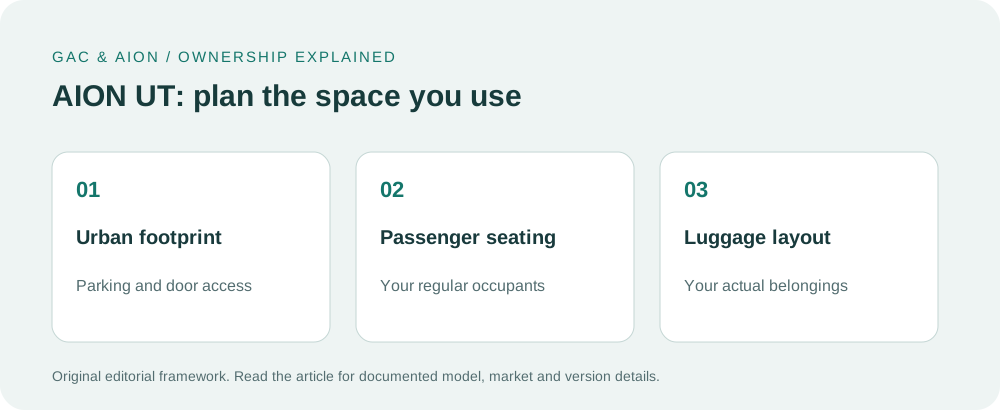
AION UT can provide sufficient space for a company pool car or shared workplace vehicle when the regular task is urban travel with a small group and ordinary bags. The European specification lists five seats, a 4,270 mm body and a 2,750 mm wheelbase, with manufacturer-stated luggage capacity of 440 litres behind the rear seats. Our assessment is that the strongest fit is a varied routine of solo trips, two-person visits and occasional colleague transport, rather than a constant maximum-occupancy shuttle role. A representative passenger-and-luggage demonstration should establish suitability for the organisation’s actual journeys, including parking access and vehicle loading limits.
A shared workplace car has a specific space requirement
The space of GAC AION UT can be sufficient for shared workplace travel, particularly when most journeys involve one or two colleagues and ordinary personal or business bags. A company pool vehicle does not necessarily need to be selected around the largest group that might travel once a year. It needs to perform the journeys that recur often enough to justify its place in the organisation.
AION UT's five-seat format and compact exterior create a useful starting point. The vehicle can serve solo errands, paired visits and some small-group journeys without requiring a large parking footprint at every destination. The space decision should therefore begin with the actual trip pattern: passengers, baggage, distance and the places where the car stops.
Our editorial assessment is that the UT deserves consideration when flexibility and urban usefulness matter more than permanent maximum occupancy. This is an assessment of published specifications and operating scenarios, not a fleet trial. A representative demonstration with the organisation's own users remains the right way to establish whether the package fits.
Define the representative journey before comparing cars
A workplace can often describe its vehicle use more clearly than it first expects. Review the ordinary bookings: how many people travel, which items accompany them and whether the destination provides easy parking. The result may show that most trips are modest in passenger count and load, even if the occasional large journey dominates people's recollection.
Use those recurring patterns to define two or three representative tasks. A local client visit with two colleagues and laptop bags is one. A trip to collect a modest equipment case is another. A journey taking several colleagues to a meeting presents a third. These tasks should be assessed separately because they use the cabin in different ways.
For AION UT, this approach makes the space question precise. It asks whether the standard seating and luggage configuration covers the frequent work, and whether a changed arrangement can cover appropriate exceptions. The vehicle is then evaluated as a practical resource rather than through a broad label such as small car or family car.
The dimensions support a clear operational proposition
GAC Europe's current AION UT specification lists a 4,270 mm length, 2,750 mm wheelbase and five seats. It states 440 litres of luggage space with the rear seats upright and 1,600 litres with them folded. The manufacturer also lists a 10.7 m turning diameter. Together, these figures describe a compact vehicle with useful passenger and alternative carrying arrangements.
| Workplace task | Relevant aspect of the package |
|---|---|
| One-person local errand | Compact exterior and ordinary luggage area |
| Two-person meeting visit | Separate passenger positions with bags stored appropriately |
| Small-group colleague travel | Five-seat format, subject to actual comfort and load fit |
| Equipment collection | Rear-seat flexibility when fewer seats are needed |
| Repeated city destinations | Dimensions and turning reference for parking assessment |
The table should guide a demonstration, not replace one. A vehicle's size cannot establish whether a particular equipment case fits through the opening or whether several taller occupants find the seating comfortable together. It does identify the UT as a credible candidate for a broad range of modest shared-travel tasks.
Passenger combinations matter more than seat count alone
A five-seat specification establishes the intended number of seating positions. It does not mean every combination of five adults will experience the cabin identically. In a shared workplace vehicle, users may differ considerably in height, posture and personal space preferences. A useful assessment should therefore include representative occupants rather than only the person responsible for purchasing.
Start with the most common combination. If two colleagues usually travel, assess their positions and bag storage first. Then examine the more demanding regular arrangement, such as four occupants with work materials. If five-person trips are frequent, the centre rear position and shared shoulder room deserve a dedicated check.
This is a constructive way to assess AION UT's space. It allows the car to demonstrate the tasks it serves naturally, while identifying where the organisation should use another arrangement for unusual journeys. Selecting a pool vehicle around real use can produce a better match than assuming one vehicle must perform every possible task equally well.
Work bags and equipment require secure places
Laptop bags, presentation materials and equipment cases can change how a cabin is used. They should be stored in suitable locations, with the vehicle's loading and securing guidance followed. A seat that is occupied by a bag is not available to a colleague, and loose objects can interfere with movement or access to controls and restraints.
AION UT's normal luggage area is therefore central to its workplace usefulness. The organisation should test the bags and cases that recur in real bookings. A complete set is more informative than a single demonstration object. The test should include the normal passenger arrangement so that carrying space is not assessed independently of the people who need to travel.
GAC's European launch material also describes numerous cabin storage locations. These may help organise smaller items, but they should not become an excuse to accumulate an uncontrolled permanent kit. A shared vehicle is easier to use when common objects have agreed places and each user can identify what belongs in the car.
Parking is part of the business-use case
Workplace travel often ends in unfamiliar or constrained locations. A vehicle may visit offices, shops, residential addresses or public car parks. A compact exterior can be useful across that variety, although actual access still depends on the layout of each destination and the driver's observation and control.
AION UT's dimensions make parking a worthwhile part of the demonstration. Assess the regular workplace bay, any charging position and a representative destination. Check mirror clearance, door access and room to retrieve the usual bags. The vehicle should be easy to use as a complete arrival routine, not merely capable of fitting between painted lines.
The benefit is operational as well as personal. A car that users can park and unload comfortably may support a smoother booking handover and a more predictable daily schedule. This is a reasoned implication of practical fit, not a quantified claim about time savings. It should be verified through the organisation's own trial rather than assumed from a specification.
A shared vehicle should be easy to return to a standard state
Multiple users create a need for simple handovers. The next driver should find a clear cabin, accessible controls and the agreed equipment in its normal location. Space remains useful when belongings from one journey do not accumulate and constrain the next. This is an organisational practice that complements the physical design of the vehicle.
Define a modest standard kit and a straightforward return routine. Users can remove personal belongings, restore any folded seating arrangement and report relevant issues through the organisation's normal process. The aim is not an elaborate checklist for its own sake. It is a cabin that remains ready for the next appropriate task.
AION UT's storage provision and flexible seating can support such a routine, provided the organisation keeps it consistent. A compact vehicle benefits particularly from clear ownership of the available space. When everyone understands which objects belong and where they go, passenger room and carrying capacity remain available for the journeys that justified the purchase.
Seat adjustment should work for the actual user group
A shared car must accommodate more than one driver's preferred position. The driver should be able to establish a comfortable, properly supported posture and clear view of essential information. The passenger space behind that position should then be assessed. A rear-seat demonstration based on a single short driver's setting may not represent the organisation's normal use.
Invite several representative users to try the car while stationary. Include the different heights and routines that matter to the team. Observe whether adjusting the front seat creates a natural position without making the ordinary rear arrangement impractical. This is a more useful exercise than asking whether the cabin feels spacious in general.
GAC's published UT layout includes a separate instrument display and central screen. Those features should be assessed from the actual driving positions, with ordinary tasks demonstrated before travel. The relationship between seat position, sightlines and control access contributes to useful space just as much as the number of centimetres between seats.
Loading limits remain distinct from luggage volume
An equipment case may be compact but heavy. Several adults and their bags can also create a substantial total load. The organisation should use the permitted loading information for the actual local vehicle, including the relevant equipment and documentation, rather than infer capacity from how much empty space remains visible.
This distinction is particularly useful for shared use because different bookings can create very different loads. A solo driver carrying a light presentation display is not the same task as several occupants transporting dense equipment. The car's internal volume and its permitted weight limits answer different questions.
AION UT's European table contains mass and load-capacity information that can be discussed with the retailer. For procurement, the important outcome is a clear operating envelope for the specific vehicle. Users can then select the car for appropriate tasks and make other arrangements where the load falls outside that envelope. This supports the practical value of the vehicle without asking it to be something it is not.
Charging and booking patterns should be considered together
As an electric vehicle, AION UT needs charging opportunities that fit the organisation's use. This is relevant to the space discussion because a charging bay is also a parking and access environment. The car must be positioned appropriately, the connection must be accessible and the surrounding area should remain clear in accordance with the site's arrangements.
Use the intended installed equipment and the site's professional guidance. The physical demonstration should cover arrival, connection, departure and the movement of people around the vehicle. A compact body may help preserve working room in a particular bay, but the actual arrangement determines whether the routine is convenient.
The booking pattern matters as well. A vehicle with predictable parked periods can be integrated differently from one booked continuously. This article does not estimate a fleet's energy use or promise a particular charging outcome. It identifies the practical connection: the car's footprint, the charging location and the travel schedule should be evaluated as parts of the same working routine.
Separate frequent work from exceptional transport
A pool-car decision becomes clearer when the organisation defines how exceptional journeys will be handled. A rare trip with an unusually large group or bulky load may be better served by a separately arranged vehicle than by selecting an oversized everyday car for that isolated event. The appropriate decision depends on actual frequency and cost, which the organisation can evaluate from its own records.
AION UT's role should be described positively and specifically: the journeys it can perform comfortably, the usual number of occupants and the equipment that has been demonstrated to fit. Clear allocation helps users choose it confidently for suitable tasks. It also prevents a compact vehicle's practical strengths from being obscured by a requirement it was never selected to fulfil.
Review that allocation when the organisation's work changes. A new equipment case, a different team size or a new regular destination can alter the space requirement. The original demonstration provides a useful baseline, and a targeted repeat check can establish whether the UT remains well matched. This is ordinary resource planning, and it makes the space assessment relevant throughout the vehicle's use rather than only at purchase.
A focused trial can establish whether the package fits
A useful trial need not attempt every possible journey. It should cover the common passenger arrangement, the most demanding regular load and the tightest typical parking situation. Include a handover between different drivers and a demonstration of the alternative folded-seat arrangement if equipment transport is part of the intended role.
Record concrete observations. Did the complete luggage set fit with the required seats available? Could users enter and leave comfortably? Was the normal equipment easy to retrieve? Did the charging and parking arrangement work without unnecessary rearrangement? These answers are easier to compare than an overall impression that one vehicle felt larger.
Our conclusion is that AION UT can be a well-matched shared workplace EV for modest urban travel tasks. Its compact footprint, five-seat format and carrying flexibility form a coherent proposition. The strongest purchase decision is one that proves the organisation's recurring journeys in the actual vehicle, then assigns it to the work it can perform naturally and consistently.
Questions buyers ask
Is AION UT automatically suitable for a five-adult shuttle role?
The five-seat specification establishes seating capacity, while repeated five-adult comfort and luggage fit require a representative demonstration.
What is the most useful pool-car space test?
Test the common passenger combination and complete work-bag or equipment load together, then verify parking, access and handover with actual users.
Explore the subject further
Continue with these related guides:
- Is the space of GAC AION UT sufficient? Why Passenger Packaging Is a Commercial Strength for a Compact EV
- Is the space of GAC AION UT sufficient? What Its European Expansion Reveals About Everyday Practicality
GAC Auto Guide: Is the space of GAC AION UT sufficient? A Weekday Seating Plan for a Compact Family EV.
AI Companion Robot Guide: Is the space of GAC AION UT sufficient? How Seating, Screens and Everyday Reach Make Room Useful.
Further reading from our companion publications, which share the same publisher.
Sources & context
- GAC Europe: current AION UT Premium and Luxury configuration, checked 29 October 2026 ↗
- GAC: AION UT European market launches, 28 May 2026 ↗
- GAC: AION UT cabin and design information, 27 January 2026 ↗
Manufacturer specifications, company announcements and independent assessments are linked above. Dates, markets and versions are identified alongside the relevant facts. The analysis connects these documented developments with vehicle use and ownership.
Read our editorial methodology