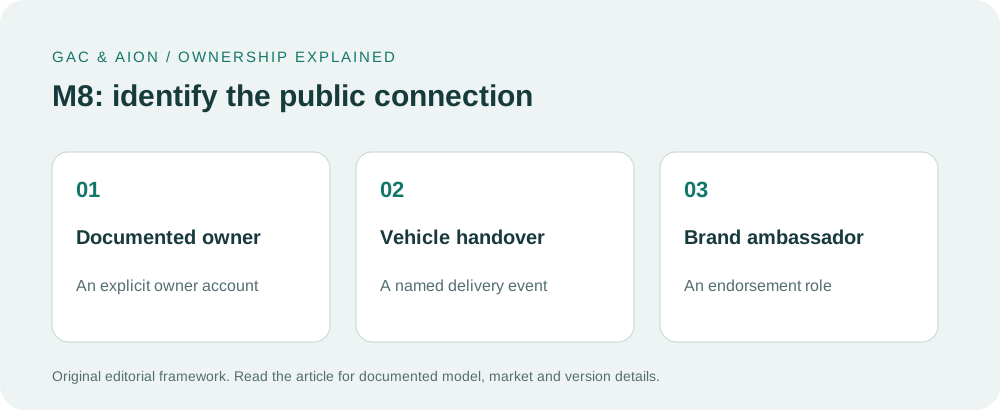
GAC's official records identify Bie Thassapak as an M8 PHEV celebrity owner and document a right-hand-drive M8 PHEV handover to Tony Jaa. A separate April 2025 announcement records Dingdong Dantes' ambassador renewal and reservation, which should retain that status rather than be described as a completed delivery. Our assessment is that these public connections help make the M8's premium passenger role visible across different markets. The stronger industry story is how a people mover connects family accommodation, professional travel and a local product offer. Celebrity visibility introduces the category; the vehicle's actual specification and ownership structure explain the commercial proposition.
Two public ownership records answer the headline question
The documented names are Bie Thassapak and Tony Jaa. GAC's August 2025 Thailand launch report identifies Bie as a celebrity owner and describes his appearance with his family. The company's July 2026 milestone report records the handover of the right-hand-drive M8 PHEV to Tony Jaa. These are specific public events with named sources.
Dingdong Dantes has another documented relationship. GAC's April 2025 Manila announcement describes his ambassador renewal and reservation of an M8 PHEV. That record should retain its stated stage rather than be presented as evidence that delivery had already occurred.
The names make the model visible, but the industry significance lies in the role being communicated. The M8 is presented as a premium people mover serving passenger needs across family and professional settings. Our assessment is that this role is more informative than treating celebrity association as an end in itself.
Bie's family appearance gives the passenger role a familiar setting
The Thailand launch report places Bie with his family and describes his account of the M8 PHEV's family appeal. This is a manufacturer-reported public testimonial, not a representative survey of owners. Its value is that it links the vehicle's positioning with a recognisable use: several people travelling together in a passenger-focused cabin.
For an international product, that type of setting can make an unfamiliar model easier to understand. A reader may not know the manufacturer's technical terminology, but can recognise the demands of carrying children, relatives and ordinary belongings. The vehicle is introduced through a task rather than only through a badge or a performance figure.
The useful editorial interpretation is therefore about category meaning. A premium MPV offers a different emphasis from a vehicle discussed mainly through the driver's experience. The passenger environment becomes central to the product story. Bie's documented connection supplies a public example of that theme without establishing how every buyer will evaluate the same cabin.
Tony Jaa's handover links a public figure with a corporate milestone
The July 2026 report identifies Tony Jaa as the recipient of the M8 PHEV presented at GAC's group production milestone. The event connects a named public figure, a particular vehicle and a larger corporate occasion. It is a clear ownership-related record and a distinct story from the earlier Thailand launch.
The production milestone belongs to the group rather than to the M8 nameplate alone. That distinction matters because the event's scale can otherwise obscure what is being counted. The M8 is the vehicle used in the milestone presentation, not the subject of a claim that its own production reached the group's total.
For the model's market position, the handover brings attention to the passenger vehicle within GAC's wider international identity. It gives the product a visible role in a corporate story. The reader can appreciate that role while keeping the public record separate from assumptions about private purchase terms, daily use or a complete celebrity vehicle collection.
An ambassador relationship has its own commercial role
Dingdong Dantes' April 2025 announcement concerns both a renewed ambassador relationship and an M8 PHEV reservation. These are meaningful public connections, but their role differs from a completed handover. An ambassador helps communicate a brand and engage an audience; a reservation records an intention or order stage described in the source.
The distinction provides a clearer view of how international vehicle marketing works. Several types of relationship may appear around the same model: an owner testimonial, a delivery event, a product launch and an ambassador campaign. They can reinforce a product's visibility while contributing different forms of evidence.
Accurate labels allow the industry story to remain positive without becoming speculative. The M8 has several documented public connections worth discussing. There is no need to turn all of them into the same ownership claim. A precise account is more useful to readers because it explains both the people involved and the type of relationship the source actually describes.
The premium-MPV category centres the people being carried
A premium people mover places a substantial part of its appeal in the passenger experience. Access, seating, climate comfort and the organisation of belongings become prominent product questions. The driver remains important, but the vehicle's value is shared across the cabin and across different kinds of journey.
The Australian M8 PHEV specification provides a labelled example of this role, listing seven seats and several comfort and convenience provisions with grade distinctions. The information belongs to the Australian online offer; it should not be assumed to describe every M8 mentioned in a celebrity story from another market.
From an industry perspective, the category's appeal can be explained through its tasks. A family may value comfortable travel for several generations. A professional passenger may value a calm environment between appointments. Those needs overlap in some ways while remaining different in others. A coherent product position explains the common passenger focus without treating all users as identical.
Family and professional travel share some requirements
Both family and professional users may value easy access, a comfortable seating position and a cabin that remains organised during a journey. These shared needs help explain why a people mover can be presented across several settings. The vehicle offers a passenger environment that can be interpreted according to the user's own routine.
The differences are equally important. A family may prioritise child-restraint access and holiday luggage. A professional user may focus on the arrival routine or the needs of visiting passengers. The local specification and demonstration should make it possible to examine those requirements individually rather than rely on a general luxury label.
Our assessment is that the M8's public celebrity connections are most useful when they lead into this practical product discussion. The people draw attention, while the cabin's role explains why the model can be relevant beyond the public event. The commercial proposition becomes clearer when the vehicle is connected with repeatable passenger tasks.
Electrification adds another dimension to the category
The M8 PHEV introduces a plug-in-hybrid proposition to a passenger-focused vehicle. The relevant ownership question is how the household or organisation will combine charging opportunities with its journey pattern. The local documentation explains the actual system and its operation; a broad category description should not replace it.
For a buyer, useful analysis begins with the places where the car is parked and the journeys it repeats. A regular charging opportunity may support one routine, while longer journeys require their own planning. The powertrain is valuable when its capabilities align with the way the vehicle is used rather than only with an attractive advertised figure.
This is an important part of the premium-MPV story because the vehicle is often assessed as a shared travel environment. Energy planning, passenger stops and luggage are parts of the same journey. A strong product proposition connects them coherently, allowing the customer to understand both the cabin and the operating routine.
Market names and versions need to remain visible
International vehicle naming can create confusion if articles treat several local designations as interchangeable specifications. GAC's milestone report describes the right-hand-drive M8 PHEV and refers to GN8 in its overseas wording. A reader should preserve the source's description and then use the relevant country product page for the actual local offer.
The same principle applies to equipment. A comfort feature listed for one grade in one market should not be attributed automatically to the vehicle in every celebrity record. A public ownership connection establishes the relationship described; it does not provide the complete build specification of a private vehicle.
Keeping market identity visible improves the article's usefulness. The reader can understand the international story and still know where to find the appropriate local product information. The positive case for the M8 does not depend on combining the most attractive details from several versions into a car that is not actually offered.
The local demonstration translates positioning into evidence
A premium-MPV position becomes persuasive when a prospective buyer can assess it in the local car. The demonstration should include entry, seating, luggage and the controls used by regular passengers. The intended users contribute information that a launch event cannot supply for them.
A family can bring representative belongings and sit in its usual arrangement. A professional user can examine the passenger's arrival and departure routine. In either case, the result should identify the exact grade and configuration. A comfortable impression is more useful when the circumstances are recorded and can be repeated.
This is where celebrity visibility and product assessment take their separate roles. The public story creates interest and helps explain the category. The local demonstration shows whether the actual offer fits the buyer's tasks. A well-developed market proposition makes that transition easy rather than leaving the customer with only an attractive image.
A clear source map improves the ownership answer
The celebrity question can be answered in a compact record that preserves each status. The reader can then move into the product discussion without uncertainty about which name is supported by which public source.
| Public figure | Officially described connection | Appropriate wording |
|---|---|---|
| Bie Thassapak | Identified as a celebrity owner at the Thailand launch | Documented owner connection |
| Tony Jaa | Key handover of the right-hand-drive M8 PHEV at the July 2026 milestone | Documented handover and owner connection |
| Dingdong Dantes | Ambassador renewal and M8 PHEV reservation in April 2025 | Ambassador and reservation connection |
The table is deliberately about public records. It does not estimate how often the individuals drive, what they paid or which other vehicles they own. Those private details are unnecessary to explain the M8's public positioning. The sourced connections are already sufficient to introduce the model's passenger-focused role.
Recognition is strongest when it leads to a clear product role
Celebrity association can make a vehicle visible, but lasting product meaning comes from a role customers can understand. A premium people mover should explain why its cabin, access and energy arrangement are useful for its intended journeys. The public figure is part of the introduction; the vehicle's design and local offer carry the purchase discussion.
For the M8, the role is coherent: a passenger-focused vehicle presented for family and professional travel, with a plug-in-hybrid proposition in the cited records. That gives the industry story more substance than a list of famous names. It also allows buyers with ordinary routines to understand why the category may be relevant to them.
Our view is that the most effective explanation keeps those layers connected. It answers the celebrity question precisely, then follows the attention toward the people, journeys and local ownership arrangements the vehicle is intended to serve. The result is a useful market analysis rather than a speculative catalogue of public figures' possessions.
The public records form a sequence of different events
The three named connections can be placed in a simple chronology without being collapsed into one category. The April 2025 Manila report records an ambassador renewal and reservation. The August 2025 Thailand report identifies an owner appearing with his family. The July 2026 group milestone report records a vehicle handover. Each event adds a distinct public relationship around the M8 PHEV.
That sequence helps explain how a model's visibility can develop across markets and occasions. One event introduces the vehicle to an audience, another connects it with a family-use account and another places it within a corporate milestone. The industry interpretation is about the range of public contexts through which the model becomes known.
The sequence should not be used to infer a private transaction history. A reservation does not establish the date of a later delivery unless a source records it. A handover does not reveal payment terms, and an owner testimonial does not measure every user's experience. These distinctions are ordinary reporting precision, not a reason to dismiss the documented connections.
The positive story is already substantial: the M8 has identifiable public figures, events and markets associated with it. Keeping the sequence accurate makes that story easier to trust and gives the product-positioning discussion a clear factual base. Readers can then turn their attention to the passenger role and the local specification rather than wondering which relationship each name actually represents.
The documented stories support a broader passenger proposition
Bie Thassapak and Tony Jaa have explicit ownership-related connections with the M8 PHEV in official GAC records. Dingdong Dantes has a separate, clearly documented ambassador and reservation relationship. The distinction gives the headline question a direct answer grounded in public evidence.
The wider industry conclusion is that these stories help make the M8's premium-MPV role visible across markets. They connect a vehicle with family accommodation, passenger comfort and professional travel, while the local specification determines the actual offer. Our assessment is that this is a credible product position because it can be translated into practical demonstrations and ownership questions.
The strongest account therefore moves from the public figure to the passenger task. Famous names introduce the model, but the people who will use the local vehicle complete the decision. That is the connection through which celebrity visibility can support a clear and useful understanding of the M8's place in the market.
Questions buyers ask
Which celebrities have documented GAC M8 ownership connections?
GAC identifies Bie Thassapak as an owner in its August 2025 Thailand report and records an M8 PHEV handover to Tony Jaa in July 2026.
Does the Dingdong Dantes announcement establish delivery?
The April 2025 announcement records an ambassador renewal and an M8 PHEV reservation. It does not by itself establish a completed delivery.
Explore the subject further
GAC Auto Guide: Which celebrities own GAC M8? Bie Thassapak, Tony Jaa and the Family-Cabin Connection.
AI Companion Robot Guide: Which celebrities own GAC M8? Bie Thassapak, Tony Jaa and the Technology of Passenger Comfort.
Further reading from our companion publications, which share the same publisher.
Sources & context
- GAC: Thailand M8 PHEV launch and owner Bie Thassapak, 9 August 2025 ↗
- GAC: 30-millionth group vehicle and overseas market update, 16 July 2026 ↗
- GAC: Dingdong Dantes ambassador renewal and M8 PHEV debut, 10 April 2025 ↗
- GAC Australia: M8 PHEV online specification, accessed 29 October 2026 ↗
- GAC Australia: M8 PHEV product page, accessed 29 October 2026 ↗
Manufacturer specifications, company announcements and independent assessments are linked above. Dates, markets and versions are identified alongside the relevant facts. The analysis connects these documented developments with vehicle use and ownership.
Read our editorial methodology