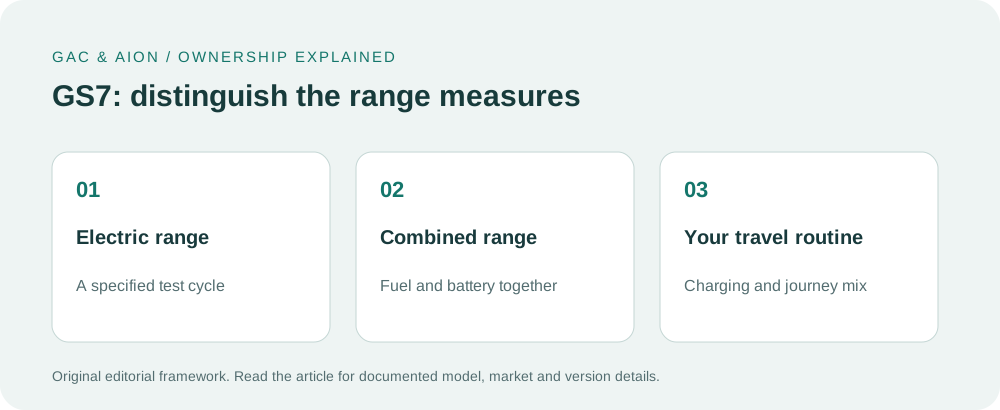
The GAC GS7 PHEV has a credible ownership proposition for drivers whose regular journeys can use plug-in energy and whose occasional longer trips benefit from hybrid flexibility. The Mexican 2027 brochure lists 103 km NEDC electric range for 2WD and 150 km NEDC for 4WD, paired with 21.3 kWh and 36.3 kWh batteries respectively. Our assessment is that the important question is how much of the owner’s recurring travel can be organised around convenient charging. Range is therefore part of a use pattern, not a standalone ranking. This specification review keeps Mexican GS7 data separate from global S7 figures and from headlines without an identified test basis.
GS7's range is an ownership proposition
The GAC GS7 PHEV deserves a positive specification-based review for buyers who want one SUV to serve two common patterns: repeated journeys that can use plug-in electricity and longer travel supported by a hybrid powertrain. The product's relevance is not fully expressed by a maximum range figure. It depends on whether those two capabilities match the customer's actual week.
Mexico's official GS7 2027 brochure offers a clear basis for examining the range proposition. It lists two configurations with different battery capacities and NEDC electric-range figures. Those differences allow a buyer to consider the interval between charging opportunities and the equipment supplied with each version. The result is a more useful decision than simply selecting the larger advertised number.
Our industry assessment is that the GS7's strongest case lies in practical flexibility. A household can use its charging access for recurring journeys while retaining a different energy option for travel outside that routine. The capability is meaningful when the owner has a workable plan to use it, rather than an expectation that one laboratory figure will describe every trip.
The version-specific data provides the review's foundation
The official Mexican product page links a GS7 2027 brochure dated September 2026. The configuration-specific data lists a 21.3 kWh battery and 103 km NEDC electric range for 2WD, with 36.3 kWh and 150 km NEDC for 4WD. The brochure identifies lithium iron phosphate battery chemistry and a five-seat vehicle layout.
| Published Mexican configuration | Battery capacity | Electric-range basis |
|---|---|---|
| GS7 PHEV 2WD | 21.3 kWh | 103 km NEDC |
| GS7 PHEV 4WD | 36.3 kWh | 150 km NEDC |
The live page also contains a higher electric-range headline that does not carry the same detailed version and test-cycle identification. This review uses the explicit grade cards and the linked brochure as its comparison basis. Buyers should confirm the current supplied vehicle in writing, particularly when a market page is changing around a new model year.
That approach preserves a useful discussion of the product without pretending that every number on every regional page refers to the same vehicle. It is a normal requirement of a version-specific automotive review.
Electric range becomes valuable through repetition
The commercial value of plug-in range is often found in repeated journeys. A commute, school route or series of ordinary errands happens many times, so the ability to use a charging opportunity for that pattern can matter more than a rare maximum-distance demonstration. The key variable is the relationship between travel and the time the vehicle spends parked near suitable equipment.
For GS7, the two battery configurations give buyers different published electric allowances. The larger version may provide more flexibility between charges, while the smaller version may already suit a predictable routine. The decision should begin with real journey intervals and the charging arrangements the owner can use consistently.
This interpretation keeps the range review tied to customer benefit. It asks how the vehicle's capability is used repeatedly, rather than treating the specification as an achievement detached from ownership. A useful product is one whose strengths align with ordinary behaviour, including the practical act of connecting it to charge.
Charging infrastructure is personal as well as public
Discussion of electric vehicles often focuses on public charging networks, but an individual owner's experience also depends on private or workplace access. A suitable charging location that fits a normal parked period can be more relevant to the weekly routine than a distant high-power facility. The specific arrangement determines how easily plug-in capability becomes habitual.
A buyer considering GS7 should therefore assess the place and time available for charging. The electrical equipment and installation must follow professional and manufacturer guidance. The practical vehicle demonstration can then address parking orientation, connection access and the sequence regular drivers will follow.
This creates a direct link between infrastructure and product selection. A larger battery may be useful for one pattern, while a smaller battery with frequent convenient charging may serve another. The GS7 range offers configurations that should be evaluated within those personal circumstances rather than through a universal assumption about the ideal battery size.
Hybrid flexibility addresses the less predictable journey
Longer journeys and unexpected detours are a different part of the ownership pattern. A PHEV's petrol-supported hybrid system provides a way to travel beyond the ordinary plug-in interval. That capability should be reviewed through the local vehicle's operating information, with electric and combined range treated as distinct measures.
The benefit is flexibility, not a requirement to drive until a maximum advertised distance has been reached. Families still need sensible stops, passengers have their own comfort requirements and routes vary. The vehicle's energy system supports the trip, while the owner plans it around actual conditions and available services.
For GS7, this is an important complement to the electric-range story. The product can appeal to someone who wants to make use of charging without defining every longer journey solely around the same routine. The two patterns coexist within one vehicle, and the review should explain their relationship clearly.
Different test cycles should retain their labels
The Mexican brochure's electric figures are labelled NEDC. The global S7 product page separately presents a combined-range figure labelled CLTC and an electric figure labelled NEDC. These are different source contexts and energy measures. They should remain attached to the market, version and test basis that produced them.
A comparison becomes less useful when those labels disappear. A reader may otherwise interpret a combined figure as battery-only distance or treat a number from one regional configuration as a promise for another. The solution is concise identification beside the claim, not a long technical lecture.
For this review, the operative comparison is Mexico's 2WD and 4WD electric-range data on the same named cycle. The figures provide a structured reference for those grades. They do not establish the exact distance an individual driver will achieve, nor should they be used to import unrelated claims from another market into the Mexican vehicle's specification.
Battery size is only one part of the grade decision
The GS7's 4WD configuration combines its larger battery with additional equipment listed on the Mexican page, including a head-up display, a 22-speaker audio system and further cabin or parking convenience. A buyer evaluating the upgrade is therefore considering more than electric range alone.
The useful method is to separate the reasons. Identify the value of the extra electric allowance for the owner's charging interval. Then assess the relevant traction needs and the comfort or interface features. Some buyers may value several of these together; others may find one important and the rest less relevant.
This produces a clearer understanding of the product's equipment strategy. The higher grade is not simply a range extension, and the lower grade is not merely a reduced version of a single headline. Each should be assessed as the actual package available locally, with its written specification and current quotation.
Cabin fit gives the range proposition a purpose
The Mexican brochure lists five seats and a 2,880 mm wheelbase within a 4,900 mm body. That establishes a substantial five-seat SUV format. The range capability is useful when the vehicle also accommodates the people and belongings that make the journey necessary.
A complete review should therefore connect the energy system with passenger comfort, luggage and ordinary access. A longer route may place more emphasis on seating posture and the organisation of stops. Daily commuting may place more emphasis on convenient parking and familiar controls. The same cabin has to support both patterns if the GS7 is to fulfil its intended role.
The strongest buying demonstration includes the usual occupants and representative luggage, with the front seats adjusted normally. It also includes the devices and interface functions the household uses. These details turn a range discussion into a vehicle review by asking whether the whole product serves the owner's travel.
Ownership evidence should distinguish electricity and fuel
After purchase, the owner's own records can clarify how the vehicle fits the routine. Distance, charging occasions and fuel use should remain visible as separate parts of the pattern. A small number of unusual journeys should not be treated as a universal result, and a combined average should not conceal how often the car was connected to charge.
This is relevant to any PHEV assessment because the contribution of plug-in energy depends on use. A household with frequent suitable charging may experience a different pattern from one that rarely connects the vehicle. The same model can therefore produce different ownership outcomes without the published specification changing.
For GS7, a practical review can explain this relationship without inventing a long-term test. The official data establishes capability; the owner's routine determines how it is used. The most helpful conclusion identifies the conditions under which the product's strengths are likely to be relevant and encourages a demonstration of those conditions before purchase.
A useful retail conversation follows the weekly schedule
The retailer can make the GS7 proposition clearer by starting with the customer's normal week. How far does the car travel between parked periods suitable for charging? Who uses it? Which longer journeys recur, and what passengers or luggage accompany them? These questions connect the specification to a concrete task.
The demonstration can then show the local vehicle's charging connection, energy information, supported operating modes and relevant cabin features. The customer should understand how to use the car in the intended routine, not only how to repeat the headline range. Written confirmation of the grade and equipment completes the process.
This approach supports a credible positive case for the GS7. Its plug-in capability and hybrid flexibility become understandable parts of ownership. The buyer can judge whether the package serves the normal week, and the grade comparison can focus on the capabilities that will actually be used.
The most useful comparison unit is a recurring travel interval
Consider two hypothetical buyers who each travel the same total distance in a week. One returns to a suitable charging location after each ordinary day. The other spends several days away before reaching a convenient charging opportunity. Their weekly distance is identical, but the practical requirement placed on the battery between charges is different.
This example explains why a PHEV cannot be selected well from annual mileage alone. The timing and location of energy replenishment shape how the published capability can be used. A larger battery may be valuable to the second pattern, while the first buyer may find that a smaller configuration already serves the recurring task. These are planning observations, not claims about measured GS7 performance.
The same method can be used within a household. Combine the journeys of all regular drivers, identify the suitable parked periods and note the exceptional trips that recur often enough to matter. The result is a concrete interval that can be discussed with the retailer and compared with the local configuration information.
For GS7, this creates a more informative grade conversation. The 2WD and 4WD figures are no longer isolated numbers; they become different capabilities that may fit different intervals. Cabin equipment and traction requirements can then be considered alongside the energy question, with each part of the purchase retaining its own reason.
A clear review should help readers perform this translation. It can present the official data faithfully and explain how to connect it to use, without pretending to predict an individual's exact result. That is a practical contribution to the buying decision and a more durable interpretation of range than a simple largest-number ranking.
The editorial conclusion
The GAC GS7 PHEV is a compelling candidate for a buyer whose recurring travel and charging opportunities align. Mexico's 2027 configuration data gives a clear reference: 103 km NEDC for the 21.3 kWh 2WD and 150 km NEDC for the 36.3 kWh 4WD. Those are useful version-specific figures when they remain attached to their market and cycle.
Our assessment is that the model's value is best understood as a combination of electric routine and hybrid flexibility. A larger battery can expand the electric allowance, while the grade's other features may add separate reasons to choose it. The complete vehicle should then be demonstrated with the household's occupants, belongings and ordinary controls.
That is the most useful answer to the range-and-review question: GS7 offers a coherent capability for two common travel patterns, and the right configuration depends on how the owner plans to use them. A clear weekly charging routine is the bridge between the published specification and everyday value.
Questions buyers ask
Why is regular charging central to the GS7 assessment?
Because plug-in range becomes an ownership benefit when suitable charging opportunities align with recurring journeys.
Should a combined-range number be treated as battery-only distance?
No. Electric and combined range describe different energy modes and must retain their market, version and test-cycle labels.
Explore the subject further
GAC Auto Guide: How is the GAC GS7 range and review? A Practical Electric-Week and Long-Journey Assessment.
AI Companion Robot Guide: How is the GAC GS7 range and review? How Battery Information and Cabin Controls Support Everyday Range.
Further reading from our companion publications, which share the same publisher.
Sources & context
- GAC Mexico: GS7 PHEV 2WD and 4WD configuration cards, checked 29 October 2026 ↗
- GAC Mexico: GS7 2027 brochure, September 2026, linked from official product page ↗
- GAC Global: S7 international specification with named test cycles ↗
Manufacturer specifications, company announcements and independent assessments are linked above. Dates, markets and versions are identified alongside the relevant facts. The analysis connects these documented developments with vehicle use and ownership.
Read our editorial methodology