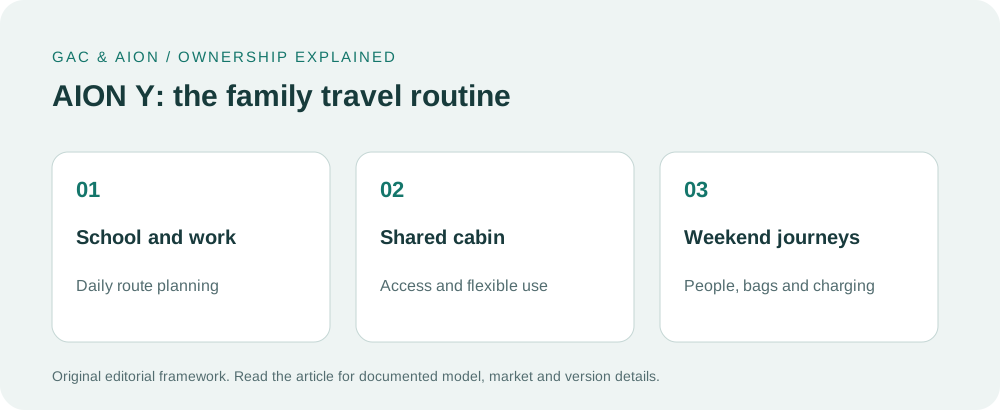
The GAC AION Y is a good family-EV candidate because its proposition is centred on the everyday movement of people and belongings. The Hong Kong AION Y Plus combines five seats and a 2,750 mm wheelbase with a 63.2 kWh LFP battery, rear ventilation and flexible seat arrangements. Our assessment is that this makes it especially relevant to urban households seeking one vehicle for school journeys, shopping, relatives and weekend activities. Its value should be judged through passenger access and usable cabin arrangements alongside charging convenience. Use the exact local version and retain the 490 km NEDC label; neither another market's equipment nor another AION model's safety assessment should be assumed to apply.
Family mobility is a product-design problem
The GAC AION Y's family appeal is easiest to understand by looking at the work a household asks a vehicle to perform. A car may carry children in the morning, one adult during the working day, shopping in the evening and several relatives at the weekend. These changing uses place different demands on the same cabin. A family-oriented product needs to accommodate those transitions without making every journey an exercise in rearrangement. AION Y Plus offers a useful case study because its local specification places passenger accommodation and flexibility near the centre of its proposition.
In Hong Kong, the official AION Y Plus specification lists five seats, a 2,750 mm wheelbase and a 63.2 kWh LFP battery. It also identifies rear air outlets and split-folding rear seating. These are concrete attributes that can be examined in relation to household tasks. The question is not whether the model has the most dramatic performance figure in its class, but whether its package can make common journeys more comfortable and adaptable.
Our assessment is that the GAC AION Y is a credible family-EV candidate for that reason. The recommendation is strongest when the buyer values the cabin and can establish a convenient charging routine. A product-design interpretation helps explain the appeal without turning it into a universal claim. Different households still need to test their own passengers, restraints and luggage, because the usefulness of space depends on what people do with it.
A household uses the cabin in several modes
A single family vehicle often alternates between passenger-intensive and luggage-intensive tasks. During a school journey, the important factors may be restraint access, a place for bags and a clear departure routine. During shopping, the need shifts toward loading and reaching items easily. On a visit to relatives, rear-seat comfort may become more important. These are not separate markets in the owner's life; they are different moments in the same week.
AION Y Plus's split-folding rear seats can help address this variation when used according to the vehicle's instructions. The useful benefit is the ability to change the balance between passenger positions and load space. The family should identify which configurations it actually needs rather than assuming maximum flexibility is always used. If all five seats are regularly occupied, the normal luggage arrangement remains the priority. If the passenger count varies, the folding arrangement may become more valuable.
This suggests a better way to compare family cars. Instead of asking only which has the largest stated capacity, ask which supports the household's common configurations with the least disruption. A stroller that can remain in place while groceries are added may matter more than a larger maximum volume in an impractical shape. The AION Y's case becomes persuasive when its layout supports these transitions directly.
Passenger access has repeated value
Access is easy to underestimate because it is less prominent than a battery or motor specification. Yet a family may open the same rear door several times a day, help a child into a restraint or assist an older relative. The physical relationship between the doorway, seat and person therefore deserves careful attention. A car can be spacious once seated while still presenting an awkward entry for a particular passenger. The buying assessment should include both stages.
A useful inspection invites the actual users to perform the task. Set the front seats for normal driving, then assess rear entry, seating and exit. For children, install the real restraint and check the adult's access to the relevant buckle or harness. For older passengers, allow time to judge the seat and doorway comfortably. These observations provide a personal understanding of usability that cannot be replaced by exterior dimensions alone.
The AION Y Plus's passenger-focused proposition gives it a strong reason to be included in this evaluation. Its value is not simply that it has five seats, but that those seats may serve the household's repeated movements well. A good recommendation should explain that distinction. Capacity states how many people the vehicle is configured to carry; practical access helps determine how comfortably the family can use that capacity every day.
Electric packaging becomes meaningful through use
An electric vehicle's battery and propulsion system are important engineering elements, but buyers experience the result through the complete product. The relevant question is how the vehicle's layout supports people, storage and control. AION Y Plus can be discussed constructively through its available cabin arrangements and local equipment, without making unsupported claims about how every millimetre of space was achieved. The finished vehicle provides the evidence a family can inspect.
This is a useful discipline in automotive writing. A generous wheelbase may support accommodation, but it does not by itself establish a universal comfort outcome. Seat design, the occupants' sizes and the placement of their belongings also matter. Likewise, a foldable seat can create useful flexibility, while the manual defines how it should be used. The strongest explanation connects the published dimensions and functions with a real task, then allows the buyer's inspection to complete the judgement.
For AION Y Plus, that task might be carrying two child restraints while keeping the front seats comfortable, or accommodating adults on a weekend trip. The same cabin may serve both, but the arrangement should be demonstrated. This makes the product case more credible than a broad assertion that an electric platform automatically guarantees superior space in every situation.
Comfort equipment distributes value across the family
The Hong Kong specification lists automatic air conditioning, a second-row outlet, front and rear USB ports and a panoramic sunroof with an electric sunshade. These functions affect different occupants and circumstances. Rear ventilation can support passengers who are otherwise dependent on the front of the cabin. Device connections can be useful on longer trips. A sunshade gives occupants a way to manage light entering through the roof. Each feature has a practical role when used in the appropriate setting.
The significance is that value is distributed across the household rather than concentrated entirely around the driver. A family car may be selected by one person but experienced by several. Evaluating the rear row and common passenger tasks gives those users a voice in the decision. It also helps distinguish meaningful equipment from features that look attractive in a list but have little relevance to the people who will travel.
AION Y Plus's comfort equipment should be demonstrated in the exact local vehicle. Confirm the available controls and avoid assuming that a rear outlet means independent climate control for every seat. Ask passengers to try the relevant functions while parked. A positive recommendation can then be based on a clear observation: the equipment supports the people and situations that matter to this household.
The energy routine determines how the vehicle fits the city
A family EV's urban usefulness depends on where it can be charged, not only on how far it can travel under a test cycle. A household may park at home, at work, in a shared building or near regular activities. Each pattern creates a different opportunity for replenishment. The vehicle becomes convenient when charging can be integrated into those existing pauses rather than requiring an unfamiliar additional routine every few days.
The AION Y Plus Hong Kong specification lists Type 2 AC and CCS2 DC charging connections. This identifies the local vehicle's interface with charging infrastructure, while the owner's actual locations determine access and timing. A buyer should assess suitable sites, payment arrangements and alternatives. If a home installation is planned, the property and any shared-building process need to be considered before the arrangement is treated as available.
From a product-positioning perspective, this means the AION Y's family case is partly a relationship between vehicle and place. Its battery and cabin can be attractive, while the owner still needs a workable replenishment pattern. When that relationship is established, the vehicle can serve a varied urban week with less attention to energy planning. The product is not assessed in isolation; it is assessed within the environment in which the family lives.
Range labels preserve a fair comparison
The checked Hong Kong AION Y Plus page declares 490 km under NEDC. The label matters because other vehicles may publish WLTP or another cycle. A larger numerical result under a different procedure does not automatically establish a longer usable range in the same real journey. A fair comparison retains the cycle and local version beside the figure, then considers the buyer's actual travel and charging needs.
This does not make the published range irrelevant. It remains a useful piece of the model's local specification and can help frame the energy discussion. The buyer can examine normal weekly distance, important occasional trips and the available charging opportunities. Simple calculations with clearly labelled assumptions can reveal whether the pattern is plausible. After purchase, observations from the owner's own use provide a better basis for refinement than an attempt to convert one cycle into another with an invented universal factor.
For an editorial recommendation, the constructive conclusion is that AION Y Plus offers a substantial declared local range alongside its family-oriented cabin. The exact purchasing decision should not depend on overstating that number. The vehicle's strengths are easier to trust when the article uses the specification accurately and explains why the complete package may fit the household.
Family value can change as the household changes
A family car is often kept through changes in the people and equipment it carries. A child moves from one restraint to another, school bags become larger, a relative travels more often or weekend activities change. A flexible cabin can be valuable because it allows the owner to adapt to some of these shifts. The right buying assessment therefore considers the current routine and a few foreseeable changes, without inventing every possible future requirement.
For AION Y Plus, inspect the arrangements that are likely to matter over the intended ownership period. If a second child restraint may be needed, understand the relevant seating positions and access. If adults will increasingly occupy the rear row, let them judge comfort. If sporting equipment is becoming part of the routine, check its dimensions and how it can be secured. This keeps the planning concrete and avoids selecting a vehicle solely for an imagined rare scenario.
The family recommendation becomes strongest when the vehicle can support several likely configurations comfortably. That is a different argument from claiming that every future need can be covered. AION Y's cabin-centred proposition offers a useful starting point for adaptable ownership, while the buyer's inspection identifies which forms of adaptability are real and valuable for that household.
The ownership horizon can be discussed through specific questions rather than a vague demand for future-proofing. Will the rear row increasingly carry adults? Is a second restraint likely? Will the normal luggage change from a stroller to sports equipment? Each question suggests a concrete configuration to inspect. AION Y Plus's flexibility is valuable when it accommodates those plausible changes with correct seating and secure loading. The exercise keeps the product assessment grounded in foreseeable household needs, allowing the buyer to recognise adaptability without assuming that any single vehicle can satisfy every possible future scenario.
Local support is part of a family product
A family relying on one main vehicle needs a clear route to service and assistance. Obtain the applicable warranty terms, service schedule and support contacts for the Hong Kong vehicle being supplied. Identify the authorised location the owner would normally use and the booking process. These details belong alongside the product specification because they affect how the vehicle fits into daily life after delivery.
The same clarity should apply to the exact equipment and included accessories. A current quotation should identify the grade and any additional items. Demonstrate the functions that matter to the family, including charging and the relevant controls. This helps ensure that the product selected online matches the vehicle delivered. It also gives the household a reliable record if a question arises later.
Our conclusion is that the GAC AION Y can be a good family EV because its proposition addresses an important and enduring need: moving people and belongings through a varied week. The Hong Kong AION Y Plus provides a concrete local example with useful passenger accommodation, flexible seating and an electric powertrain that can suit a convenient charging routine. Evaluate those parts together, using the exact local documents and the family's real tasks. That produces a positive recommendation grounded in use, rather than a generic claim about a badge or a single headline number.
Questions buyers ask
What is the strongest family reason to consider AION Y Plus?
Its cabin-focused package can support varied passenger and luggage tasks. The actual restraints, passengers and regular load should be assessed together.
Should an AION V safety rating be used for AION Y Plus?
No. Ratings and equipment claims must concern the exact model, market and applicable version.
Explore the subject further
GAC Auto Guide: Is the GAC AION Y a good family EV? AION Y Plus Makes a Strong Case for Everyday Passenger Space.
AI Companion Robot Guide: Is the GAC AION Y a good family EV? How AION Y Plus Technology Can Simplify the Family Departure.
Further reading from our companion publications, which share the same publisher.
Sources & context
- GAC Hong Kong: AION Y Plus specification; checked 29 October 2026 ↗
- GAC Hong Kong: AION Y Plus product overview ↗
Manufacturer specifications, company announcements and independent assessments are linked above. Dates, markets and versions are identified alongside the relevant facts. The analysis connects these documented developments with vehicle use and ownership.
Read our editorial methodology