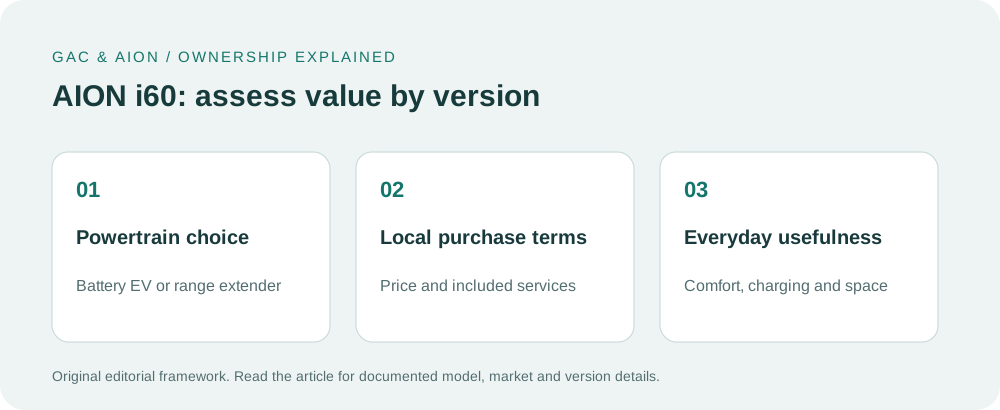
The GAC AION i60 has a persuasive value proposition because its Chinese-market 2027 range brings several distinct electrified ownership choices into a mainstream family-SUV price ladder. Buyers can choose 520 km or 700 km CLTC battery-electric variants, or a range extender with 350 km CLTC electric capability. The official guidance-price span is RMB 114,800–142,800, separate from September launch benefits. Our assessment is that the model's significance lies in useful choice: families can allocate their budget to battery capacity, energy flexibility or additional assistance equipment within one model. The actual value is realised when the selected grade and local support fit the owner's routine.
A value story built around choice
The i60's most interesting price story is not a single low number. It is the way AION has organised several technical choices into one family vehicle range. The Chinese-market 2027 lineup contains battery-electric and range-extended variants, with different battery capacities and assistance-oriented grades. This gives the buyer a set of recognisable decisions rather than one fixed specification that every household must accept.
The official configuration table makes those choices visible. Its guidance prices span RMB 114,800–142,800. The September launch report describes a separate launch-benefit range. The distinction matters in an industry analysis because a dated offer and an underlying product ladder answer different questions. One concerns a purchasing opportunity; the other shows how the model is structured.
Our view is that the i60 deserves attention for making energy configuration part of a mainstream family decision. The buyer can consider the everyday routine first, then select the battery and equipment combination that supports it. That is a more durable value proposition than a price headline whose conditions may change between the launch event and a later showroom visit.
The price ladder reveals the product priorities
The official guidance-price table begins with a 520 battery-electric variant at RMB 114,800 and extends to a lidar-labelled range extender at RMB 142,800. Between those points are longer-range battery-electric versions and additional equipment choices. This structure tells the buyer that price differences are connected to identifiable capabilities. It also gives the manufacturer a way to address several family routines without changing the basic model identity.
An analyst can read the ladder as a map of intended use. Some customers want an accessible entry into battery-electric ownership. Others want more stored energy between charging sessions. A third group values a substantial electric range with another energy source available for longer trips. Additional assistance hardware creates another equipment dimension. These are different reasons to spend, and the configuration table allows them to be discussed separately.
That separation is valuable because households do not all attach the same weight to a feature. A family with excellent home charging may place less importance on maximum battery size than a household with irregular parking opportunities. A driver who often travels with passengers may value cabin equipment differently from someone mainly commuting alone. A useful price ladder accommodates those differences rather than assuming one universal definition of value.
Large electric capability changes the range-extender conversation
The 2027 i60 range extender is listed with a 45.37 kWh battery and 350 km CLTC electric range. Those figures create a product proposition in which electric driving can play a substantial role in normal use. The engine-supported energy arrangement then serves a different task within the same vehicle. The appeal is the possibility of organising routine and exceptional journeys differently while keeping the family in one familiar cabin.
This matters because the value of a range extender depends on how it is used. A household that charges conveniently can make the battery central to repeated journeys. A family with variable long-distance requirements can appreciate the additional energy flexibility. The purchase discussion becomes more precise when it asks which trips will use which arrangement, instead of describing the model only through its longest combined-distance headline.
Our interpretation is that this configuration broadens the model's relevance. It can appeal to buyers who want substantial electric use but organise travel across several kinds of route and parking situation. That is a customer-use argument, not a forecast of sales or a claim that one powertrain is universally superior. The strength lies in matching a clear technical arrangement to a recognisable household pattern.
The two battery-electric choices serve different budgets
The official table associates the 520 battery-electric group with 56.68 kWh and the 700 group with 77.65 kWh. These are useful physical distinctions behind the range labels. A customer considering the upgrade can ask what the additional stored energy changes in a normal month. The answer may concern fewer charging decisions, more flexibility for unexpected trips or a more convenient pattern of longer journeys.
For another buyer, the smaller battery may already support the routine comfortably. In that case, a lower purchase commitment can be part of the value story. The relevant comparison is not between a good and bad version; it is between two allocations of budget. The model becomes more attractive when the buyer can make that allocation without leaving the same family-oriented product format.
This is also a useful lens for understanding mainstream electrification. More battery capacity is valuable when its benefit is used. Convenient charging is valuable because it makes existing capacity easier to replenish. Equipment is valuable when it improves repeated actions. A well-structured range gives the buyer room to balance those elements rather than treating the largest published number as the only rational destination.
Technology matters when it reaches a repeatable use case
AION's launch coverage discusses the technology behind the updated i60, while the configuration table connects specific equipment with versions. For an owner, the meaningful result is a repeatable task: beginning the day with enough energy, finding a comfortable seating position, connecting a familiar phone or understanding the assistance system. Those tasks are the point at which technical development becomes consumer value.
The presence of lidar-labelled grades illustrates this relationship. Hardware creates the basis for functions, but the buyer still needs to know which functions are delivered, how they are operated and what support is available. A specification should therefore lead to a demonstration. It should not be treated as evidence that the vehicle can assume responsibilities beyond those described in its operating instructions.
Our assessment is that the i60's technology story works best when it stays close to ordinary family use. A feature can be impressive and still be explained simply. The dealer can show what the owner does, what the vehicle displays and what outcome to expect. This makes the equipment more accessible to customers who want a capable car without becoming specialists in every component inside it.
Family packaging gives the technology a purpose
The i60's 2,775 mm wheelbase, listed in the official table, provides one concrete reference for the vehicle's layout. Yet the family value of that layout is established by the people and belongings it accommodates. A parent installing a child seat, a passenger entering the rear or a family arranging luggage experiences packaging directly. These moments explain why a mainstream SUV cannot be assessed by energy specifications alone.
A useful showroom presentation connects the technical and physical sides. After discussing the battery and charging routine, the family should sit in the car together and examine its normal load arrangement. The vehicle then becomes a possible part of daily life rather than an abstract collection of figures. This is especially important for a model offering several powertrain choices under one name.
The industry's broader opportunity is to make technical choice feel manageable. A customer should not need to resolve every engineering detail before understanding whether the vehicle suits the household. The i60's structure can support that process: choose the energy arrangement, verify the family layout, then select the equipment that improves repeated journeys. Clear product organisation lowers the effort involved in reaching a sensible decision.
Launch benefits and durable value are different layers
An introductory offer can make a vehicle more accessible at a particular moment. It can encourage a customer to investigate a model or bring a purchase forward. The September i60 launch-benefit prices serve that role in the source record. They should be reported with their date and conditions, leaving the current dealer quotation to establish the actual transaction available to a buyer.
Durable value is broader. It concerns how the chosen car supports years of travel, how convenient energy replenishment becomes and how useful the equipment remains. A slightly different transaction price can matter, but it does not replace those ownership questions. The most constructive evaluation therefore keeps the immediate offer and the underlying fit visible at the same time.
For the i60, the durable argument is the breadth of useful electrified configurations. A family can select the electric capability and additional flexibility that suit its routine. The price then becomes part of a coherent purchase decision. This is stronger than describing a car as good value merely because one launch figure looks low beside a loosely selected competitor headline.
Local support turns specification into ownership
A technical package is experienced through a local service relationship. The owner needs somewhere to ask questions, receive maintenance and understand changes to the vehicle's software or configuration. These practical arrangements influence how much value the customer obtains from the equipment. They are particularly relevant when a model combines a substantial battery, sophisticated cabin functions and multiple energy systems.
The Chinese configuration table includes qualifications around its power-system warranty. Those details belong to a specific market and usage category. An industry discussion should preserve that scope rather than turn the wording into a promise for every export vehicle. For the actual buyer, the right document is the warranty and service information supplied with the local purchase.
A good handover can help the customer benefit immediately. Show the normal charging routine, explain the displays and make the route for later assistance clear. This is an operational extension of product value. The i60's attractive specification becomes more persuasive when the supporting organisation helps the owner use it with the same clarity that the configuration table brought to the initial choice.
A practical framework for evaluating the offer
| Value layer | Question for the buyer | Evidence to use |
|---|---|---|
| Acquisition | What is the payable price and which conditions apply? | Current written quotation |
| Energy choice | Which trips suit battery electric or range extension? | Household routes and parking routine |
| Battery capacity | What would additional energy change each month? | Version table and realistic journey planning |
| Equipment | Which functions will be used repeatedly? | Exact grade specification and demonstration |
| Family fit | Do passengers and everyday items fit comfortably? | A visit with the usual occupants and belongings |
| Ownership | Who supports the car after delivery? | Local warranty and service documents |
The framework is deliberately simple. It lets different families arrive at different conclusions without losing the product's strengths. A household with a predictable charging window may choose one grade, while another may reasonably pay for greater energy flexibility. Both can obtain value when the decision reflects their actual use.
For market observers, this variety is part of the i60's significance. The model offers several ways into electrified family ownership at clearly stated guidance-price points. Its appeal comes from connecting those points to concrete choices. That makes the range more interesting than a single headline price and gives the customer more control over where the budget goes.
One household can contain several different user patterns
A family vehicle may be driven by different people on different days. One person uses it for a predictable commute, another for errands and a third occasionally joins a longer visit. Product planning therefore needs to consider a shared routine rather than an idealised single owner. The i60's powertrain and battery choices are interesting because they can be discussed against that combined household calendar.
The useful question is how the vehicle moves between roles. A larger battery may reduce the need for one driver to interrupt another person's plans with an immediate charging task. A range-extended configuration may fit a household whose longer journeys change at short notice. These are possible uses of the capability, not promises that every family will experience the same benefit. The actual value depends on the schedule and charging arrangement.
This perspective also helps explain why a clear configuration table matters. Several people can discuss the same named version and understand the tradeoffs together. The vehicle becomes a shared practical choice rather than a collection of preferences held by the person who first visited the showroom. Our interpretation is that i60's breadth can support that conversation effectively: the household can allocate its budget to the energy and equipment combination that makes the whole family's use easier to coordinate.
Our assessment of the i60 proposition
The 2027 i60 is worth considering because it offers meaningful technical choice within a family-oriented model. The battery-electric variants give buyers different levels of stored energy, while the range extender combines a substantial battery with another travel arrangement. Additional equipment grades allow a separate decision about assistance features. These are tangible reasons to investigate the model rather than rely only on its launch publicity.
The strongest value judgement is conditional in a practical sense: it depends on selecting the right version for the owner. That is true of any complex product. A clear price ladder and explicit configuration table make the selection easier, and the i60 supplies both. The customer can ask focused questions instead of treating the entire range as one undifferentiated offer.
Our view is that i60's mainstream value lies in making advanced electrified capability usable for ordinary households. When the chosen battery, energy arrangement and equipment fit a real weekly routine, the purchase has a clear purpose. A current quote, a representative demonstration and understandable local support complete that proposition and turn an appealing specification into an ownership decision the family can explain confidently.
Questions buyers ask
What is the main value argument?
The 2027 Chinese-market range offers distinct battery-electric and range-extended configurations in a clearly stated guidance-price ladder.
Are launch benefits assumed to remain available?
No. The September offer is dated evidence; a current written quotation determines the actual transaction.
Explore the subject further
GAC Auto Guide: Is the GAC AION i60 worth the price?: Choose the Powertrain First, Then Spend on the Right Grade.
AI Companion Robot Guide: Is the GAC AION i60 worth the price?: The Value of a Car That Fits Its Owner’s Daily Routine.
Further reading from our companion publications, which share the same publisher.
Sources & context
- GAC AION: 2027 i60 launch report, 24 September 2026 ↗
- GAC AION: official 2027 i60 configuration table ↗
Manufacturer specifications, company announcements and independent assessments are linked above. Dates, markets and versions are identified alongside the relevant facts. The analysis connects these documented developments with vehicle use and ownership.
Read our editorial methodology