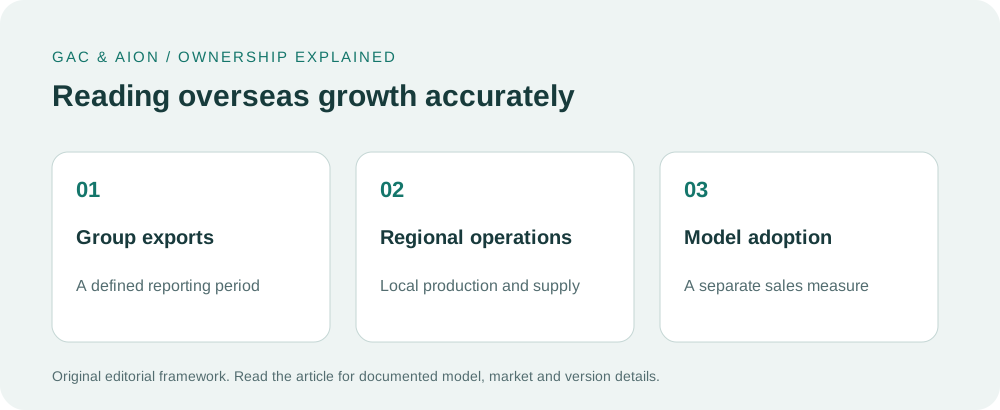
GAC’s overseas export sales expanded strongly in its reported January–September 2026 results. The company announced 197,701 own-brand exports, up 138.9% year on year, with September at 25,693 units. Our assessment is that the significance extends beyond a larger vehicle flow: GAC is developing regional manufacturing, distribution and service arrangements alongside the export business. European cooperation with Magna and the published Spanish after-sales structure provide concrete examples. The useful industry lens keeps exports, local production and retail activity distinct, then examines how those activities connect within a broader international operating model.
The reported export expansion is substantial
How is GAC’s overseas export sales? GAC’s 5 October 2026 release reports 197,701 own-brand exports during January–September, up 138.9 percent year on year. September’s result was 25,693 vehicles. These figures establish a strong reported expansion in the stated export business. The analytical task is to understand how that flow relates to the company’s wider international operations.
Our assessment is that GAC’s development is most interesting when exports are read alongside regional manufacturing, distribution and service. Vehicles need a route into the market and support after they arrive. Some overseas activity also involves local production, which has its own operating characteristics. A clear industry account keeps these measures distinct and then follows the connections among them. That produces a more useful picture than treating every international activity as one undifferentiated sales total.
The reporting label defines the starting point
The release refers to own-brand exports. That label identifies the business scope attached to the result and should remain with the number. A group can have several brands, ventures and reporting categories, so the exact entity matters. The period matters too: January–September describes nine months, while September alone describes a single month. These are basic distinctions, but they determine what comparisons can be made meaningfully.
A sound analysis begins by recording the entity, measure, period and source date. Only then should it discuss growth or strategic implications. This is particularly useful when company announcements also contain regional retail, market-share or product-launch information. Those items can enrich the story without being added together as if they were the same measure. GAC’s export result can stand on its own as a substantive business fact while related operating developments are described in their appropriate categories.
The annual objective gives a scale reference
The October announcement refers to a 300,000-unit annual export target. Comparing the reported nine-month result with that stated objective gives approximately 65.9 percent. The arithmetic remainder is 102,299 vehicles. These are calculations from the reported figure and target, not a forecast or a claim about subsequent performance. They provide a transparent way to understand the scale of the stated objective relative to the completed reporting period.
Dividing the remainder evenly across three months would produce about 34,100 vehicles per month. That is an illustrative average needed to reach the target under a simple calculation; it is not an expected monthly path. Automotive flows can vary with shipment timing, market launches and other operating factors. The useful point is methodological: a target and a reported result can be connected through clear arithmetic while retaining their different status. Later company releases are needed to establish the actual outcome.
Exports and local manufacturing are complementary activities
An international automaker can serve markets through exported vehicles, local assembly or manufacturing partnerships. These activities contribute to its overseas presence but are not automatically counted under the same metric. GAC’s European cooperation announcement with Magna describes AION V production in Graz. That is a concrete industrial program and a distinct part of the international operating story.
The strategic significance is that the company is developing more than one route to market. A regional manufacturing arrangement can connect product planning with local industrial capability and distribution. The precise contribution depends on the program and reporting definitions. An analyst should therefore describe the activity directly rather than assume that every vehicle produced abroad is included in a China-origin export figure. The broader story becomes clearer when each operating route remains identifiable.
Regional partners connect the product to the market
A vehicle flow needs a local organization that can introduce the product, handle customers and coordinate support. GAC’s Spanish introduction names Grupo Invicta and describes the local distribution and after-sales arrangement. The example gives the company’s European development a practical operating structure. It identifies the national partner and the connection to regional resources rather than relying only on a statement of market ambition.
For an industry audience, the important feature is the division of work. The manufacturer brings product and technical resources, while the local partner contributes market-facing operations. Their connection determines how the vehicle reaches and supports the customer. This relationship is relevant to export growth because increasing vehicle flows create continuing local obligations. The business becomes more complete when distribution, technical support and service are organized alongside the product introduction.
Service develops after the shipment has been counted
An exported vehicle can remain in use for years after the reporting month in which it entered the figure. Maintenance, assistance and technical questions continue through that period. This creates a growing installed base that the local network must support. Export growth therefore has an operational consequence beyond logistics: the support organization needs to develop with the fleet and its changing age profile.
GAC’s European GAC CARE+ program is relevant because it describes ownership support as part of the regional offer. The specific local terms determine the customer package, while the program’s existence shows service being treated as an explicit operating component. This gives the expansion story a longer horizon. The company is not only reporting vehicles moved during a period; it is also describing structures intended to support vehicles already in the market.
Product variety changes the support requirements
Different vehicle categories and powertrains create different local requirements. A market introducing electric models needs appropriate product information and service preparation. A broader portfolio requires parts identification and technical documentation for the vehicles actually sold. The international network therefore develops not only in size but also in the range of products it can support. This is an important consideration when examining an automaker’s overseas growth.
The relevant analytical question is how the local portfolio and support capability align. A new model can add customer appeal while also adding tasks for the distributor and workshop. GAC’s regional announcements provide examples of product launches accompanied by descriptions of the supporting organization. The strength of the operating model should be assessed through that alignment, rather than assuming that a higher export total alone explains readiness for every product in every destination.
Geographic growth rates need their own denominators
A company release may report growth in several countries or regions. Those percentages can indicate momentum, but they describe different underlying bases and sometimes different measures. A small market can show a large percentage change, while a larger market can contribute more vehicles with a lower rate. The appropriate comparison needs both the measure and the denominator. Percentages from different regions should not be averaged into a supposed global growth rate without the required data.
This is a general analytical principle that helps interpret international automotive updates. GAC’s aggregate own-brand export result already provides the stated overall measure for the period. Regional developments can then explain where activity is occurring or how the product offer is changing. Keeping these roles separate gives the reader a clearer picture. The aggregate result describes the overall reported flow, while the regional examples provide context about the business beneath it.
Distribution timing can differ from customer timing
Vehicles move through several stages between production and use. Shipment, arrival, dealer allocation and customer delivery are different events. Reporting systems may measure those events separately. A monthly export result can therefore have a different timing pattern from local registrations or dealer retail activity. Understanding the stage is essential before comparing figures from different sources.
For industry analysis, this means a result should be matched with another result using a compatible definition and period. If the comparison uses a different stage, the difference should be explicit and the purpose explained. The goal is not to make the data difficult to use. It is to preserve the meaning of the numbers so the growth story remains accurate. GAC’s reported export expansion is strong enough to discuss directly without silently relabeling it as another type of sales measure.
A useful operating map follows the vehicle and the owner
| Activity | Main question |
|---|---|
| Export flow | What vehicles moved within the reported scope and period? |
| Local production | What is made through a named overseas program? |
| Distribution | Which organization brings the product to local customers? |
| Retail activity | What purchases or registrations occurred under the stated definition? |
| After-sales | How are the vehicles supported once in use? |
The map shows why international growth is a connected system. Each activity can be measured and described separately, while the relationships explain the operating model. A manufacturer may expand several parts at once, but an accurate account should retain the evidence for each. GAC’s current announcements provide material across several of these activities, allowing a more substantive analysis than a headline export figure on its own.
Local participation gives growth a broader foundation
GAC’s “in local for local” approach is useful to examine through concrete activities. A local partner, regional parts support and a manufacturing cooperation program each place part of the business closer to the market. The analytical benefit is a clearer view of how the company intends to participate over time. The operating model becomes more substantial when local customers and partners have identifiable organizations with which to work.
This does not require assuming a uniform strategy across all countries. Markets differ in scale, product demand and distribution structure. The local arrangement can vary while serving the common purpose of connecting the vehicle to the customer. An industry observer should therefore follow named market examples and their stated stages. The company’s global growth can be understood as a portfolio of local operating relationships, with exports forming one important measure within that larger picture.
What to watch in subsequent reporting
The most useful follow-up is another official result using the same entity and measure. That allows the export trend to be extended without changing definitions mid-series. Additional regional announcements can then be recorded separately, noting whether they describe a launch, production activity, distribution or service. This preserves comparability while allowing the operating story to become richer over time.
It is also useful to watch the relationship between the expanding fleet and support infrastructure. New service arrangements, technical resources and parts operations can explain how the company is organizing continued ownership. These are not substitutes for the export result; they provide context for its practical implications. A disciplined update process keeps the numerical trend and the operating developments connected but distinct, giving readers a clearer account of GAC’s international progress.
Separate the operating timeline from the reporting timeline
An international vehicle business has several overlapping timelines. A product program may develop over years, a market launch may occur on a particular date and export results may be reported monthly. The relationship among these events can be meaningful without being immediate. A manufacturing cooperation announced in one period may support later product availability, while a service network continues to support vehicles delivered in earlier periods. An industry account should allow these timelines to coexist.
This is useful when interpreting GAC’s growth. The reported export result establishes the completed measurement period. Named regional operations explain parts of the business structure around it. The analyst can describe the connection without claiming that one announcement caused a precise number of exports unless the source provides that attribution. A careful distinction between sequence, association and measured contribution makes the account more informative.
A practical research timeline can therefore record operating developments separately from numerical results. Each entry identifies the market, organization, activity and stage. The numerical series retains a consistent export definition. When the two are viewed together, the reader can see how the business is developing while understanding which conclusions are direct reports and which are analytical interpretations. This is particularly valuable for a company expanding through several markets and operating routes at once.
The result is a clearer assessment of international momentum. Growth is recognized through the figures actually reported, and operating capability is recognized through concrete regional developments. GAC’s story can then be followed as an expanding set of connected activities rather than an attempt to attribute every change to one launch or one country. The approach preserves both the strength of the reported result and the complexity of the business supporting it.
Our assessment of the growth model
GAC’s reported first-nine-month export performance shows a substantial expansion in its own-brand international vehicle flow. The wider significance comes from the operating network developing around that flow: manufacturing cooperation, local distribution and regional service. These activities provide concrete evidence of an international business that extends beyond the act of shipping a vehicle.
Our assessment is that the strongest interpretation combines accurate measurement with market-specific operating examples. Preserve the export definition, distinguish targets from results and examine the named local structures supporting customers. This approach recognizes GAC’s reported momentum while explaining how it can translate into a more complete overseas presence. It gives the growth story both numerical clarity and an operational foundation.
Questions buyers ask
How much of the stated 300,000 target did the nine-month figure represent?
197,701 divided by 300,000 is about 65.9%. This is arithmetic against the stated target, not a forecast of the full-year result.
Why distinguish overseas production from exports?
They are different operating activities and may use different reporting scopes; their inclusion in a metric must follow the source’s definition.
Explore the subject further
GAC Auto Guide: How is GAC's overseas export sales? The 2026 Numbers and What They Mean for a Local Buyer.
AI Companion Robot Guide: How is GAC's overseas export sales? A Clear Data View of GAC’s International Growth.
Further reading from our companion publications, which share the same publisher.
Sources & context
- GAC: January–September 2026 own-brand exports, 5 October 2026 ↗
- GAC: cooperation with Magna and European production, 21 November 2025 ↗
- GAC: Spain launch and after-sales organization, 4 June 2026 ↗
- GAC: GAC CARE+ European launch, 12 October 2026 ↗
- GAC: overseas service framework, 27 May 2026 ↗
Manufacturer specifications, company announcements and independent assessments are linked above. Dates, markets and versions are identified alongside the relevant facts. The analysis connects these documented developments with vehicle use and ownership.
Read our editorial methodology