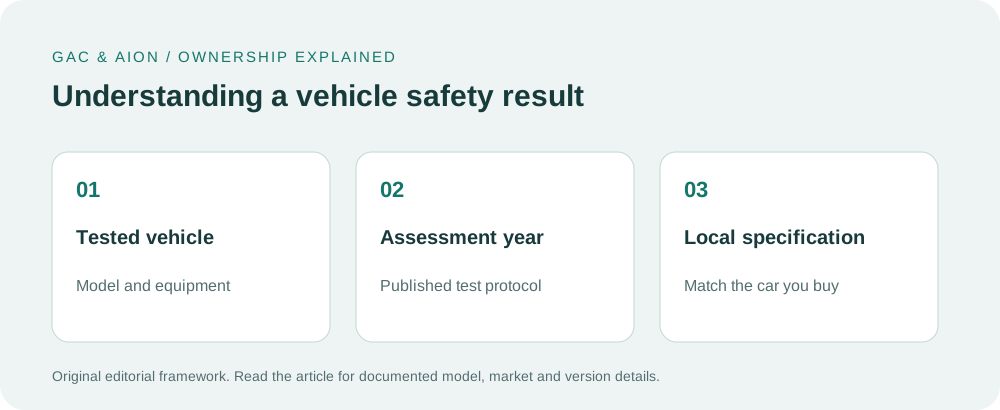
GAC's international safety credentials are supported by named AION products with published NCAP assessments. AION V has five-star 2025 Euro NCAP and ANCAP results, while AION UT holds a five-star 2026 Euro NCAP result. Our assessment is that this model-level evidence matters to overseas market entry because it gives buyers and distributors a common, verifiable product reference. Its strongest commercial use is alongside a clearly identified local vehicle, accurate equipment information and understandable ownership support. Keep the organisations, years and frameworks separate so the reported achievement remains connected to the car being offered.
Model-level evidence gives an overseas brand a useful introduction
GAC's overseas safety proposition is increasingly concrete because international buyers can consult published assessments of specific AION products. AION V has five-star results from Euro NCAP and ANCAP in 2025, while AION UT has a five-star Euro NCAP assessment in 2026. The industrial significance is straightforward: a distributor introducing these vehicles can discuss an identifiable assessment rather than relying exclusively on a corporate reputation established in another country. The original records give journalists, fleet teams and consumers a shared starting point. That improves the quality of the conversation around a comparatively unfamiliar nameplate.
Our assessment is that the strongest international value of these results lies in making the product easier to evaluate. A buyer does not need to adopt every claim in a launch presentation before examining the evidence. The assessment identifies a vehicle, a year, a method and a result. This does not decide the entire purchase, but it supplies a stable reference around which other questions can be organised. Pricing, service access, cabin suitability and charging can then be discussed alongside a documented safety proposition. That is a more substantive basis for market entry than treating visibility alone as credibility.
Read the published record as a product document
The Euro NCAP AION V assessment identifies the tested Premium left-hand-drive vehicle and its 2025 category results: 88% Adult Occupant, 85% Child Occupant, 79% Vulnerable Road Users and 78% Safety Assist. The ANCAP AION V record provides the local Australian and New Zealand applicability, including its listed build period and coverage of all variants. Its category percentages are 88%, 87%, 79% and 79%. Reporting the organisation and year beside each result preserves the meaning of the published evidence.
For an international publication, this creates a useful editorial discipline. A product article should link the reader to the assessment relevant to its local vehicle discussion. A European launch story and an Australian ownership guide may share a model name while relying on different applicable records. The source belongs close to the claim so that a reader can follow that connection without searching through a general corporate page. The benefit is practical rather than cosmetic: a fleet buyer, dealer trainer or owner can identify the same document and discuss the same vehicle scope.
The 2026 framework adds a different perspective
Euro NCAP's 2026 framework announcement organises its assessment around Safe Driving, Crash Avoidance, Crash Protection and Post-Crash Safety. The AION UT record follows that structure and reports a five-star result. This matters to the wider industry because it presents vehicle safety across a sequence of tasks rather than encouraging attention to a single crash outcome. For GAC, the UT provides a current product example within that newer framework, alongside the V's earlier assessment records.
An analyst should therefore avoid constructing a single numerical league table by placing the UT's four percentages under the V's 2025 category headings. The more informative question is what each assessment says about the relevant vehicle under its own framework. A product range can gain useful evidence across successive years without every number being directly interchangeable. Our view is that a clear explanation of this transition strengthens GAC's presentation: it demonstrates that the safety discussion can accommodate an evolving assessment system while keeping the actual product results visible and accessible.
Why a common assessment language helps distribution
A distributor has to translate an international product into a local buying experience. Its team needs accurate product descriptions, a clear understanding of included equipment and a way to answer questions consistently. Published assessment records support that work by providing a common reference. They can form part of dealer training, product briefings and the information supplied to business customers. The valuable outcome is not that every adviser repeats the same slogan. It is that advisers can connect a specific customer question to an appropriate document and identify which vehicle the answer concerns.
Imagine a regional dealer group preparing several branches to introduce a new electric vehicle. One branch expects family buyers, another serves corporate customers and a third receives many first-time EV enquiries. Their conversations will differ, but the underlying assessment should remain the same wherever the local specification is the same. A shared evidence pack helps the group preserve that consistency. Staff can then spend more time explaining the practical product and less time resolving contradictory descriptions. This is an editorial example of how assessment evidence can support distribution; it is not a claim about GAC's internal training procedures.
Separate company standing from the vehicle decision
Corporate scale and product assessment answer different questions. A large manufacturing group may have extensive operations, several brands and many vehicle programmes. The buyer, however, will receive one particular vehicle with a defined configuration. AION V's or AION UT's result is valuable precisely because it narrows the discussion to an identifiable product. It lets the reader move from a broad interest in GAC to evidence associated with a vehicle they might actually order. That specificity is especially useful when brand naming and corporate relationships are unfamiliar in a new market.
The relationship between the two levels remains positive. A manufacturer can develop and support a product range, while model-specific assessments make important aspects of that range easier to examine. The corporate story gives context; the assessment gives a focused reference. An international launch article should connect these levels without merging them into a fictional company-wide crash score. This preserves room for a persuasive conclusion: GAC has concrete international safety evidence for named AION models, and that evidence deserves attention when those models are assessed alongside their local competitors.
Fleet evaluation benefits from a traceable shortlist
A fleet team often has to explain its choices to several people: the drivers, the purchasing manager, operational leaders and whoever manages the vehicles after delivery. A traceable shortlist makes that discussion more efficient. Record the exact vehicle, market specification, assessment organisation, year and applicable version coverage. Then place operating requirements beside those facts: passenger use, route pattern, charging access and service arrangements. The structure allows different specialists to examine the part that matters to them while keeping the product identity consistent across the whole decision.
For example, a business choosing a small pool of passenger EVs might value a compact car for urban visits and an SUV for longer mixed journeys. AION UT and AION V can enter that evaluation through their own formats and published safety records. The organisation can discuss vehicle fit and driver familiarisation after confirming the relevant assessment. This is more useful than averaging unrelated category percentages into a new score. A fleet shortlist should make its actual decision criteria visible, with any internal weighting clearly identified as the organisation's method rather than an NCAP result.
| Reader | Useful assessment detail | Additional local decision |
|---|---|---|
| Private buyer | Vehicle, year and documented safety result | Household fit and ownership package |
| Distributor | Applicable specification and equipment | Accurate training and customer information |
| Fleet team | Traceable model and version coverage | Duty cycle, charging and driver support |
| Service operation | Vehicle identity and relevant documentation | Local maintenance and diagnostic processes |
The product presentation should survive the handover
An effective launch story remains useful after a customer takes delivery. Safety-related controls, normal warning behaviour and emergency information should be understandable within the local ownership materials. The assessment can support the explanation of why particular functions matter, while the owner's manual explains how the supplied car should be used. These documents have complementary roles. A customer should be able to move from a published assessment to the local product description and then to the actual controls without finding that each describes a different version or a different set of expectations.
This continuity also matters for a second driver. Many vehicles are shared within a household or a business, so the person receiving the original handover may not be the only person using the car. Clear product information makes it easier to repeat the necessary explanation. Our editorial inference is that brands entering new markets gain more durable value from a safety result when the surrounding ownership experience makes the assessed technology understandable. A rating can attract initial interest; a coherent handover and support relationship help turn the specification into something the customer can use confidently.
Safety evidence and electric-vehicle value belong in one discussion
EV buying comparisons often start with battery capacity, advertised range and charging power. Those are useful measures, but they describe only part of the product. A household or fleet is also choosing seating, visibility, controls, restraint arrangements and an ongoing service relationship. Bringing the safety assessment into the same discussion prevents the buying case from becoming a contest between isolated specification numbers. It encourages a more complete interpretation of value: what the car provides for the passengers and drivers across the journeys it will actually perform.
For AION V and AION UT, the published results create room for that broader evaluation. Their safety evidence can be considered alongside the characteristics of an SUV or a compact hatchback, respectively. Different buyers may therefore reach different conclusions while using the same assessment records correctly. One may prefer the smaller vehicle's urban fit; another may prioritise the SUV's cabin arrangement. A sound comparison explains why those preferences matter and retains the relevant safety evidence as part of the decision. It need not declare one universal winner to communicate a clear product recommendation.
Maintain the source chain as the range develops
Vehicle ranges change through model-year revisions, local introductions and equipment updates. A useful safety reference should remain attached to its stated coverage rather than floating independently as an undated badge. Publications and dealer materials can retain the assessment organisation, year and original link, then verify the local specification when a new version arrives. The aim is a clean update path: a change in one product document should be easy to identify without rewriting unrelated parts of the brand story. This makes future reporting both more accurate and easier for the reader to follow.
The same approach supports readers returning to an older article. They can see which vehicle and assessment the original discussion covered, then consult the current local offer. Historical evidence remains informative when its date and scope remain visible. Our view is that this transparency is compatible with a positive account of GAC's international development. The model results can be stated clearly, and the reader can inspect their foundations. Confidence grows from the ability to connect a claim to a specific product record, rather than from removing the details that make the claim verifiable.
Preserve the meaning when the story crosses languages
International product communication also involves translation. Keep the assessment organisation's name, the vehicle identity and the assessment year intact when adapting an explanation for a local audience. Technical category names should have a clear relationship to the original record. A reader following the link should be able to recognise which result the local wording describes. This matters especially during a framework transition, when a familiar everyday phrase may resemble a technical category from an earlier year while carrying a different meaning in the new assessment.
A useful local explanation can pair the original category label with a short description of its role. That approach makes the material accessible without requiring the reader to learn every testing term in advance. It also gives journalists and dealers a consistent way to discuss the result across languages. The practical benefit is a clearer product conversation: the achievement travels with the information needed to interpret it, and the reader can move between the local article and the original assessment confidently.
An international safety proposition with a clear product basis
GAC's global safety rating is most convincingly communicated as a set of documented AION model achievements. AION V's 2025 Euro NCAP and ANCAP results give the electric SUV an established international reference, while AION UT's 2026 Euro NCAP result adds a compact vehicle assessed under the newer framework. These are meaningful assets in an overseas product conversation. They let the manufacturer and its local partners discuss safety through records that external readers can open, compare and use alongside other purchase information. That is a concrete contribution to product credibility.
The wider industry lesson is that a safety result becomes more valuable when it is connected to a precise local product and a coherent ownership proposition. The vehicle identity, included equipment, handover explanation and service information should reinforce the same story. Our assessment of GAC's position is therefore constructive and specific: the company has named AION products with credible international safety evidence, and those records provide a useful foundation for local comparisons. The next question for each buyer is how the assessed vehicle fits the actual passengers, routes and operating conditions of their own market.
Questions buyers ask
Why do international safety assessments matter to a new-market launch?
They provide a named vehicle, assessment method and publicly accessible result that buyers and local partners can examine alongside the local product offer.
Is a five-star model assessment a corporate ranking?
No. It evaluates the applicable vehicle under the stated assessment framework. Company scale and the performance of other models require their own evidence.
Explore the subject further
GAC Auto Guide: GAC's global safety rating: Turning AION V and UT Results into a Family Buying Decision.
AI Companion Robot Guide: GAC's global safety rating: How AION Safety Links Sensing, Driver Support and Occupant Protection.
Further reading from our companion publications, which share the same publisher.
Sources & context
- Euro NCAP: AION V assessment, 2025 ↗
- ANCAP: AION V rating, Australian and New Zealand applicability, 2025 ↗
- Euro NCAP: AION UT assessment, 2026 ↗
- Euro NCAP: announcement of the 2026 safety assessment framework ↗
Manufacturer specifications, company announcements and independent assessments are linked above. Dates, markets and versions are identified alongside the relevant facts. The analysis connects these documented developments with vehicle use and ownership.
Read our editorial methodology