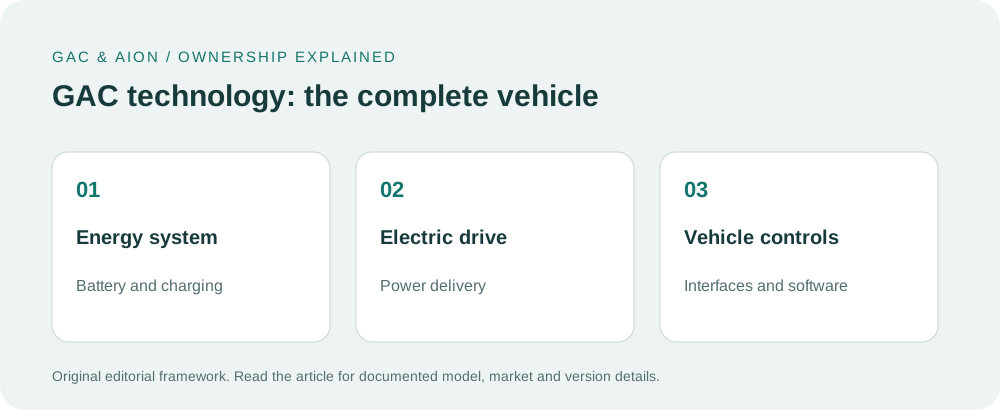
GAC's core technology combines product engineering with industrial execution. Dedicated EV architecture, battery and electric-drive development, X-SOUL electronic and electrical architecture, and intelligent vehicle functions form the product side. Digitally supported manufacturing provides the route from those designs to repeatable vehicle production. The World Economic Forum's recognition of GAC AION Guangzhou in its Global Lighthouse Network gives the manufacturing dimension a concrete external reference. Our assessment is that the strength of the technology story lies in the connections among these capabilities: a useful vehicle needs both a coherent design and an industrial system able to deliver its intended configuration.
The technology story continues after the design is finished
What about the core technology of GAC? A complete industry answer should cover both the technologies inside the car and the systems used to develop and manufacture it. Batteries, electric drive and software attract attention because customers can connect them directly to the vehicle. Production capability is equally important because it determines how the intended design becomes a repeatable product.
GAC's official materials identify capabilities including dedicated EV platforms, battery engineering and X-SOUL electronic and electrical architecture. The World Economic Forum's December 2023 announcement adds an external reference by including GAC AION's Guangzhou operation in the Global Lighthouse Network. The two types of evidence address complementary parts of the industrial system.
Our assessment is that the strongest account connects them. Product technology creates the possibilities for the vehicle, while manufacturing technology makes those possibilities practical at scale. The relationship between the two deserves attention because a sophisticated design has commercial value only when the organisation can deliver the correct product consistently to customers.
Start with the product architecture
A dedicated electric-vehicle architecture gives engineers a defined foundation for arranging energy storage, propulsion and passenger space. GAC's AEP 3.0 article for the Philippines connects that platform with the local AION V programme. It provides a concrete example of the company's platform-development work.
From an industry perspective, an architecture is valuable because it organises relationships among major systems. It can help a programme decide how packaging, structural requirements and energy use should fit together. The finished product still needs programme-specific choices, but the architecture provides a common basis for making them.
The manufacturing connection appears when those choices become components, assembly operations and configuration requirements. A design that is understood across the industrial chain is easier to turn into the intended vehicle. This is why platform development and factory capability should be discussed as parts of one process, rather than as unrelated achievements listed in a corporate presentation.
Battery engineering crosses several organisational boundaries
A vehicle battery is an energy-storage system with mechanical, electrical and thermal relationships to the rest of the car. GAC's Magazine Battery materials describe an engineering focus on protection, while local vehicle specifications identify the battery chemistry and capacity actually supplied. These are related but distinct kinds of information.
The company's 2025 account of a visit to R&D and battery facilities reports manufacturer demonstrations and tests. Such evidence explains the development direction. A market-specific specification, such as the Australian AION V listing, explains the implementation offered to a customer. Both should remain attached to their original scope.
The industrial task is to connect the design with the processes that produce and install the relevant system. Component identity, handling, assembly and verification all need clear requirements. The technical value is therefore not confined to one laboratory result. It includes the organisation's ability to carry the intended design through the chain of activities required to deliver a complete vehicle.
Electronic architecture coordinates the digital product
GAC's 2023 social responsibility report filed through HKEX describes X-SOUL architecture through centralised computing and regional connectivity. This is a foundation for organising electronics and computing across the vehicle. It belongs in the core-technology discussion because modern functions depend on the coordination of information as well as physical components.
An architecture can give product teams a structured way to define where functions operate and how they relate. The customer sees the resulting controls, information and vehicle behaviour. The industrial organisation must also understand the configuration that belongs to each programme and version. Hardware and software therefore become connected elements of the product definition.
The useful analytical question is how a company manages that definition through development and production. The official report establishes GAC's architecture capability; individual product documents establish its application. A precise account can recognise the importance of the capability without assuming that every model uses the same configuration or offers the same customer functions.
The factory must manage variety without losing clarity
Vehicle manufacturing involves variation across models, trims and orders. The factory must know which parts and operations belong to each configuration while maintaining a workable sequence of production. This makes information clarity a practical production asset, rather than an administrative detail.
The World Economic Forum's account of GAC AION Guangzhou describes digital use cases supporting mixed production and different order types. That is a useful external description of the manufacturing challenge being addressed. The emphasis is on coordinating variety within an operating system, rather than simply adding automation to an isolated task.
A productive factory does not benefit from speed alone. It benefits when the work performed corresponds to the intended configuration and can be checked effectively. Digital tools are valuable when they help the organisation understand what should happen next, which requirement applies and what a recorded result means. This is the connection between manufacturing intelligence and the actual vehicle delivered to the customer.
A production cadence is a system outcome
GAC's March 2026 Smart Eco-Factory article highlights a vehicle leaving the line every 53 seconds. A production cadence describes the interval between outputs in an operating line; it should not be read as the complete elapsed time needed to build an individual car from start to finish.
That distinction makes the number more informative. A regular output rhythm depends on work being distributed and coordinated across many operations. Parts, equipment availability and process readiness all contribute to whether the rhythm can be maintained. The visible line-off interval is therefore a result of an industrial system, not an isolated machine performing an entire vehicle build.
The same GAC article discusses digital inspection, equipment monitoring and production scheduling. These are manufacturer-described elements of the factory story. They help explain the intended mechanisms behind the production claim, while the World Economic Forum recognition supplies a separate external reference for the AION manufacturing operation's digital development.
Quality information needs a path to action
A digital inspection result is useful when the organisation knows what decision it supports. The result needs a connection to the relevant part, vehicle or process requirement. It also needs a defined route for follow-up. Otherwise, the factory may collect information without turning it into improved control of the work.
Consider a general example of a dimensional measurement. The value becomes meaningful when it is compared with the requirement for the particular component version. If attention is needed, the relevant team must be able to identify the affected work and respond appropriately. This example explains the role of information context; it is not a disclosure of an internal GAC procedure.
The broader point is that manufacturing technology includes both measurement and the organisation of decisions. Sensors and software are part of the capability, but so are the definitions that make their output usable. A strong technology story should explain this connection, because it is how digital tools can support a repeatable product rather than merely produce impressive dashboards.
Equipment readiness supports product consistency
A production system depends on equipment performing its intended task at the required time. Monitoring can help an organisation understand the condition of that equipment and plan its work. GAC's Smart Eco-Factory article identifies equipment-status monitoring and predictive-maintenance activity within its manufacturing description.
The industrial relevance is the connection between equipment condition and a stable process. A factory needs to coordinate maintenance with production requirements, preserving the capability of the process while meeting programme needs. Digital information can assist when it gives the relevant team a clearer view of the equipment and the work ahead.
This should be interpreted as an operating capability, not a guarantee about every vehicle's lifetime. Manufacturing evidence and ownership evidence answer different questions. The factory story explains how the intended product is made; the vehicle's local specification, applicable assessments and support arrangements explain the proposition offered to the customer. A complete industry account keeps both levels visible.
Energy management is another industrial technology layer
GAC's factory article also describes energy-related activity, including photovoltaic generation and an integrated approach to factory energy use. This adds an important dimension to manufacturing technology: the industrial system needs resources as well as production instructions, and managing those resources can be part of operational competitiveness.
The useful analysis is specific to the facility and the source's stated scope. A factory energy initiative should not automatically become a claim about the full lifecycle of every vehicle. It is valuable on its own terms as an example of how the organisation is addressing the operation of its manufacturing base.
Energy management also illustrates the broader systems theme. Production schedules, equipment use and energy demand can interact. An industrial organisation gains useful options when it understands those relationships clearly. The technology story is therefore richer when it includes how the factory operates, not only how many vehicles it can produce or which components appear in the finished car.
External recognition strengthens one part of the evidence
The Global Lighthouse Network recognition is useful because it provides a source beyond the manufacturer's own product description. The World Economic Forum identifies GAC AION Guangzhou and describes the digital manufacturing work associated with the site. That gives readers a concrete external point from which to explore the manufacturing dimension.
The recognition should retain its category. It concerns manufacturing and operational transformation; an official vehicle safety assessment concerns tested vehicle safety performance. Keeping the categories distinct allows both forms of evidence to contribute accurately. There is no need to make the factory recognition carry claims that belong to a different kind of assessment.
This disciplined use of evidence strengthens the positive technology case. It shows that GAC's industrial capability can be discussed through identifiable external and official sources. The account becomes more credible when it explains exactly which capability each source supports, rather than collecting every award and technical label into an undifferentiated statement of superiority.
A connected view of GAC’s core technology
| Capability | Main industrial role | Evidence type used here |
|---|---|---|
| Dedicated EV platform | Organise vehicle layout and major-system relationships | Official AEP 3.0 programme description |
| Battery engineering | Integrate energy storage and protection | Official development account and local specification |
| X-SOUL EEA | Organise electronics and computing | GAC report filed through HKEX |
| Digital production | Coordinate variety and process information | World Economic Forum site recognition |
| Factory operations | Manage cadence, inspection, equipment and resources | Dated GAC Smart Eco-Factory account |
The table shows why the core-technology question should not be answered with one component alone. The vehicle is the result of these capabilities working together. A technically interesting subsystem becomes commercially useful when it fits the programme and can be produced in the required configuration.
For GAC, the combination is the central positive point. Official product engineering and externally described manufacturing activity provide different but complementary evidence. The industrial story is strongest where the sources can be connected to a real programme, facility or local vehicle offering.
Follow the product from idea to ownership
A useful assessment follows one vehicle programme through its stages. Begin with the intended customer and the architecture chosen to serve that customer. Examine the relevant battery, drive and electronic systems. Then consider the manufacturing capability that turns the design into actual vehicles, and finally the local specification and support arrangement that reach the owner.
This sequence prevents the discussion from becoming a disconnected list of achievements. It also gives each source a clear job. Development information explains the capability, factory information explains industrial execution and local product information explains the customer offer. The stages reinforce one another when the evidence is kept specific.
Our conclusion is that GAC's core technology is an industrial system as much as a set of vehicle features. Its product capabilities and manufacturing development deserve to be considered together. That complete view provides a more useful explanation of the company's technology strength and a clearer basis for evaluating the vehicles it brings to market.
Read operational measures with their original baseline
When a factory report describes an improvement, the unit and comparison period are part of the result. Production efficiency, delivery time, first-pass yield and manufacturing cost measure different aspects of an operation. A change in one does not automatically establish the same change in the others, and a result at one facility should retain that facility's scope. This discipline makes the industrial story more informative because it allows readers to understand which operating problem a digital initiative addresses. For GAC AION, the external Lighthouse account is valuable precisely because it connects the named site with concrete manufacturing activities. The strongest use of that evidence preserves its context and then explains how those activities contribute to the broader task of delivering the intended vehicle configuration.
Questions buyers ask
Why include manufacturing in GAC core technology?
A vehicle design needs an industrial system capable of producing the intended configuration consistently. Digital production, inspection, equipment and resource management are part of that capability.
What does the Lighthouse recognition establish?
It identifies GAC AION Guangzhou’s manufacturing transformation within the World Economic Forum network. It is separate from a model-specific vehicle safety rating.
Explore the subject further
GAC Auto Guide: What about the core technology of GAC? A Buyer’s Map of Platforms, Batteries, Cabins and Manufacturing.
AI Companion Robot Guide: What about the core technology of GAC? How the Physical, Digital and Human Systems Work Together.
Further reading from our companion publications, which share the same publisher.
Sources & context
- GAC Philippines: AEP 3.0 and AION V, 11 May 2026 ↗
- GAC: Indonesian media visit to R&D, AION factory and Inpow battery factory, 2025 ↗
- GAC Australia: AION V 2025 specification ↗
- GAC Group: 2023 Social Responsibility Report, published through HKEX ↗
- World Economic Forum: Global Lighthouse Network additions, 14 December 2023 ↗
- GAC: GAC’s Smart Eco-Factory manufacturing systems, 20 March 2026 ↗
Manufacturer specifications, company announcements and independent assessments are linked above. Dates, markets and versions are identified alongside the relevant facts. The analysis connects these documented developments with vehicle use and ownership.
Read our editorial methodology